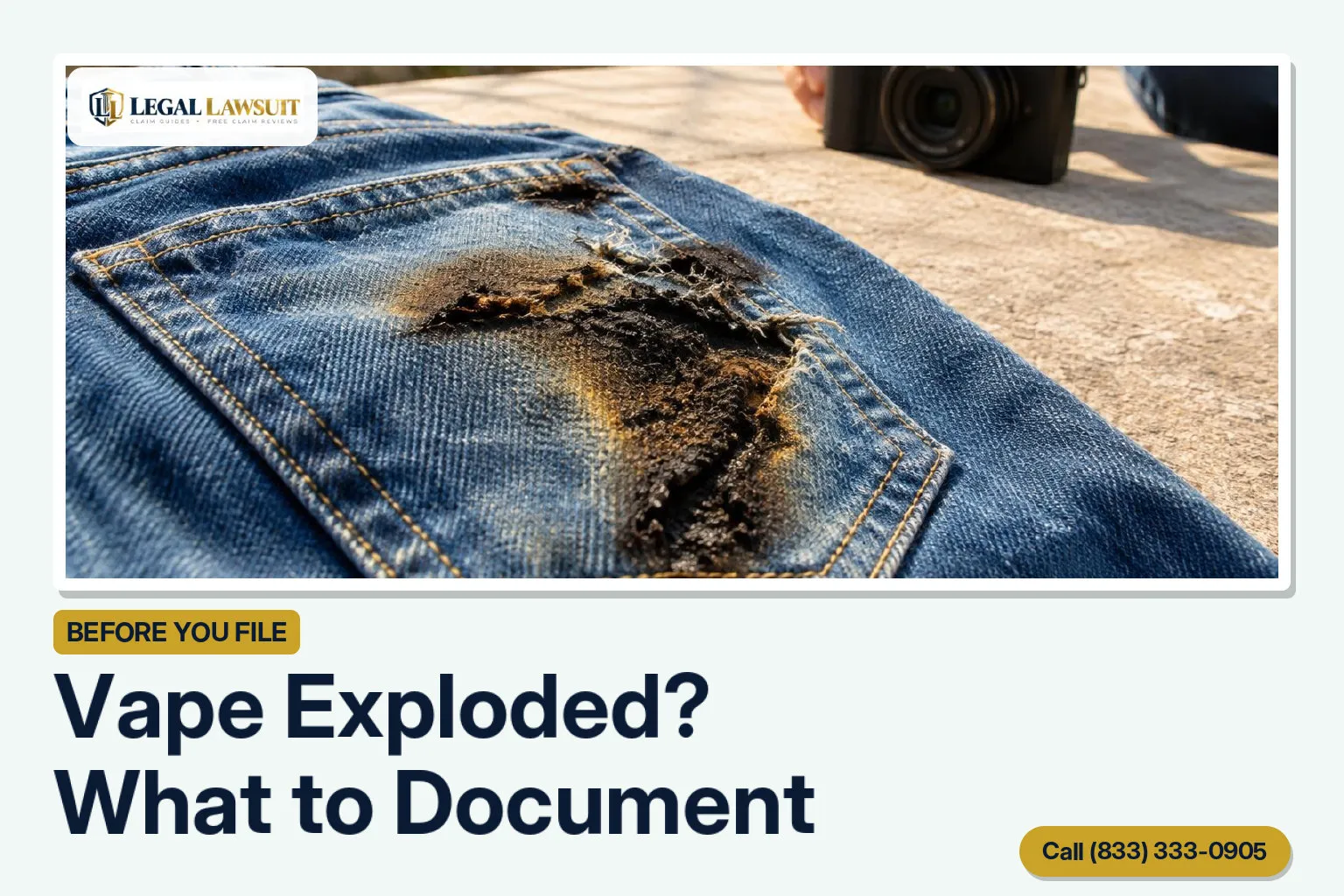
Phone Explosion Ends Basketball Career: What the Lawsuit Shows
By Mason ArnaoUpdated

By Mason ArnaoReviewed by Mason Arnao

Often, yes. If a defective phone or battery exploded and hurt you, you may be able to bring a product liability claim against the companies that made it, as the injured player did in the lawsuit behind the “phone explosion ends basketball career” headlines. Suing the store is harder in Texas because Texas products liability law protects sellers that did not make the product unless a specific exception applies, such as when the manufacturer is beyond the reach of Texas courts.
In that case, according to the federal court’s opinion in Thiam v. T-Mobile, a phone bought at a MetroPCS store in Dallas exploded on or about May 15, 2019. The injured owner filed suit in state court on July 16, 2019, and named several companies, including the battery maker LG Chem. His case shows who can be named and where the fights tend to happen. Every claim depends on its own facts, so the outcome of one lawsuit doesn’t predict another.
Below, we walk through:
- who was sued, and why
- when you can sue the seller
- what changes when the manufacturer is overseas
- the first steps to take if your phone exploded, including how to report the injury to federal product safety regulators
- the two-year Texas deadline for personal injury lawsuits
What happened: the phone explosion that ended a basketball career
According to the federal court record, Khouraichi Thiam bought an LG K20 Plus phone, made for T-Mobile, from a MetroPCS store in Dallas, Texas. On or about May 15, 2019, he says, the phone exploded in his hand. The court record describes him as severely injured and permanently disfigured. These facts come from the court’s opinion in Thiam v. T-Mobile USA, Inc., which summarizes what he claims happened.
How the case moved through the courts
- Purchase: An LG K20 Plus for T-Mobile, bought from MetroPCS in Dallas.
- Explosion: On or about May 15, 2019.
- Lawsuit filed: A petition in Texas state court on July 16, 2019, about two months after the injury.
- Where it went next: The U.S. District Court for the Eastern District of Texas, Sherman Division.
What these facts do and do not tell you
These are Mr. Thiam’s allegations. When a court opinion describes a plaintiff’s side of the story, it is explaining what he says happened. It is not a finding that his account is true or that any company was at fault. This guide does not guess at how the case ended or whether he received any money. If you are dealing with your own phone injury, his case is not a prediction of what your claim is worth.
The case is still useful for a different reason. It shows which companies an injured person may try to hold responsible for a phone explosion and what problems can come up along the way. The rest of this guide walks through those issues, starting with who was named in the lawsuit.
Who was sued: the phone maker, the battery maker and the sellers
One exploding phone can lead to claims against several companies, because many businesses handle a phone between the factory and your hand. The basketball player in this case did not sue only the brand printed on the phone.
According to the federal court’s opinion in Thiam v. T-Mobile USA, Inc., the companies he named included:
- T-Mobile USA
- MetroPCS Texas
- LG Electronics U.S.A.
- LG Electronics of Korea
- Inspur LG Digital Mobile Communications
- LG Chem of Korea
The list covers the store side of the sale, several LG companies tied to the phone itself, and the company accused of making the battery inside it.
Why the battery maker was included
The lawsuit says LG Chem made the batteries used in LG K20 phones that ended up in Texas. A battery is a separate part, often made by a different company than the one whose logo is on the phone. If the battery is what failed, the battery maker may be part of the case.
The extra hurdle with an overseas company
A company based in another country can argue that a Texas court has no power over it at all. LG Chem raised that kind of challenge. When that happens, the injured person may first have to show the company had enough contacts with Texas before the court will look at whether the product was defective. In this case, that meant evidence about how phones and batteries were shipped.
What this means for you
If your phone caught fire or exploded, the brand on the back may not be the only company responsible. The battery maker, the company that assembled the phone, its U.S. distributor and the store that sold it may each have played a role. Holding on to your receipt, the phone’s box and any remains of the device can help show which companies were in that chain.
Can you sue the store that sold the phone? The Texas seller rule
Usually not, at least not on its own. In Texas, a store or carrier that sold a phone but did not make it is generally not responsible for injuries the phone causes. That changes only if the injured person can prove that one of the specific exceptions written into Texas Civil Practice and Remedies Code Chapter 82, the state’s products liability law, applies.
Section 82.003 calls these businesses “nonmanufacturing sellers.” That covers retailers, phone carriers and other sellers that pass a product along without building it.
When a seller can still be held responsible
The statute lists several exceptions. A seller may still be liable if, for example:
- It helped design the product. A seller that took part in designing the phone is not treated as a bystander.
- It changed or modified the product. This applies when the seller altered the phone and that change caused the harm.
- It actually knew about the defect. The seller must have known about the defect when it sold the phone. It is not enough that the seller should have known.
- The manufacturer can’t be reached. This covers a manufacturer that is insolvent or is not subject to the court’s jurisdiction.
The last exception matters most when a phone or battery was made overseas. It ties directly into the question of whether a Texas court can hear a case against a foreign company.
Why the manufacturer often becomes the main target
Chapter 82 also gives a seller the right to recover its defense costs and fees from the manufacturer. In practice, the case tends to focus on the company that made the product. Sellers have both a legal shield and a way to pass their costs up the chain.
Keep in mind that this is a Texas rule. If you bought the phone or were hurt in another state, that state’s law may treat sellers very differently. For a broader look at product liability rights, claim types and how compensation works, the guide Product Liability Injuries: Your Rights Explained is a useful starting point if you are researching attorneys for defective products.
When the manufacturer is overseas
When a phone or battery is made by a company based abroad, that company may argue that a Texas court has no power over it at all. The Thiam case shows how this argument can play out.
The jurisdiction fight in the Thiam case
In the federal court’s opinion in Thiam v. T-Mobile USA, LG Chem, one of the named defendants, argued that it had no connection to Texas. Thiam argued the opposite: LG Chem’s batteries reached Texas inside phones sold through stores in the state, so the company should answer for them there.
To decide, the court looked at evidence about the product’s path to Texas, including how many LG K20 phones and batteries were shipped to the United States and how many went to Texas. For an injured person, this means a case against a foreign maker can turn on distribution records, not only on what happened to the phone.
Why this matters for claims against the seller
Texas law usually shields stores that only sell a product. But under the Texas products liability statute, § 82.003(a)(7), a nonmanufacturing seller can be held liable if the manufacturer is not subject to the court’s jurisdiction. If an overseas maker succeeds in getting out of a Texas case, the seller may still have to answer for the injury.
That is one reason people injured by a product made abroad often name both the manufacturer and the sellers at the start. If one defendant falls away on jurisdiction grounds, the other claims may still go forward.
Explosions from other sources raise their own questions about who can be held responsible. For workplace blasts, see our guide to claim steps after a deadly Houston machine shop explosion.
If your phone exploded: what to do first
Get medical care first, then protect the evidence. Those two steps matter most, and both are easier to handle well in the first days after the incident than weeks later.
1. Get treated and keep every record
See a doctor even if a burn or cut seems minor. Hand and finger injuries can affect grip and movement in ways that are not obvious right away. Keep copies of everything: emergency room papers, follow-up visits, prescriptions, therapy notes and bills. Your treatment records are the main proof of what the injury was and how it changed your life.
2. Keep the phone, the charger and the paperwork
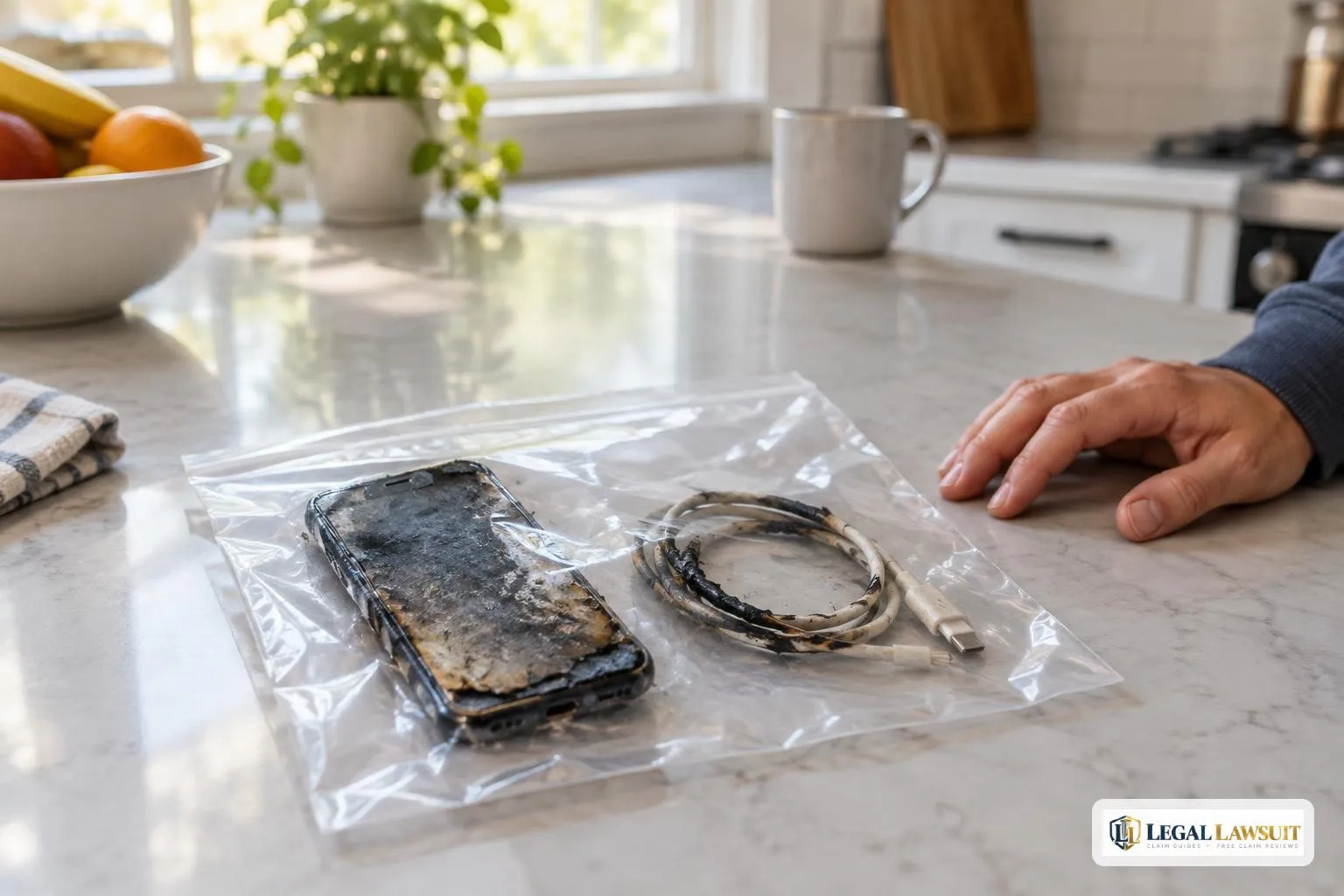
- The damaged device: Store it somewhere safe and dry. Do not throw it away, try to repair it or mail it to the manufacturer, carrier or store without advice first. It is key evidence.
- The charger and cable: Keep whatever was connected or nearby when it happened.
- Proof of purchase: Save the receipt, carrier account records or order confirmation that show where and when you bought the phone.
- Photos: Take pictures of the device, your injuries and any damage around you.
3. Report it to the federal safety agency
You can report a dangerous product or product-related injury on SaferProducts.gov. Staff at the Consumer Product Safety Commission review the reports, and reports are added to a searchable public database. Your report can also feed into CPSC decisions about recalls, penalties or new safety rules. That helps other people even if you never file a claim.
Once you are safe and your records are organized, it helps to understand how a personal injury claim works, from proof to deadlines, so you know what each piece of evidence is for.
How long you have to file in Texas
In Texas, you generally have two years to file a personal injury lawsuit. Under Texas Civil Practice and Remedies Code § 16.003, the suit must be brought no later than two years after the day the cause of action accrues. If you miss that deadline, you may lose the right to have a court hear your claim, even if the injury was serious.
The same section also covers wrongful death claims. Those claims also have two years, but the clock starts on a different day:
- Personal injury: two years from the day the cause of action accrues.
- Wrongful death: two years from the date of the person’s death.
Thiam’s case shows how this can play out. According to the federal court’s opinion, the phone exploded on or about May 15, 2019, and his petition was filed in state court on July 16, 2019. That is about two months after the injury, well inside the Texas window. Filing early also leaves time to sort out questions such as which companies to name and whether a court can reach an overseas manufacturer.
If you live outside Texas
This two-year rule is Texas law. It does not apply nationwide. Each state sets its own deadlines for injury and wrongful death claims, and those rules can differ from Texas’s. If your phone exploded somewhere else, look up your own state’s deadline as soon as you can. A lawyer licensed in that state can also tell you how the deadline applies to your situation.
When you’re ready to work through what comes next, you can find more plain-language claim guides in Legal Insights. They cover each step at your own pace.
Frequently asked questions
Who was the basketball player whose phone explosion ended his career?
The player is the plaintiff in Thiam v. T-Mobile USA, Inc., a federal case in the Eastern District of Texas. According to the court’s opinion, he bought the phone from a MetroPCS store in Dallas, and it exploded on or about May 15, 2019. He filed his petition in state court on July 16, 2019.
The companies he sued included T-Mobile USA and LG Chem, the battery maker. His lawsuit claims that the injuries from the explosion ended his basketball career. These are his allegations, and the case record shows how each defendant responded.
Can I sue the carrier or store that sold me a phone that exploded in Texas?
Often the store is not liable. Under Texas Civil Practice and Remedies Code § 82.003, a seller that did not make the product generally is not liable for harm the product causes. There are exceptions. A seller can be liable if it took part in designing the phone, modified it, or actually knew about the defect when it sold the phone.
A seller can also be liable if the manufacturer is insolvent or is not subject to the court’s jurisdiction. The same chapter gives sellers a right to recover their costs and fees from the manufacturer in certain cases. Because of this, the maker of the phone and the maker of the battery are usually the central defendants.
How long do I have to sue over an exploding phone in Texas?
For most personal injury claims, Texas sets a two-year limitations period under § 16.003. If someone died, the two years for a wrongful death claim run from the date of death. Missing the deadline can end a claim even if the claim is strong. If you are close to the two-year mark, Legal Lawsuit can help you understand your next steps.
Where do I report a phone or battery that exploded?
You can report a dangerous product or a product-related injury at SaferProducts.gov. Staff at the Consumer Product Safety Commission review the reports. Reports can contribute to recalls, penalties or new safety rules. The site also has a public database you can search to see whether other people have reported problems with the same phone or battery.
Can a foreign battery maker be sued in a U.S. court?
It can be contested. In the Thiam case described above, LG Chem disputed that the Texas federal court had jurisdiction over it. The court then looked at evidence about how the phones and batteries were shipped. Whether a foreign company can be brought into court can depend on that kind of evidence.
If the manufacturer turns out not to be subject to the court’s jurisdiction, the Texas seller rule explained above becomes important. That rule is one of the exceptions that can make the store or carrier that sold the phone responsible instead.
Sources
- Thiam v. T-Mobile USA, Inc. (E.D. Tex.) opinion · CourtListener (U.S. District Court, Eastern District of Texas record) · 2021-04-20
- Texas Civil Practice and Remedies Code Chapter 82, Products Liability · Texas Legislature
- Texas Civil Practice and Remedies Code Chapter 16, Limitations · Texas Legislature
- SaferProducts.gov: Report unsafe products · U.S. Consumer Product Safety Commission
This article is general information, not legal advice. Laws and deadlines vary by state and change over time; check the linked sources or speak with a licensed attorney about your situation.
Related Posts

You have the right to say no to medical treatment, but in an injury, disability, or workers' comp claim that choice can lower or stop your benefits. Here is how each system treats a refusal, and which reasons the rules accept.
Ninguna calculadora en línea sabe cuánto recibirás de un acuerdo por filtración de datos. Esta guía explica cómo se reparte realmente el dinero y cómo calcular tus propias pérdidas documentadas antes de presentar tu reclamo.
Learn about burns, dental trauma, and other documented vaping explosion injuries, then organize product details and treatment records for reporting and a claim discussion.