Short answer: This article explains the key facts, eligibility issues, settlement factors, deadlines, and source-backed updates related to this legal topic. Results vary by case facts, evidence, jurisdiction, and representation.
📋 Table of Contents
- Why Mastering Your Disability Appeal Forms Can Change Everything
- Understanding the Core Elements of a Disability Appeal
- Navigating Disability Appeal Forms in the United States
- What to Do If Your Disability Appeal Is Denied Again
- After a Successful Appeal: Managing Your Benefits
- Frequently Asked Questions about Disability Appeals
- Conclusion
Why Getting Your Disability Appeal Forms Right Matters So Much
Disability appeal forms are the official paperwork used to contest a denial of disability benefits. In the U.S., most people file them with the Social Security Administration (SSA).
| Agency | Forms for the First Appeal | How to Get Them |
|---|---|---|
| Social Security Administration (SSA) | Form SSA-561 (Request for Reconsideration) Form SSA-3441-BK (Disability Report – Appeal) Form SSA-827 (Authorization to Disclose Information) | SSA Forms Website or Appeal Online |
A disability denial can feel crushing. Your health already keeps you from working, and now you are staring at stacks of forms and tight deadlines. Here is what many people do not realize: most first-time disability applications are turned down, and approval rates rise noticeably at the appeal levels — especially at the hearing before an Administrative Law Judge (ALJ). The denial letter starts the appeals process rather than ending your claim, and plenty of people succeed once they understand how that multi-step system works. Success hinges on filing the correct forms, filled out properly and on time. Miss the deadline — usually only 60 days after the denial — and you may have to reapply or lose your appeal rights altogether. Errors on the forms can slow your case or produce another denial. Below, we cover which disability appeal forms you need, how to complete them and how to back up your appeal with strong documentation. More resources on disability appeal forms:
The Building Blocks of a Disability Appeal
For many claimants, a denial is where the real process begins. Appeals exist because first-level reviewers sometimes overlook key medical records or misjudge how a condition limits daily life. Knowing how the appeal levels work can be the difference between quitting and getting the benefits you need.
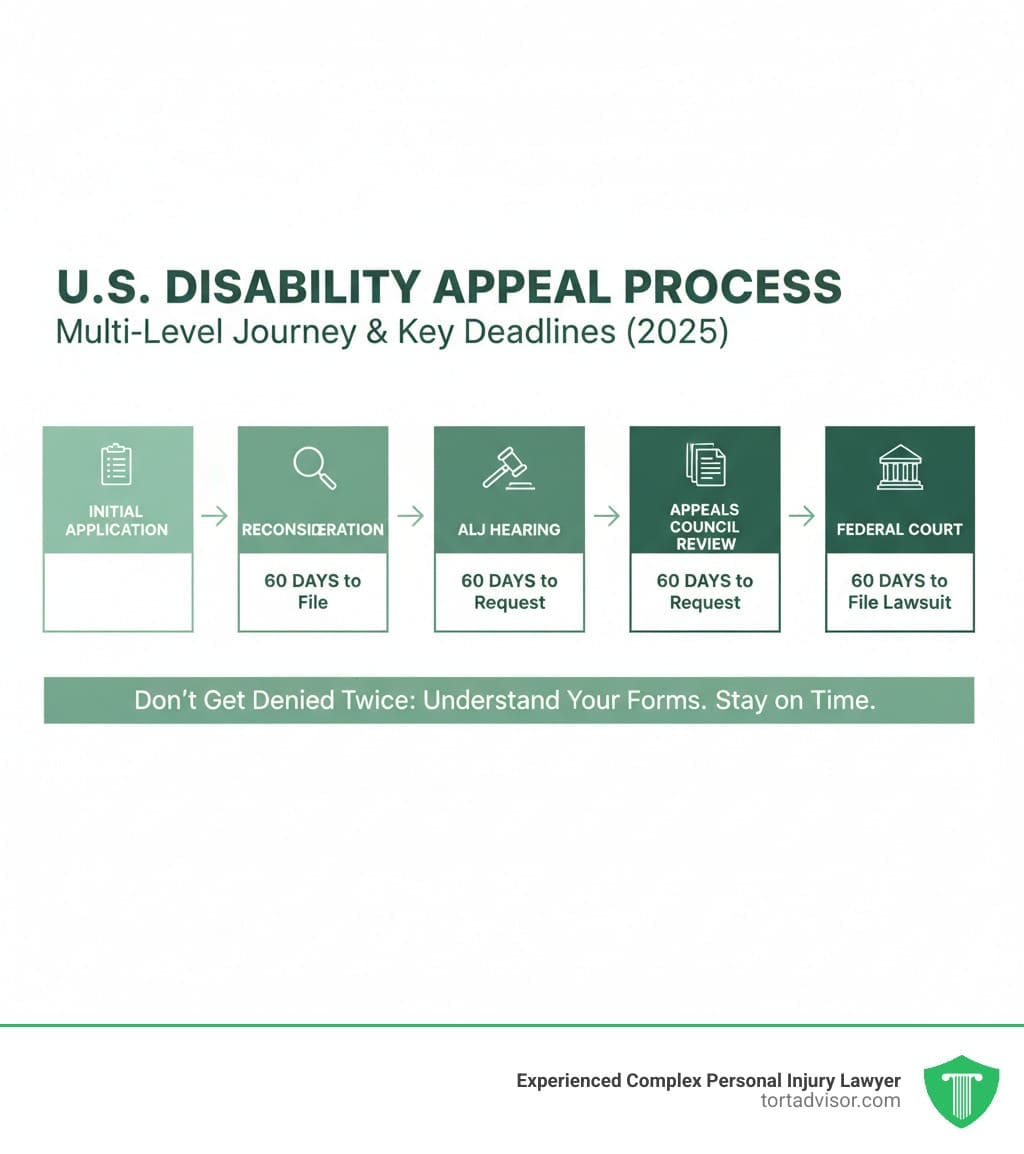
The Four Levels of a Social Security Appeal
U.S. disability appeals usually move through four levels:
- Reconsideration: A different SSA reviewer takes a fresh look at your full file plus any new evidence you add. It is mostly a review of the paperwork.
- Hearing Before an Administrative Law Judge (ALJ): You present your claim directly to a judge, testify, bring witnesses and answer questions. Approvals are considerably more common at this level.
- Appeals Council Review: After an unfavorable ALJ decision, you can ask the Appeals Council to look for legal or procedural mistakes. It may affirm, reverse or send the case back for a new hearing.
- Federal Court: The last option is a lawsuit in federal district court — a complex legal step for claimants who believe the law was misapplied.
What Decides Whether an Appeal Succeeds
At each level, three things drive the outcome: solid medical evidence, supporting statements and meeting every deadline. Medical evidence is the core. It needs to show more than a diagnosis — it must explain exactly how your condition keeps you from working, through detailed reports, test results and doctor statements about functional limits (how long you can sit or stand, how much you can lift, how your focus is affected). Letters from past employers, relatives or caregivers add a personal dimension by describing everyday struggles and lost abilities. Deadlines are firm. In the U.S., you usually get 60 days (plus five days for mailing) after the denial to appeal, and your letter lists the exact date. Put it on your calendar and treat it as the single most important date in the process. More info about what to do after a denied disability claim.
How to Complete and File Your Appeal
Be thorough when you fill out disability appeal forms. Begin with your personal information (name, address, SSN) and details about the decision you are challenging. The section that matters most is your explanation of why you disagree. Be concrete: point to statements in the denial letter, explain why they are wrong and list any new medical records you are attaching. Signing and Filing: Sign paper forms in ink. For electronic filing, follow the agency’s directions, which may accept a typed name as your signature. Common ways to file include:
- Online: The SSA’s online appeal system is usually the quickest option.
- By Mail: Send it registered so you have tracking and proof it arrived.
- By Fax: Save the confirmation sheet as proof it went through.
Keep a copy of every page you file, along with any confirmation you receive.
Form Formats and Accessibility Options
You can get disability appeal forms in several formats.
- HTML versions run in a web browser and work well with screen readers.
- PDF versions can be downloaded, completed on screen as “fillable PDFs,” and then printed or saved. Adobe Reader tends to work best.
If you need an accommodation — a large-print form or a hearing interpreter, for example — contact the agency directly. It must provide reasonable accommodations so the process is accessible to you.
Filing Disability Appeal Forms With the SSA
In the U.S., the Social Security Administration handles disability appeals for both Social Security Disability Insurance (SSDI) and Supplemental Security Income (SSI), and the steps are identical for each program. Everything begins with a Request for Reconsideration.
| Agency | Step One of the Appeal | Key Form(s) | How to Get Them |
|---|---|---|---|
| Social Security Administration (SSA) | Request for Reconsideration | Form SSA-561 (Request for Reconsideration) Form SSA-3441-BK (Disability Report – Appeal) Form SSA-827 (Authorization to Disclose Information) | SSA Forms Website or Appeal Online |
The Main Social Security Disability Appeal Forms Explained
Using the right disability appeal forms is essential. Here is what each core form does in the early stages. Form SSA-561, Request for Reconsideration: Filing this form formally launches your appeal by telling the SSA you disagree and want another review. In many cases you can submit your request for reconsideration online. Form SSA-3441-BK, Disability Report – Appeal: This form brings the SSA up to date on your health since your original application — new treatment, appointments, changing symptoms and effects on daily life. Give specifics rather than just writing “no change.” Form SSA-827, Authorization to Disclose Information: This authorization lets the SSA request records straight from your doctors and clinics; without it, the agency cannot collect the evidence it needs. Sign a separate copy for each provider. Form HA-520, Request for Review of Hearing Decision/Order: After an unfavorable ALJ decision, this form asks the Appeals Council to review the ruling, and you must explain the legal or factual mistake you believe the judge made. Each of these forms is on the SSA Forms Website, and many can be filed through the online appeal portal, which is typically faster and confirms receipt right away. For a state-focused walkthrough, read How to Claim Social Security Disability Insurance Arkansas.
Denied Again? Your Next Moves
A second denial is disheartening, but it does not close the door — many people are turned down more than once before they are approved. When reconsideration fails, the usual next stage is an ALJ hearing, where the odds are considerably better. Start Here Read the denial notice closely. It lays out the reasons for the decision, which tells you what to strengthen, and it lists your next deadline — do not let it pass. Adding Evidence Concentrate on what is new since you last filed your disability appeal forms: new doctors, more testing or a worsening condition. Ask your physicians to describe your functional limitations in detail. “Patient cannot sit for more than 15 minutes and cannot lift more than 5 pounds” carries far more weight than “Patient has severe back pain.” When to Bring In a Lawyer If you have not done so yet, this is the moment to talk with a disability attorney. Represented claimants consistently do better, particularly at the hearing stage. An experienced lawyer knows what judges look for, how to present medical evidence and how to manage the rules and deadlines. Most charge on contingency — a legally capped percentage of back pay paid only if you win — so nothing is due upfront. Private Long-Term Disability (LTD) Coverage An employer-provided LTD policy has its own appeal process, separate from the SSA. Those appeals go through the insurer and are often controlled by a complicated federal law, ERISA, so talking with an attorney experienced in LTD claims is strongly recommended after a denial. You do not have to face another denial by yourself; the rules are complex and too much is riding on the outcome. Learn more about disability claim assistance
Once You Win: Keeping Your Benefits on Track
After a long fight, an approval notice brings real relief — but managing your benefits well is what keeps them coming. How Back Pay Works A winning appeal entitles you to back pay for the months you should already have been paid. The amount turns on your disability onset date, your application date and whether you receive SSDI or SSI. It often arrives as a lump sum, which helps but may carry tax consequences. Taxes Depending on total household income, part of your SSDI may count as taxable income; SSI is not taxable. A large lump-sum back payment could change your tax picture for that year, so consider speaking with a tax professional. Continuing Disability Reviews (CDRs) Benefits are not automatically permanent. The SSA runs periodic Continuing Disability Reviews (CDRs) to confirm you still qualify, more or less often depending on your age and whether improvement is expected. You will get a letter asking for updated medical information. Working While on Benefits SSA work incentives let you try returning to work without losing benefits right away. Under SSDI’s Trial Work Period (TWP), you can work up to nine months (they need not be consecutive) and still receive your full check no matter what you earn. Next comes the Extended Period of Eligibility (EPE), a 36-month cushion during which you can still be paid for any month your earnings stay under the “Substantial Gainful Activity” (SGA) level. If work ends your benefits and your disability forces you to stop working again within five years, Expedited Reinstatement may restart them without a fresh application. When Benefits Stop Payments end if a CDR finds you are no longer disabled, if your earnings exceed the SGA limit, or when you reach full retirement age, at which point disability benefits convert automatically to retirement benefits. When a recipient dies, the family should tell the SSA right away to avoid overpayments, and relatives may qualify for survivor benefits.
Disability Appeal Forms: Frequently Asked Questions
Appeals can be confusing. Below are answers to common questions about disability appeal forms and how the process works.
What is the deadline to file a disability appeal?
Timing is everything. In the U.S., you usually have 60 days after you receive the denial letter to appeal to the SSA, and the agency presumes the letter reached you five days after mailing — effectively 65 days. The same deadline applies at the Reconsideration, ALJ Hearing and Appeals Council levels, and your letter states your exact date. Missing it could mean filing a brand-new application.
What happens once the SSA receives my appeal?
The SSA will send an acknowledgment after your appeal forms arrive.
- During Reconsideration, a new claims examiner reviews your full file and any new evidence. This paper review may take several months.
- When you ask for an ALJ hearing, your file goes to a hearing office, and getting a date can take many months — sometimes more than a year. The hearing gives you the chance to testify in front of a judge.
- When you ask for Appeals Council review, the Council checks the ALJ decision for legal errors rather than reweighing the evidence.
Track your appeal through your online My Social Security account or by phoning the SSA.
Can someone help me deal with the SSA?
Yes, and it is a smart move. You are entitled to name a representative to assist you.
- A disability attorney is usually the strongest choice — they focus on SSA rules, know how to build a persuasive case and can represent you at a hearing. Represented claimants tend to succeed far more often, and most attorneys work on contingency, so you owe nothing unless you win.
- Legal aid organizations may help for free or at low cost if you meet income limits. The Legal Services Corporation’s Find Legal Aid tool can point you to options nearby.
To name a representative, file Form SSA-1696, Appointment of Representative, with the SSA, which authorizes that person to deal with the agency for you.
Conclusion
The disability appeals process is genuinely complicated, with several levels, firm deadlines and detailed disability appeal forms, so feeling overwhelmed is normal. Remember that a first denial is routine, not final; persistence and preparation are what set approved claims apart. Your odds improve meaningfully when you appeal, and more so with experienced representation. This guide gives you a starting point, but every claim is different. If collecting records feels impossible or the process is too much while you manage your health, Legal Lawsuit can help. As a legal-information site, we connect people with experienced disability attorneys in our network who handle the paperwork, track the deadlines and build a strong case so you can focus on your health — usually on contingency, so there is no fee unless you win. You don’t have to handle this by yourself. The right legal guidance can change the outcome of your appeal. Get help with your disability appeal
Related Posts
Quick Answer: The Boy Scouts of America (BSA) filed for Chapter 11 bankruptcy in 2020 after facing tens of thousands [...]
Quick Answer: Survivors of sexual abuse by Catholic priests, nuns, or other Church personnel may be able to file a [...]
Quick Answer: Clergy abuse settlements vary enormously based on the severity of the abuse, the strength of evidence that the [...]