Short answer: This article explains the key facts, eligibility issues, settlement factors, deadlines, and source-backed updates related to this legal topic. Results vary by case facts, evidence, jurisdiction, and representation.
📋 Table of Contents
The Hair Relaxer Lawsuit Truth: What the Science Says About Cancer
#
Here is the hair relaxer lawsuit truth in brief: the so-called hair relaxer class action lawsuit is one of the largest legal fights in the U.S. today, with thousands of women alleging that chemical straighteners caused serious illnesses, cancer among them. A quick overview:
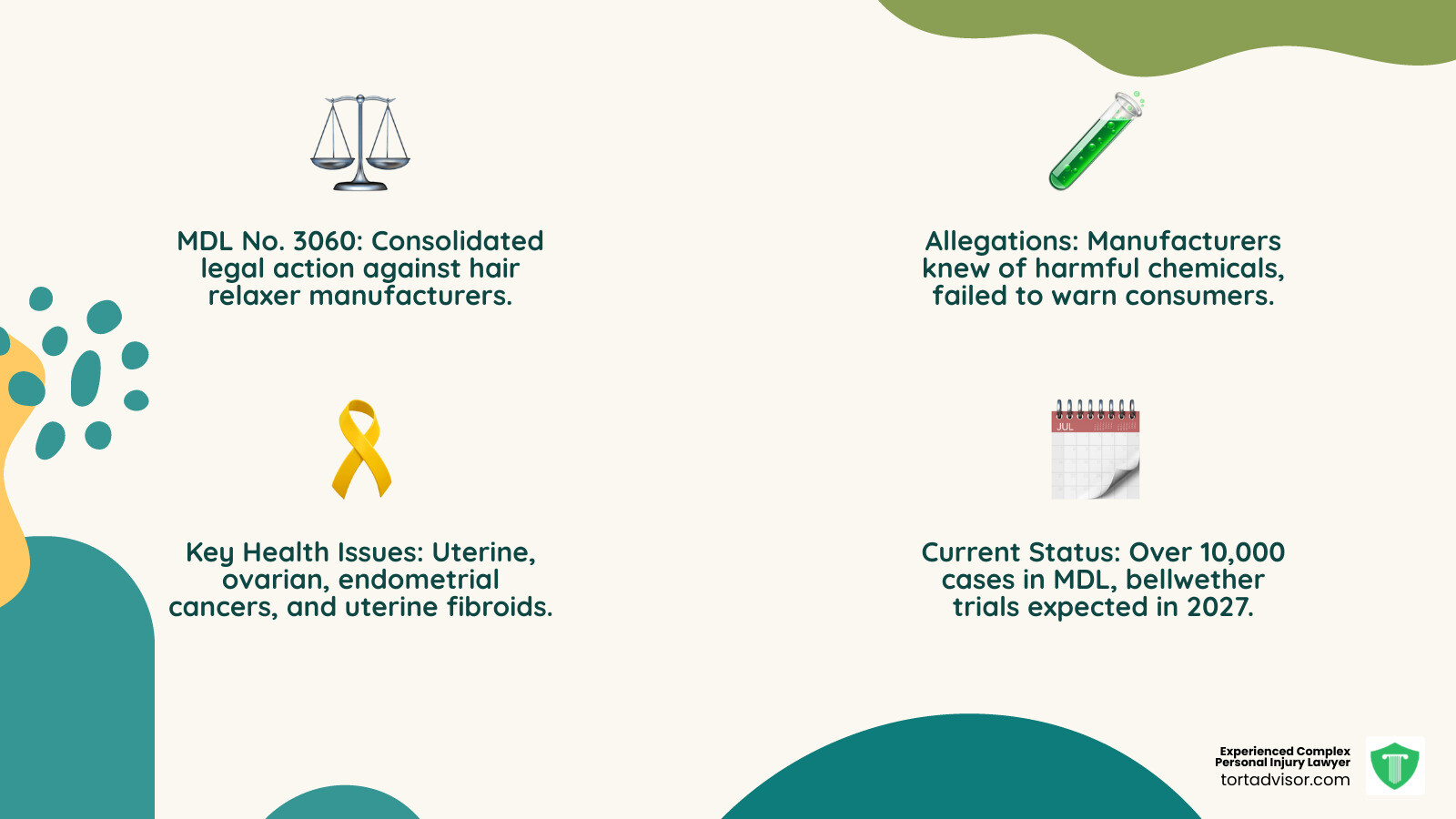
- What It Is: A consolidated federal proceeding (a Multidistrict Litigation, or MDL) against companies that make chemical relaxers.
- Core Allegations: Manufacturers knew their products contained harmful chemicals, didn’t warn customers and used predatory marketing.
- Illnesses Alleged: Uterine, ovarian and endometrial cancer, as well as uterine fibroids.
- Who Is Most Affected: Mostly Black women, historically the products’ main customers.
- Status: More than 10,000 cases are pending in an Illinois MDL, which remains at an early stage, with the first bellwether trials expected in 2027.
The cases picked up speed after the NIH Sister Study, published in October 2022, reported a strong association between frequent relaxer use and higher uterine cancer risk. Plaintiffs claim companies knowingly sold dangerous products, often promoted with misleading labels like “natural” or “gentle.”
Relaxers have been a beauty staple for decades, especially for Black women. They permanently straighten hair by breaking down its natural curl, but the harsh chemicals that make that possible now sit at the center of a huge legal battle.
At its core, the litigation relies on scientific evidence tying these products to serious illness. The chemicals blamed include endocrine-disrupting chemicals (EDCs), phthalates, parabens and formaldehyde-releasing agents, which can be absorbed through the scalp, particularly when it is burned or irritated, a frequent side effect of relaxers. Once inside the body, they can throw hormones out of balance.
Which Cancers Have Been Linked to Hair Relaxers?
The cancers cited most often in the lawsuits are:
- Uterine Cancer (Including Endometrial Cancer): The landmark 2022 NIH study found women who used relaxers more than four times a year were over twice as likely to develop uterine cancer, with estimated risk by age 70 rising from 1.64% among non-users to 4.05% among frequent users. Boston University’s Black Women’s Health Study added support, finding a more than 50% higher uterine cancer risk among postmenopausal women who used relaxers frequently for over five years. Black women already experience more aggressive uterine cancers and are almost twice as likely as non-Hispanic white women to die from the disease.
- Ovarian Cancer: A 2021 NIH-funded study associated frequent relaxer use (four or more times a year) with a 50% higher risk of this aggressive cancer.
- Uterine Fibroids: Fibroids aren’t cancer, but they appear in many claims, particularly when they led to a hysterectomy. Studies have found a possible link between relaxers and fibroids among African American women.
The National Institutes of Health summarizes the scientific research on hair straighteners and uterine cancer on its website.
How Relaxer Chemicals May Cause Harm
Relaxer chemicals can pass through a scalp that has been irritated or burned during treatment, which opens a path into the bloodstream. The familiar “tingling or burning” during application signals the kind of chemical irritation that makes absorption easier.
Inside the body, chemicals such as phthalates and parabens behave as endocrine-disrupting chemicals (EDCs), interfering with glands like the ovaries and thyroid by imitating or blocking hormones such as estrogen. That hormonal disruption is considered a major factor in hormone-sensitive cancers like uterine and ovarian cancer. For more, see the scientific consensus on endocrine-disrupting chemicals.
Di(2-ethylhexyl)phthalate (DEHP), a phthalate named frequently in the cases, is known to cause cancer and birth defects, and formaldehyde, which the FDA has proposed banning from relaxers, is a recognized carcinogen. Plaintiffs say years of steady exposure to these substances led to their serious illnesses.
Inside the Hair Relaxer “Class Action” Lawsuit
Federal hair relaxer injury cases have been combined into a multidistrict litigation (MDL), MDL No. 3060, formally titled “In RE: Hair Relaxer Marketing, Sales Practices, And Products Liability Litigation,” and assigned to Judge Mary Rowland in the U.S. District Court for the Northern District of Illinois.
The cases rest on several central allegations against manufacturers:
- Predatory Marketing: Companies allegedly aimed advertising at Black women and young girls, promoting Eurocentric beauty ideals and using misleading words like “natural” or “gentle” to suggest safety while concealing harmful ingredients.
- Failure to Warn: Manufacturers knew or should have known about serious health risks but did not provide adequate warnings, keeping consumers from making informed choices.
- Defective Design: The products allegedly were defectively designed because their dangerous chemicals created an unreasonable risk, particularly with long-term use.

As of September 15, 2025, 10,858 lawsuits were pending in the Hair Relaxer MDL, one of the largest active product liability proceedings in the country, and the count has climbed steadily since the MDL began. To learn how these cases work generally, see our guide to defective product lawsuits.
Which Companies and Brands Are Named?
Defendants include some of the beauty industry’s best-known companies, whose products have been sold for decades, such as:
- L’Oréal USA, Inc. and its partner SoftSheen-Carson LLC, behind brands like Dark & Lovely and Optimum.
- Revlon, Inc. and Revlon Consumer Products Corporation.
- Strength of Nature Global, LLC, which makes Motions and Just for Me.
- Namaste Laboratories, LLC, linked to ORS Olive Oil relaxers.
Additional defendants include Godrej SON Holdings, Inc., Dabur International Ltd., Dermoviva Skin Essentials, Inc., AFAM Concept, Inc. d/b/a JF Labs, Inc., Parfums de Coeur, Ltd. d/b/a PDC Brands, McBride Research Laboratories, Inc., Avlon Industries, Beauty Bell Enterprises, LLC d/b/a House of Cheatham, Inc., Luster Products, Inc., and Sally Beauty Holdings, Inc. d/b/a Silk Elements.
Several of these companies have sold relaxers for generations, some since the 1950s, and the suits claim they kept selling even as scientific evidence of harm accumulated.
Why Black Women Bear the Brunt of the Hair Relaxer Litigation
The case carries deep personal and historical weight, and Black women are disproportionately affected for several reasons:
- Targeted Advertising and Social Pressure: For generations, relaxers were marketed heavily to Black women, often leaning on Eurocentric beauty norms that prized straight hair. Products like “Just for Me” were pitched to young Black girls, creating customers for life. The litigation’s Master Complaint traces this history back to hair discrimination rooted in slavery and laws like Louisiana’s Tignon Law, which policed how Black women wore their hair.
- Heavier Use: As a result, Black women have been the main and most frequent relaxer users. In the NIH Sister Study, roughly 60% of participants who reported using relaxers were Black women, meaning more intense and longer exposure to the chemicals in question.
- Health Disparities: Black women also face higher rates of aggressive uterine cancer and are almost twice as likely to die from it as non-Hispanic white women. Targeted marketing, heavy use and worse outcomes combine to hit the Black community especially hard.
Plaintiffs allege manufacturers knowingly exploited these pressures and put profits ahead of their most loyal customers’ health.
Timelines, Challenges and Possible Outcomes
Mass torts like the hair relaxer class action lawsuit follow an organized process for handling thousands of individual claims. This MDL is now in discovery, where the parties exchange information, prepare expert testimony and argue procedural motions.
How Long Will the Hair Relaxer Cases Take?
The MDL was formed in February 2023 to gather dozens of lawsuits into one federal court. Key milestones include:
- A Rapidly Growing Docket: Starting with about 60 cases, the MDL had grown to 10,858 pending lawsuits by September 15, 2025.
- Discovery: The parties are exchanging documents and information, with expert discovery scheduled to wrap up by October 2026.
- “Science Day”: Set for January 2026, this non-adversarial session lets experts on both sides walk Judge Rowland through the science on relaxers and health effects before any trial.
- Bellwether Trials Ahead: From a pool of 32 cases selected in May 2025, a few representative cases will go to trial first, expected in early 2027. Their results can signal how juries view the evidence and strongly influence settlement talks.
- Settlement Prospects: No global settlement exists, but the bellwether stage often sparks serious negotiations, and large early verdicts could push defendants to resolve the whole MDL.

What Compensation Might Victims Receive?
Women who prove their claims may recover meaningful compensation for their injuries and losses:
- Economic Damages: Measurable financial losses.
- Medical Costs: Past and future expenses including hospitalization, surgery, chemotherapy, medication and continuing care.
- Lost Income: Wages lost to illness or inability to work, and reduced earning ability.
- Non-Economic Damages: Intangible harms, often a large share of any award.
- Pain and Suffering: For physical pain, emotional distress and the overall hit to quality of life.
- Loss of Consortium: For how the illness has affected family relationships.
- Disfigurement: For physical changes caused by major surgery.
- Punitive Damages: Juries may award these to punish extreme recklessness or malice and deter similar conduct.
No settlements or verdicts have happened yet. Some attorneys have floated speculative projections by injury type, shown below for reference only; they are not based on any actual hair relaxer outcomes, and the real drivers of value will be diagnosis, age, treatment, lost income and the strength of each woman’s evidence:
| Injury Type | Speculative Projection (Individual Cases) |
|---|---|
| Uterine Cancer (Younger Than 35) | $250,000 – $1,000,000 |
| Uterine Cancer (Older Than 50) | $250,000 – $500,000 |
| Endometrial Cancer | $200,000 – $450,000 |
| Fibroids With Hysterectomy (Younger Than 40) | $90,000 – $150,000 |
| Fibroids Without Surgery | $10,000 – $75,000 |
(Important: these are unverified projections drawn from other mass torts and legal commentary, not actual hair relaxer results. Real outcomes may differ greatly.)
For an estimate tailored to you, try our Hair Relaxer Settlement Calculator.
How Manufacturers Are Fighting Back
Companies such as L’Oréal and Revlon are contesting the claims vigorously, arguing:
- No Proven Link: Companies have publicly said they do not believe the science supports a connection between chemical straighteners or relaxers and cancer, calling the evidence inconclusive.
- Time Limits: Defendants say some claims are too late under the statute of limitations. Many courts apply the “discovery rule,” which starts the clock when a person learned, or should have learned, of the injury and its likely cause, and for many women that was after the October 2022 NIH study. Some states, Georgia among them, also have stricter “statutes of repose” that set an absolute cutoff no matter when the injury was discovered.
- Jurisdiction: Defendants have challenged the court’s authority over them; L’Oréal S.A., the French parent company, and Walgreens were dismissed from the MDL because plaintiffs couldn’t show enough connection to the forum.
- Specific Causation: Defendants may argue it is hard to show their particular product caused an illness when many women used several hair products over the years.
Plaintiffs’ lawyers remain optimistic. Judge Rowland has rejected many motions to dismiss and noted that defendants should have known about EDC risks. Observers often compare the case to the Monsanto/Roundup litigation, where juries returned large failure-to-warn verdicts, and similar results are possible if plaintiffs show manufacturers concealed the risks. To understand your rights, read about Product Liability Personal Injury on our site.
Hair Relaxer Lawsuit FAQs
Answers to common questions about the hair relaxer class action lawsuit.
Who can file a hair relaxer lawsuit?
You may be eligible if you have:
- Used chemical relaxers or straighteners regularly over a period of years.
- Been diagnosed with uterine, ovarian or endometrial cancer after you started using relaxers.
- In some cases, been diagnosed with uterine fibroids that required surgery, such as a hysterectomy.
- Medical records documenting the diagnosis and treatment.
Attorneys in our network review cases nationwide, including in Chicago, Fort Lauderdale and Miami. Request a free, confidential case review to see whether you have a viable claim.
Is this an MDL or a class action?
People often call it a “class action,” but the hair relaxer litigation is actually a Multidistrict Litigation (MDL), and the difference matters:
- An MDL gathers thousands of separate lawsuits from around the country into one federal court, here the Northern District of Illinois, for pretrial steps like discovery. Each plaintiff keeps her own case, and a case that doesn’t settle can be sent back to its original court for trial.
- A true class action is one lawsuit brought on behalf of a large group, the “class.” A settlement or verdict covers everyone in it, and the money is split among the members.
Using an MDL lets the courts manage the claims efficiently while each woman keeps her individual case.
What does it cost to file a hair relaxer lawsuit?
Cost shouldn’t stand in your way. Attorneys in our network generally work on contingency, which means:
- There are no upfront fees or out-of-pocket costs to get started.
- The attorney is paid only from a settlement or verdict, as a percentage of what is recovered.
- If there is no recovery, you typically owe no attorney fee.
Legal Lawsuit also offers a free, confidential case review with no obligation, so you can explore your options without financial pressure.
Your Legal Options and the Path to Accountability
The hair relaxer class action lawsuit marks a turning point for the beauty industry. With more than 10,000 cases on file, manufacturers are being forced to answer for decades of alleged aggressive marketing and hidden health risks, and the FDA’s proposal to ban formaldehyde in relaxers reflects the very dangers victims have raised.
Regulation alone won’t make injured women whole. These lawsuits seek accountability and compensation for women who developed cancer and other serious conditions, along with transparency, safer products and an end to marketing that has long targeted vulnerable communities.

Awareness is rising, but many women used these products for decades, trusting claims of “gentle” or “natural” formulas. Recent research now gives consumers the information to make better-informed choices.
Legal Lawsuit understands how devastating a cancer diagnosis is, particularly when it may have been avoidable. You are not alone, and you have options. We connect people with experienced attorneys in our network who handle complex product liability cases and are reviewing hair relaxer claims across the country, including in Florida, Illinois and New Jersey.
The legal process can feel intimidating, but attorneys in our network typically work on contingency, so there is no fee unless your case recovers money, and your first case review is free, confidential and carries no obligation.
Taking action can bring compensation for what you have endured while holding an industry accountable and protecting future generations. If you or someone you love used chemical relaxers and was later diagnosed with uterine, ovarian or endometrial cancer, or with fibroids that required surgery, consider getting legal advice.
You deserve answers and accountability. Take the first step: Learn more about Hair Relaxer Lawsuits and request your free case review.
Related Posts
Quick Answer: The Boy Scouts of America (BSA) filed for Chapter 11 bankruptcy in 2020 after facing tens of thousands [...]
Quick Answer: Survivors of sexual abuse by Catholic priests, nuns, or other Church personnel may be able to file a [...]
Quick Answer: Clergy abuse settlements vary enormously based on the severity of the abuse, the strength of evidence that the [...]