
Short answer: This article explains the key facts, eligibility issues, settlement factors, deadlines, and source-backed updates related to this legal topic. Results vary by case facts, evidence, jurisdiction, and representation.
How Alabama Crime Victim Compensation Helps Survivors
In This Guide
Alabama crime victim compensation is a state program that reimburses people hurt by violent crime for actual out-of-pocket losses such as hospital bills, therapy, missed paychecks and funeral costs. It works alongside, not instead of, the help an Alabama injury lawyer can provide.
The key points in brief:
| Key Detail | Key Details |
|---|---|
| Program | Run by the Alabama Crime Victims Compensation Commission (ACVCC) |
| Maximum Award | $15,000, or $20,000 for crimes on or after Oct. 1, 2014 |
| Eligible Applicants | Violent crime victims, or their relatives, who satisfy the program rules |
| Report Deadline | Report to police within 72 hours of the crime |
| Filing Deadline | File the claim within 1 year of the crime |
| Expenses Paid | Medical treatment, counseling, lost income, funerals, rehabilitation |
| Expenses Excluded | Stolen or damaged property, pain and suffering, lawyer fees |
| Ways to Apply | Send to the ACVCC by mail, fax or email |
| Phone | 1-800-541-9388 (victims only) |
Recovering from a violent crime in Alabama is painful enough without money worries piling on. Hospital invoices arrive, income stops and a funeral can drain a family’s savings almost overnight.
Here is the reassuring part: help with those bills exists.
Alabama runs a program built to lighten exactly this kind of financial load. Its deadlines, eligibility tests, covered costs and caps can be hard to decode, though, and one missed step can cost you benefits you qualify for.
Below, we explain the program in everyday language so you understand what support is out there and how to claim it.
I’m Mason Arnao. Years of work in data systems and online research have taught me how to make sense of complicated state programs such as Alabama crime victim compensation. This guide covers eligibility, deadlines, covered costs and appeals so you can put your energy into healing.
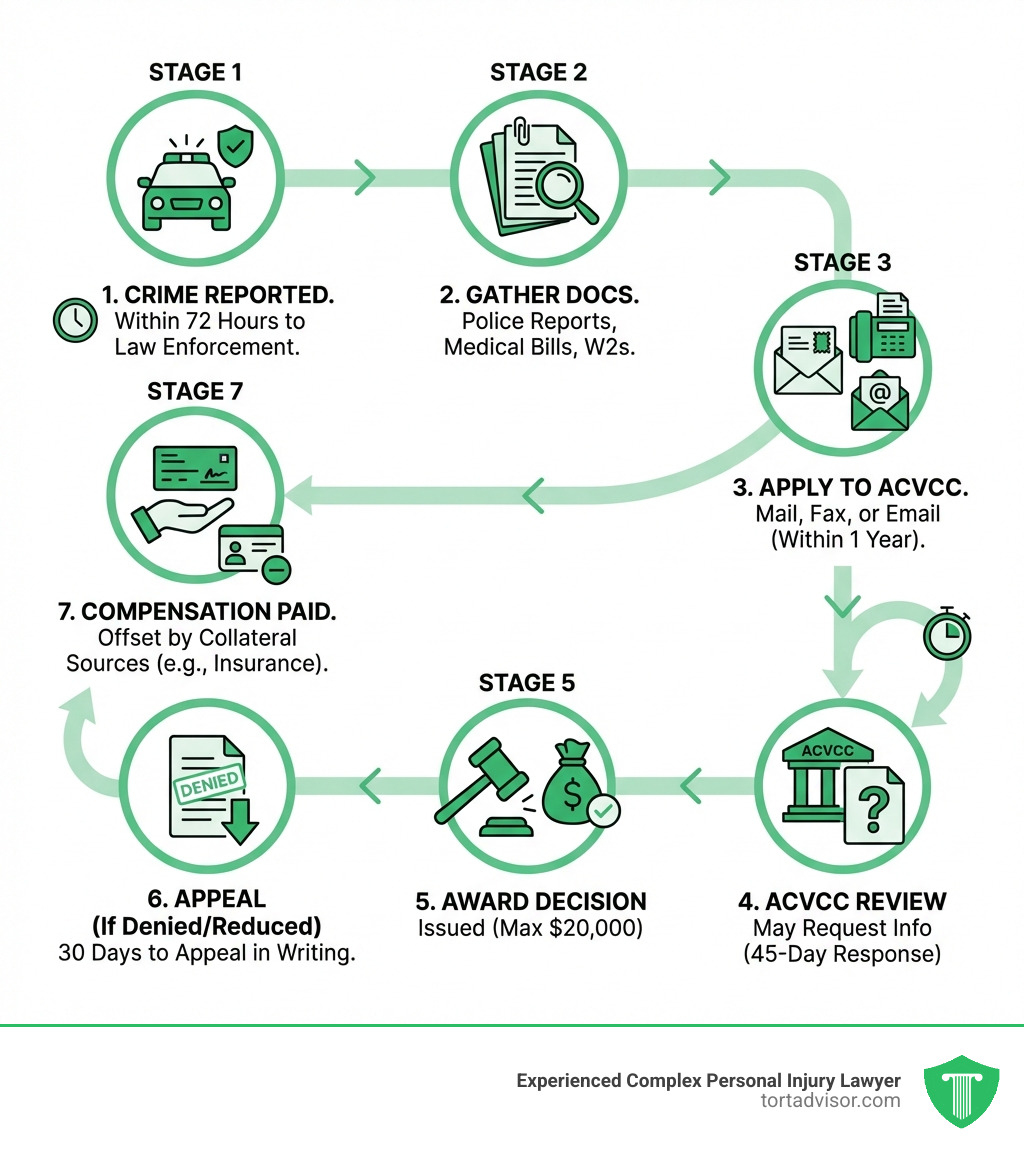
What the ACVCC Is and Why It Exists
Violent crime damages far more than the moment it happens. In the words of the Alabama legislature, families are often left “bereft and destitute.” The state responded by establishing the Alabama Crime Victims Compensation Commission (ACVCC).
Much of the ACVCC’s budget comes from offenders themselves through court costs and assessments, supplemented by federal Victims of Crime Act (VOCA) money. Its core purpose is to give financial help to victims of “criminally injurious conduct,” meaning violent crimes that cause bodily injury or death.

The Commission’s mission and rules are explained on the official Alabama Crime Victims Compensation Commission site. A detailed Administrative Code governs the program so that money reaches the people who genuinely need it.
How the Commission Operates
The Commission pays second, after sources like health insurance or workers’ compensation have been used. From its Montgomery office, it coordinates with the Alabama Law Enforcement Agency and local District Attorneys to confirm claims.
The ACVCC also pays for costs insurance usually ignores, such as crime scene cleanup and certain grief counseling, which makes it an important part of recovery. It helps people move from being a “victim” toward being a “survivor.”
Who Qualifies for Alabama Crime Victim Compensation, and By When
The program sets several requirements. They are not there to block people; they exist to make sure funds go to genuine victims who are working with the justice system.
The main conditions for Alabama crime victim compensation are:
- Report Within 72 Hours: The crime must be reported to law enforcement no later than 72 hours after it happened.
- File Within One Year: Your formal ACVCC claim must be submitted within a year of the crime.
- Cooperate: You need to work fully with police, prosecutors and the Commission. Declining to testify or ignoring an investigator’s questions can lead to a denial.
- Not Involved in the Crime: You cannot have committed or helped commit the offense, and your own behavior should not have contributed to it (see “contributory conduct” below).
- Legal Status: Usually you must be a U.S. citizen or lawfully present, with important exceptions for human trafficking victims and some domestic violence cases.
Missed a deadline? It may not be too late. The Commission can excuse the 72-hour or one-year limits if you explain “good cause” in writing, which commonly covers minors, people hospitalized or physically unable to act, and those whose mental disability delayed them. A victim service officer can explain how these exceptions work, and you can find more about the victim compensation fund on our site.
Completing the Alabama Crime Victim Compensation Application
The application runs several pages and demands documentation. Saying you lost money is not enough; you must prove it.
Expect to provide items such as:
- The full police report.
- Itemized medical bills and receipts.
- Lost income records, such as W2s, tax transcripts or a signed employer statement.
- Any funeral home contract, if one applies.
- A notarized signature confirming the application is accurate.
You can file your application by mail, fax or email. The Commission may then ask for more information; if it requests a document, you generally have 45 days to send it before your file may be closed.
What the Program Pays For and the Award Caps
How much you can receive depends mostly on the date of the crime. A 2014 change in Alabama law raised the amount of help available.
| Expense Type | Cap for Crimes Before Oct 1, 2014 | Cap for Crimes On or After Oct 1, 2014 |
|---|---|---|
| Overall Award Cap | $15,000 | $20,000 |
| Funeral Expenses | $5,000 | $7,000* |
| Weekly Lost Wages | $400 | $600 |
| Length of Lost Wage Payments | 26 weeks | 52 weeks |
*Note: The funeral cap went back to $5,000 for crimes committed after July 9, 2020.
Counseling and Medical Bill Reimbursement
Emotional recovery matters as much as physical healing, and the ACVCC covers as many as 50 counseling sessions per claim. Payment rates are capped under a “cost containment” schedule:
- Psychiatrists: a maximum of $125 an hour.
- Psychologists: a maximum of $100 an hour.
- Licensed counselors and social workers: a maximum of $80 an hour.
- Group therapy: a maximum of $60 an hour.
Medical bills other than counseling and dental are frequently paid at a discount, commonly 30% of eligible charges with a $6,000 ceiling, because the Alabama Crime Victims Compensation Act is designed to stretch funds across as many victims as possible. The program may also cover rehabilitation, relocation costs (up to $1,000 when safety is seriously at risk) and crime scene cleanup (up to $2,500).
Denials, Other Payers and How to Appeal
Applying does not guarantee payment. Alabama takes a particularly hard line on “contributory conduct.”
An award can be cut or refused when:
- Contributory Conduct: Your illegal or provocative behavior helped bring about the crime, such as a drug transaction that turned violent.
- Benefit to the Offender: Paying you would “unjustly enrich” the offender, for instance if you still share a home with the person who harmed you and they could reach the money.
- Later Felony Conviction: A felony conviction after you apply makes you ineligible.
- Stopping Cooperation: You quit assisting police or the Commission.
Other Payment Sources and Paying the Commission Back
Because the ACVCC is a “payer of last resort,” it first checks for “collateral sources,” including:
- Health and dental coverage.
- Workers’ compensation.
- Social Security payments.
- Life insurance.
- Restitution a criminal judge has ordered.
If an insurer later pays you for medical bills the Commission already covered, you must reimburse the Commission, a process called subrogation. And if you sue the offender in civil court, you have 15 days to notify the Alabama Attorney General’s Office.
Appealing a Decision
If your claim is turned down or the award seems too low, you can challenge it.
- Put It in Writing: Tell the Executive Director in writing that you dispute the decision.
- Act Within 30 Days: The appeal must be filed no more than 30 days after you receive the decision.
- Hearing: You will get an administrative hearing to offer evidence or testimony supporting a different outcome.
- Court Review: If the administrative appeal fails, you may be able to seek review in civil court under the Alabama Administrative Procedure Act.
Victim Resource FAQs
How can I reach the Commission for help?
The Commission is headquartered in Montgomery, but you never need to go in person. Current phone numbers, including a toll-free line reserved for victims, are posted on the official ACVCC website linked above. In addition, every District Attorney’s office in Alabama has a Victim Service Officer who will help you complete the forms at no charge.
Can Alabama crime victim compensation apply to crimes outside the state?
Sometimes. Alabama residents harmed while traveling in another state, or abroad in a terrorist attack, may still qualify. This generally depends on whether the other state lacks a comparable program or whether you satisfy particular residency and travel requirements.
What losses won’t the program reimburse?
Many people are surprised to learn the ACVCC will not pay for:
- Property that was stolen or damaged, such as a car or a broken window.
- Cash or checks that were taken.
- Pain and suffering, since this is not a personal injury case.
- Legal fees for preparing the claim.
Compensation is limited to “economic loss”: actual bills and missed income caused by physical injury or death.
Conclusion
Recovering from a violent crime takes a toll. The Alabama crime victim compensation program is an important safety net, but the legal side can get complicated, particularly with insurers or a possible civil claim against a negligent third party such as a property owner. That is where an experienced Alabama injury lawyer can help.
Legal Lawsuit believes every survivor deserves strong legal guidance. We help readers connect with attorneys in our network who handle serious personal injury and victims’ rights matters, so that while the state helps with immediate bills, you can also explore every avenue for full accountability.
Learn more about victim compensation services or request a free, confidential case review to find the right attorney. You have been through enough; we can help you see the next step clearly.
Related Posts
Quick Answer: The Boy Scouts of America (BSA) filed for Chapter 11 bankruptcy in 2020 after facing tens of thousands [...]
Quick Answer: Survivors of sexual abuse by Catholic priests, nuns, or other Church personnel may be able to file a [...]
Quick Answer: Clergy abuse settlements vary enormously based on the severity of the abuse, the strength of evidence that the [...]