
Short answer: This article explains the key facts, eligibility issues, settlement factors, deadlines, and source-backed updates related to this legal topic. Results vary by case facts, evidence, jurisdiction, and representation.
How the Right Depo-Provera Attorney Can Make a Difference
If you received Depo-Provera and were later diagnosed with a meningioma brain tumor, a Depo-Provera attorney can help you seek compensation from Pfizer.
In This Guide
- Why Hiring a Depo-Provera Attorney Could Change Everything
- Understanding the Link Between Depo-Provera and Meningioma Brain Tumors
- Why You Need a Depo-Provera Lawsuit Attorney for Your Claim
- Eligibility and Evidence: Do You Have a Case Against Pfizer?
- Current Status of Depo-Provera MDL and Settlement Projections
- Frequently Asked Questions about Depo-Provera Brain Tumor Claims
- Conclusion
Depo-Provera Lawsuit Money Tools
Depo-Provera Settlement Calculator — See which factors, such as your diagnosis and treatment, may shape the value of a claim.
Depo-Provera Settlement Amounts — Learn what is known so far about how Depo-Provera claims may be valued and resolved.
The key points at a glance:
- Who may qualify: Women who had two or more Depo-Provera injections and were diagnosed with a meningioma
- Who is being sued: Pfizer Inc. and related manufacturers, for failing to warn about brain tumor risk
- Where claims are pending: MDL No. 3140 in the Northern District of Florida
- What drives case value: Tumor grade, surgery or radiation, lasting effects, and documented losses — the 2026 settlement program has not published payout amounts
- Upfront cost: None — attorneys are paid on contingency, only if there is a recovery
- First step: Request a free case review from a Depo-Provera lawsuit attorney
More than 1,775 cases were pending in federal court as of January 2026. A major 2024 study in The BMJ found that women who used Depo-Provera for over a year had a 5.6 times higher risk of meningioma. For years, though, Pfizer’s U.S. label made no mention of that risk, even as warnings were added in Europe and Ireland. If you received Depo-Provera and were diagnosed with a meningioma, you are not alone, and you may have a strong claim. I’m Mason Arnao. My background is in data systems and internet marketing, and I have spent years helping people find the right legal resources, including researching new mass torts such as the claims handled by a Depo-Provera attorney. This guide gives you what you need to make a clear, informed decision. 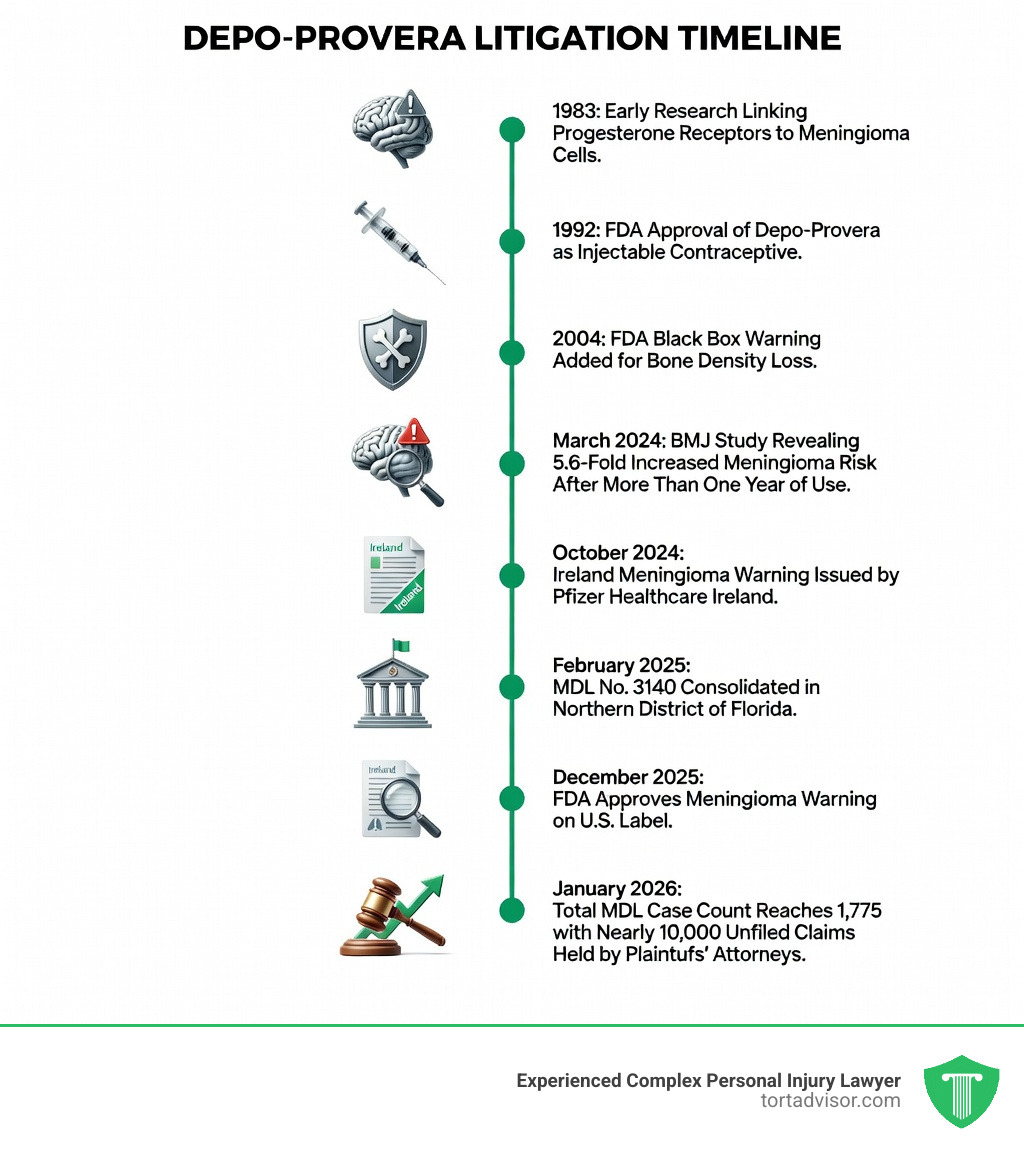 Key terms for working with a Depo-Provera attorney:
How Depo-Provera Is Linked to Meningioma Brain Tumors
The science explains why so many women are looking for a Depo-Provera attorney. Depo-Provera is a contraceptive injection containing the synthetic hormone medroxyprogesterone acetate (MPA), and it is widely used — about 24.5% of sexually experienced U.S. women reported using the shot at some point, according to 2015–2019 survey data. Recent research, however, has raised serious concern: a March 2024 study in the British Medical Journal (BMJ) found that using Depo-Provera for more than a year raises the risk of intracranial meningioma 5.6-fold.
What Is a Meningioma?
A meningioma is a tumor that develops in the meninges, the protective layers covering the brain and spinal cord. Many are benign, but that does not make them harmless; growing inside the skull, they can press on brain tissue, nerves, and blood vessels and cause serious disability. Scientists have suspected a connection for a long time. Back in 1983, a study in the European Journal of Cancer & Clinical Oncology found high levels of progesterone receptors in human meningioma cells. Because Depo-Provera is a progestogen, it may effectively “feed” these hormone-sensitive cells and encourage tumor growth. 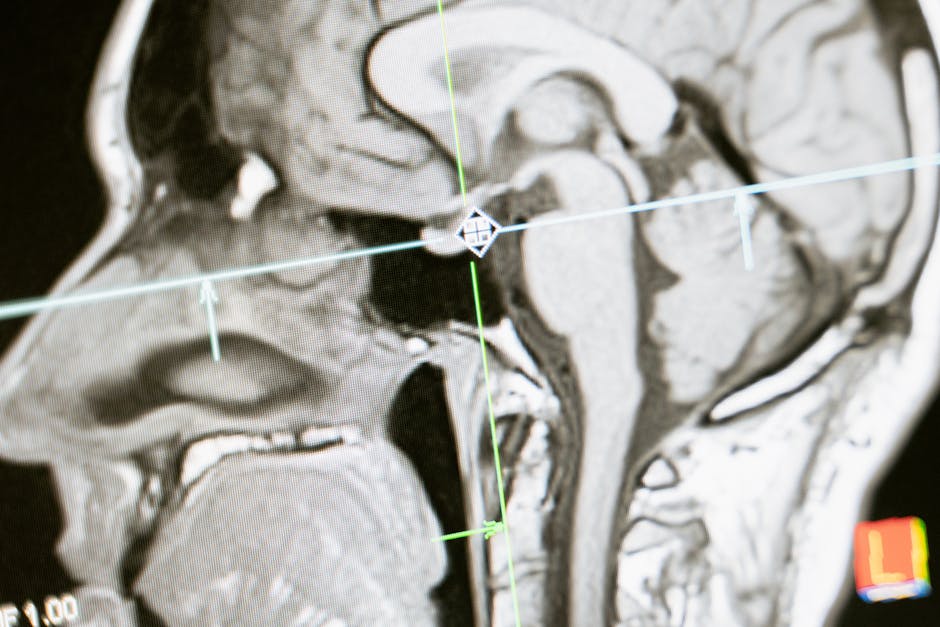 If you have received the shot, stay alert to changes in your health. Our page with more info about Depo-Provera brain tumor symptoms goes into detail, but common warning signs include ongoing headaches, vision changes, and seizures.
Why Your Claim Needs an Experienced Depo-Provera Attorney
Taking on a drug company the size of Pfizer is nothing like filing an ordinary insurance claim. These are complicated “failure to warn” cases: plaintiffs allege Pfizer knew, or should have known, about the tumor risk for decades but kept warnings off the U.S. label to protect profits. An experienced Depo-Provera attorney brings the resources these cases demand. You can read more info about the Depo-Provera injury claim process, but in general an attorney takes on the hardest work:
- Establishing Causation: Connecting your particular tumor to your own history of Depo-Provera use.
- Expert Witnesses: Retaining neurologists and oncologists who can explain the science to a jury.
- Discovery: Requiring Pfizer to produce internal records and emails showing what it knew about meningioma risk.
The picture shifted further with a Cleveland Clinic study in JAMA Neurology covering more than 10 million women, which confirmed a meaningfully higher risk for long-term users, particularly those who began after age 31.
How a Depo-Provera Attorney Handles the MDL
People often say “class action,” but the Depo-Provera cases are proceeding as a Multidistrict Litigation (MDL). In February 2025, the Judicial Panel on Multidistrict Litigation ordered the consolidation of federal lawsuits into MDL No. 3140, which sits in the Northern District of Florida before Judge M. Casey Rodgers. The MDL makes discovery more efficient, so evidence does not have to be gathered separately for each of the 1,775 cases, while your case stays individual and any settlement reflects your injuries. For the latest developments, see more info about the legal status of Depo-Provera lawsuits.
Why a Depo-Provera Attorney Helps With Gathering Evidence
For women who received the shot years ago, finding proof can be one of the biggest obstacles — clinics close and pharmacies change systems. A Depo-Provera attorney often works with investigators skilled at locating:
- Pharmacy Records: Showing you received medroxyprogesterone acetate.
- Medical Records: Establishing when your meningioma was diagnosed.
- Insurance Records: Showing the injections were billed.
Many firms manage these records securely through a platform called BrownGreer MDL Centrality. To see whether your history matches current criteria, read more info about lawsuit qualifications on our site.
Who Qualifies and What Evidence Matters in a Case Against Pfizer
Attorneys typically look for a few baseline requirements for a Depo-Provera brain tumor claim. Every case is different, but a strong claim currently tends to involve:
- Proof of Use: At least two injections of Depo-Provera or its authorized generic.
- Diagnosis: A confirmed intracranial meningioma (or another brain tumor).
- Timing: A diagnosis that came after you began receiving the shot.
| Meningioma Grade | Severity | Common Impact |
|---|---|---|
| Grade I (Benign) | Slow-growing | Surgery may be needed if it presses on critical areas; monitored for life. |
| Grade II (Atypical) | Faster-growing | More likely to return after surgery; radiation is common. |
| Grade III (Malignant) | Aggressive | Cancerous; calls for aggressive surgery plus chemotherapy or radiation. |
Act promptly. Every state sets a statute of limitations, or filing deadline. Because the shot’s link to brain tumors only became widely known in March 2024, the “discovery rule” may give you more time, since the clock may not start until you could reasonably have known the drug caused your injury. See more info about Depo-Provera lawsuit eligibility for state-by-state details.
Where the Depo-Provera MDL Stands and What Drives Claim Value
As of early 2026, the litigation was moving quickly, with 1,775 cases pending in the MDL and plaintiffs’ lawyers reporting close to 10,000 more claims not yet filed. Pfizer signed a Master Settlement Agreement for eligible MDL 3140 claims in July 2026, but the payout tiers and individual amounts have not been made public. Our page with more info about Depo-Provera settlement amounts explains the factors that are expected to matter most:
- Most Serious Claims: Grade II or III tumors, multiple brain surgeries (craniotomies), or permanent cognitive or physical disability.
- Surgical Grade I Claims: Benign tumors that still required surgery and led to substantial medical bills and lost income.
- Monitoring Claims: Small or symptom-free tumors that require lifelong “watch and wait” monitoring with costly MRIs.
Pfizer is contesting the claims with a “preemption” defense, arguing that FDA approval of the drug shields it from state failure-to-warn claims. Plaintiffs, meanwhile, have gained momentum from a newer University of British Columbia safety study reporting an elevated risk in the range of 3.55-fold to 5.6-fold.
Depo-Provera Brain Tumor Claims: Common Questions
Has the FDA recalled Depo-Provera?
No. Depo-Provera has not been recalled and is still sold as an FDA-approved contraceptive. It does carry a history of warnings: in 2004 the FDA added a “Black Box Warning” about bone mineral density loss, advising against use for longer than two years, and not until December 2025 did the FDA approve a label change adding brain tumor risk. Read more info about severe side effects for details.
What symptoms can a Depo-Provera-related meningioma cause?
Meningiomas often grow slowly, but as they enlarge they can lead to:
- Blurry or double vision
- New seizures or seizures that get worse
- Severe headaches that won’t go away
- Confusion or memory loss
- Reduced hearing or sense of smell
- Arm or leg weakness
If you notice these symptoms, see a doctor right away. A complete list is available in more info about brain tumor symptoms.
Which companies are being sued?
Pfizer Inc., the main manufacturer, is the primary defendant. Others include Pharmacia & Upjohn Company (a Pfizer subsidiary), Viatris (which handles some older Pfizer products), and several makers of generic medroxyprogesterone acetate.
Conclusion
No woman should have to choose between reliable birth control and her long-term brain health. Lawsuits allege Pfizer had the data, saw the research, and updated its European labels while leaving U.S. patients uninformed for years. Legal Lawsuit is a legal-information site that helps you connect with a Depo-Provera attorney in our network who has the experience and resources to take on a major drug company. If you or someone you love was diagnosed with a meningioma after receiving the Depo shot, don’t wait. Case reviews are free and confidential, and attorneys in our network work on contingency, so there is no fee unless there is a recovery. Read more info about filing a Depo-Provera lawsuit and take your first step toward justice today.
Related Posts
Quick Answer: The Boy Scouts of America (BSA) filed for Chapter 11 bankruptcy in 2020 after facing tens of thousands [...]
Quick Answer: Survivors of sexual abuse by Catholic priests, nuns, or other Church personnel may be able to file a [...]
Quick Answer: Clergy abuse settlements vary enormously based on the severity of the abuse, the strength of evidence that the [...]