
Short answer: This article explains the key facts, eligibility issues, settlement factors, deadlines, and source-backed updates related to this legal topic. Results vary by case facts, evidence, jurisdiction, and representation.
In This Guide
When Tap Water Turns Into a Legal Problem
People looking for a water contamination lawsuit attorney are usually facing illness or property losses tied to polluted water. Here is the key information up front:
What to Know About Water Contamination Claims:
- Roughly 77 million Americans live where drinking water has violated federal safety rules.
- Frequent sources include industrial discharge, PFAS, lead and farm runoff.
- Landmark resolutions have reached into the hundreds of millions (Flint: $626M; the Erin Brockovich case: $333M).
- Attorneys usually take these cases on contingency, so you pay nothing up front.
- Negligent companies, government bodies and water utilities can all be sued.
Safe tap water is not a given in the United States. Even with laws like the Safe Drinking Water Act, contamination reaches millions of people. The Flint water crisis and the toxic exposure at Camp Lejeune show how negligence can damage entire communities.
Polluted water can lead to grave health effects such as cancer, organ damage, developmental delays and birth defects. Many of the culprits, including PFAS “forever chemicals,” lead and industrial solvents, linger in the environment for decades.
If contaminated water has hurt you, a legal claim may be the strongest route to compensation. I’m Mason Arnao, and my work in legal technology has shown me how important it is to link people who have been harmed with experienced lawyers. A skilled water contamination lawsuit attorney knows environmental litigation and can guide you through each step while pursuing the compensation you are owed.
Related guides on water contamination lawsuits:
Sources of Water Contamination and Health Effects
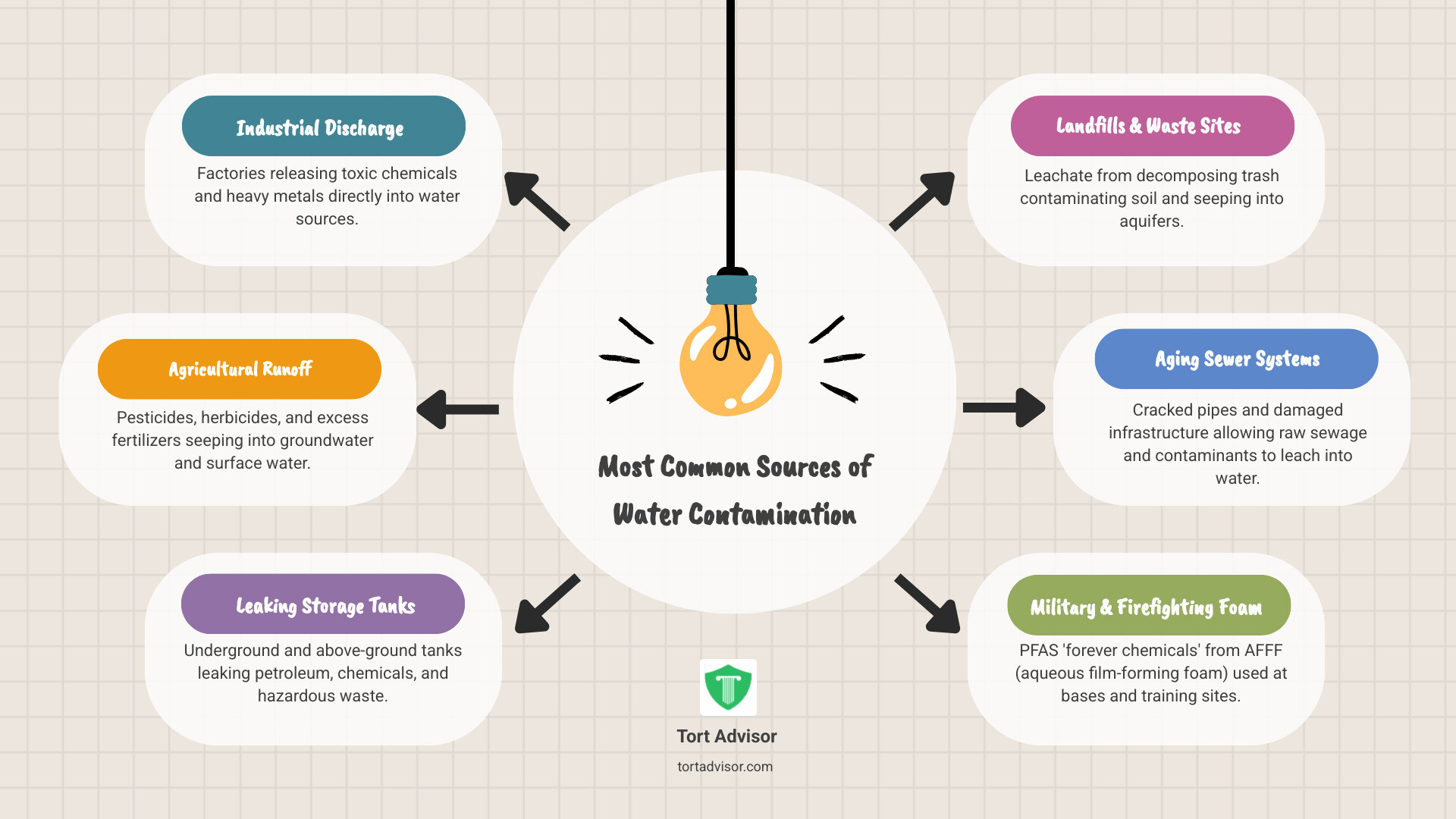
Contamination happens when harmful substances get into the water supply, often as a result of decades of human activity: factory waste, pesticide and fertilizer runoff from farms, deteriorating or broken sewer lines, and toxic seepage from landfills and buried storage tanks.
Health effects may appear quickly or take years to surface. Short exposures can bring nausea, diarrhea and cramping, but the bigger threat comes from long-term exposure. Some chemicals accumulate in the body even in small doses and can cause cancer, developmental delays in children and organ damage, as happened in places like Flint, Michigan, and Camp Lejeune.
The Chemicals Behind Most Cases

A water contamination lawsuit attorney reviewing a potential case will look for particular substances with known links to serious illness.
- PFAS “forever chemicals”: Synthetic compounds found in non-stick coatings and firefighting foam that persist in both the environment and the human body.
- Lead: A heavy metal that leaches from older pipes and is particularly harmful to children’s brains and development.
- Perchloroethylene (PCE) & Trichloroethylene (TCE): Industrial solvents associated with several cancers, liver disease and reproductive harm.
- Benzene: A widely used industrial chemical and established carcinogen.
- Mercury & Arsenic: Toxic elements that can harm the nerves and kidneys and contribute to multiple cancers.
Why PFAS Sit at the Center of So Many Lawsuits
PFAS (per- and polyfluoroalkyl substances) drive much of today’s water contamination litigation. Produced since the 1940s for their resistance to heat, water and oil, they appear in non-stick pans, water-repellent fabrics and, most importantly, firefighting foam (AFFF) used at airports and military bases.
PFAS are dangerous because of bioaccumulation: they collect in the body over time and do not break down, so even low exposure can build to harmful levels. Studies connect PFAS to serious conditions such as kidney cancer, testicular cancer and thyroid disease. If you are worried about PFAS Exposure Risks, learn the full picture, including what federal health agencies report about the health effects linked to PFAS.
Holding Polluters Responsible in Court
If contaminated water has harmed your family, the courts offer a way to seek accountability. A water contamination lawsuit attorney can pursue the parties responsible and fight for the compensation you are owed.
Claims come in several forms. Personal injury suits are brought by individuals who became ill from exposure. When a whole community is affected, class actions let residents band together against a large company. Property damage claims seek money for losses such as lower home values or the expense of water filtration.
Most of these cases rest on negligence, showing that a company or public agency did not use reasonable care. Sometimes strict liability applies instead, making a party responsible for harm from inherently dangerous activities even without proof of carelessness.
Large resolutions show that courts treat these claims seriously:
- The Erin Brockovich case ended with a $333 million settlement over chromium in groundwater.
- The Flint Water Crisis settlement totaled $626 million for residents harmed by lead.
- 3M and DuPont have agreed to pay billions to resolve PFAS contamination claims.
These outcomes show accountability is achievable, even when the road is hard. Ongoing AFFF litigation, including disputes with insurers over who pays, continues to keep corporate responsibility in the spotlight.
Who Can Be Held Liable for Contaminated Water?
Pinpointing who is responsible is one of the main jobs of a water contamination lawsuit attorney, and liability is often shared among several parties:
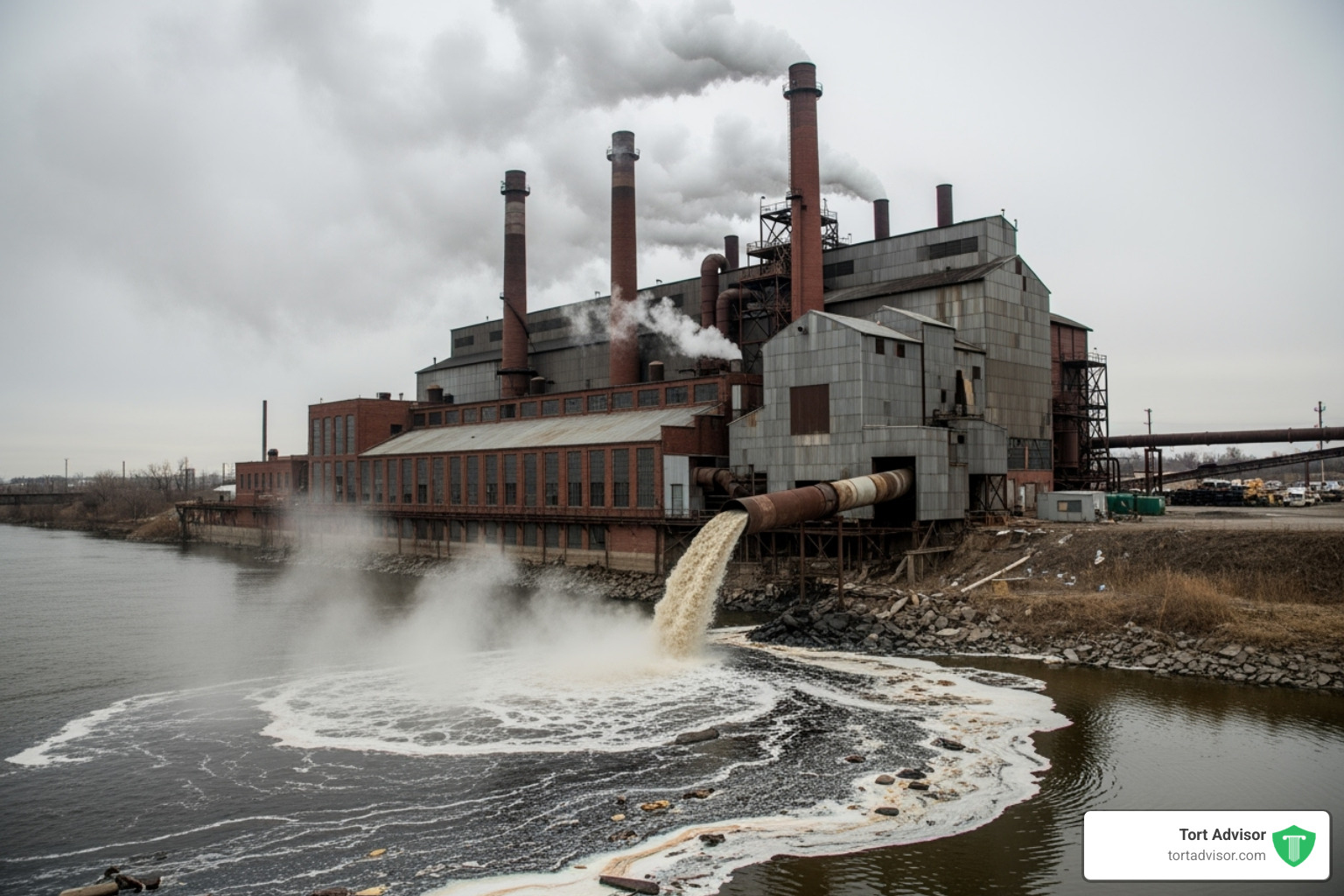
- Companies: Chemical makers such as 3M, DuPont and Monsanto, or any plant that discharges pollutants.
- Government Bodies: Cities, towns or federal agencies that fail to safeguard public health.
- Public Water Utilities: Suppliers that do not treat water properly or disregard contamination warnings.
- The Military: The Department of Defense frequently faces PFAS claims because of firefighting foam used on bases.
- Property Owners: People or businesses whose land is where the contamination started.
What Damages Can a Water Contamination Claim Recover?
Compensation is meant to address every way the contamination has affected you. How much depends on how serious the harm is and how long the exposure lasted. Recoverable damages can include:
- Medical Costs: Treatment, prescriptions and monitoring, now and in the future.
- Lost Income: Wages missed because of illness and reduced ability to earn later.
- Pain and Suffering: Physical pain, emotional distress and diminished quality of life.
- Property Losses: Reduced property value plus the cost of filters or bottled water.
- Punitive Damages: Extra damages in cases of egregious misconduct, meant to punish and discourage similar behavior.
Why an Experienced Water Contamination Lawsuit Attorney Matters
These are complicated fights against well-resourced companies and government agencies, and taking them on alone is extremely difficult. An experienced water contamination lawsuit attorney matters for several reasons.
To begin with, these claims involve a tangle of state and federal environmental laws, and an attorney knows how to use them to build a solid case. Beyond that, proving that a specific contaminant caused your illness, known as causation, is usually the hardest part, and it takes advanced scientific and medical evidence that requires a well-resourced legal team.
Finally, big corporations employ lawyers whose job is to keep payouts low. Your attorney evens the odds, negotiating hard and making sure every loss is counted, from future medical bills to lost earning power and pain and suffering.
How an Attorney Develops Your Claim
A strong water contamination case is built step by step. Here is how a water contamination lawsuit attorney typically approaches it.
- Free, Confidential Case Review: It starts with a no-cost review of your situation, in which the attorney looks at your exposure history, medical records and water quality reports to judge whether you have a valid claim.
- Investigation: The legal team digs in to find where the contamination came from and who is responsible, collecting medical and job records, public health data and historical environmental reports.
- Expert Witnesses: Expert testimony often decides these cases. Your attorney will work with toxicologists, epidemiologists and other scientists to connect the contamination to your illness. As courts demand increasingly specific proof of contamination, these experts become essential.
- Handling the Litigation: Your attorney manages every filing, court procedure and deadline, including the statute of limitations, which can end your claim if missed. They also take depositions, argue motions and handle all negotiations.
- Pursuing Full Compensation: Whether the case settles or goes to trial, the aim is the best result possible. Your attorney will advise whether an individual suit or a class action fits you better. Individual cases give you more control and may yield more for severe injuries, while class actions can be more efficient when harm is widespread.
Camp Lejeune: A Landmark Water Contamination Case
The contamination at Marine Corps Base Camp Lejeune in North Carolina ranks among the worst in American history. Between August 1953 and December 1987, Marines, their families and civilian employees drank water tainted with dangerously high levels of toxic chemicals.

The main contaminants, trichloroethylene (TCE), perchloroethylene (PCE) and benzene, came from industrial operations and storage tanks on base and from a nearby dry cleaner. For decades, legal obstacles kept victims from pursuing claims.
New laws changed that. The Honoring America’s Veterans and Caring for Camp Lejeune Families Act of 2012 provided VA benefits to veterans and family members with specific presumptive conditions tied to the exposure.
An even larger step came with the Camp Lejeune Justice Act of 2022, which opened a two-year window for anyone who lived or worked on the base for at least 30 days during the contamination period to sue the federal government for damages.
The law has given hundreds of thousands of people a chance at compensation. The government has offered an elective payout option, but many water contamination lawsuit attorneys believe a lawsuit may lead to fuller compensation for the illnesses and losses involved.
Water Contamination Lawsuit FAQs
Questions are natural when you suspect a water contamination problem. Here are answers to the ones we hear most.
How can I tell whether my water is contaminated?
Many harmful contaminants cannot be seen, smelled or tasted, but some warning signs include:
- Odd taste, odor or color: A metallic flavor, a chemical or rotten-egg smell, or cloudy water are warning signs.
- Official advisories: Watch for boil-water notices and other alerts from your utility or health department.
- Annual water reports: Utilities must provide a yearly Consumer Confidence Report listing measured contaminant levels.
- Clusters of illness: Similar unexplained health problems among neighbors may point to a common environmental source.
- Lab testing: For private wells or ongoing worries, a certified laboratory test is the most dependable way to identify contaminants.
What does it cost to hire a water contamination attorney?
Most water contamination lawsuit attorneys take cases on contingency, which means nothing up front. Their fee is a share of any settlement or verdict and is paid only if the case succeeds.
That structure lets you get experienced representation without financial risk. Attorneys in our network offer a free, confidential case review to talk through your situation and explain their fees, with no obligation.
What is the deadline to file a water contamination lawsuit?
Each state sets a filing deadline called the statute of limitations, and it differs by state and by claim type, such as personal injury versus property damage.
Many states follow a “discovery rule,” under which the clock starts when you learn of the contamination and its connection to your illness rather than when the exposure happened.
Sometimes special laws, such as the Camp Lejeune Justice Act, open a fresh filing window that overrides normal deadlines. Because the rules are complicated, reach out to a water contamination lawsuit attorney as soon as you suspect a problem so you do not lose your right to compensation.
Your Next Step Toward Accountability
Dealing with the fallout from contaminated water is exhausting, but you do not have to handle it alone. About 77 million people nationwide live where water has broken federal safety standards, and legal action has delivered results, from the $626M Flint settlement to major resolutions with polluters such as DuPont and 3M.
Those outcomes came about because people chose to push back with the right legal support.
Legal Lawsuit helps people connect with attorneys in our network who focus on environmental litigation, including water contamination lawsuit attorneys experienced in taking on well-funded defendants. They understand the science, the health impacts and the legal strategy these cases require.
Your case review is free and confidential, with no up-front cost. Attorneys in our network work on contingency, so they are paid only if they recover money for you, which lets you pursue accountability without financial risk.
Timing matters. Filing deadlines can pass and evidence can disappear, so the sooner you act, the stronger your position may be.
If contaminated water has harmed your health or your property, you deserve answers and fair compensation. Start today.
See whether you have a case with a free review from attorneys in our personal injury network.
Related Posts
Quick Answer: The Boy Scouts of America (BSA) filed for Chapter 11 bankruptcy in 2020 after facing tens of thousands [...]
Quick Answer: Survivors of sexual abuse by Catholic priests, nuns, or other Church personnel may be able to file a [...]
Quick Answer: Clergy abuse settlements vary enormously based on the severity of the abuse, the strength of evidence that the [...]