
Short answer: This article explains the key facts, eligibility issues, settlement factors, deadlines, and source-backed updates related to this legal topic. Results vary by case facts, evidence, jurisdiction, and representation.
What This Guide Covers
- What Mass Tort Lawsuit Settlements Really Mean for You
- Introduction: What is a Mass Tort Lawsuit?
- Mass Torts vs. Class Actions: Understanding the Key Differences
- The Journey of a Mass Tort Case: From Filing to Resolution
- Understanding Mass Tort Lawsuit Settlements
- Weighing the Pros, Cons, and Costs of Joining a Mass Tort
- Frequently Asked Questions about Mass Tort Settlements
- How to Move Forward with Your Claim
Mass Tort Lawsuit Settlements: What They Mean for You
Mass tort lawsuit settlements are agreements in which a company pays compensation to many people injured by the same product or conduct. The essentials:
Settlement Basics:
- Individual value: Varies widely and depends on injury severity, medical costs, lost income, and evidence
- How long it takes: Usually 2–7 years from start to finish
- Notable resolutions: 3M earplugs ($6 billion), Roundup ($10+ billion), J&J talc (about $9 billion proposed, later rejected in bankruptcy court)
- Nothing up front: Most attorneys work on contingency and are paid only if you recover
Injuries from a defective product, a harmful drug, or toxic exposure may entitle you to compensation. Mass torts let individuals join together against large companies whose conduct hurt many people. They exist because businesses sometimes put profits ahead of safety, and when a product seriously injures thousands, the courts give those people a way to pursue justice together.
Class actions often split one recovery into small, equal shares, but mass tort settlements are tailored to each person. Your payment reflects your own injuries, medical bills, lost income, and pain and suffering, and the people with the most serious injuries usually receive the most.
I’m Mason Arnao. Building legal technology has shown me how mass tort lawsuit settlements can deliver life-changing help to people buried in medical bills and lost wages, and my work focuses on the data management that keeps these complex cases moving.
Key mass tort lawsuit settlements terms:
- mass tort litigation support
- paraquat lawsuit attorney
- water contamination lawsuit attorney
Getting Started: What Is a Mass Tort Lawsuit?
When people around the country suffer similar harm from the same faulty product or dangerous medication, they can team up in a mass tort lawsuit rather than taking on a huge corporation by themselves.
A mass tort is a legal action in which many people bring claims against one or more companies over injuries caused by the same product or conduct. What sets it apart from an ordinary injury case is that many similar cases are grouped together to make the process more efficient, which gives everyday people a realistic way to challenge powerful companies.
Every mass tort centers on the claim that a company’s negligence caused widespread harm — a drug maker concealing side effects, for instance, or a manufacturer skimping on safety.
This guide walks through how mass torts work, what affects payouts, and how they differ from class actions, where you are treated as part of a group rather than as an individual. If a product that hurt many others also hurt you, you don’t have to fight alone; mass torts exist to give injured people a real chance against well-funded corporate defendants.
How Mass Torts and Class Actions Differ
After an injury from a defective product, you may wonder whether your case is a mass tort or a class action. Both involve many people suing the same company, but how they are structured, and what you might receive, differ sharply.
The key distinction is how each person is treated. In mass tort lawsuit settlements, you remain an individual with your own injuries and losses, and your case is evaluated on its own, so compensation reflects your particular medical costs, lost income, and pain and suffering.
A class action treats all plaintiffs as one group led by a “class representative,” and any recovery is split among members, often equally. Payments per person tend to be smaller, but the approach can provide some relief when individual losses are too small to justify separate suits.
How Each Plaintiff Is Handled
| Criteria | Mass Torts | Class Actions |
|---|---|---|
| Plaintiff Individuality | Every plaintiff is evaluated individually | Everyone is treated as one group |
| Damage Calculation | Individualized | Equal shares or averages |
| Opt-Out Options | Plaintiffs choose to join or not | Members are usually included automatically |
| Legal Representation | Individual attorneys | One or a handful of lead attorneys |
When Each Approach Fits
Mass torts fit situations where people suffer serious but differing injuries from one source, such as faulty medical devices, dangerous drugs, or toxic exposure. The cause is shared, but the harm to each person is distinct and significant. In the 3M earplug litigation, for example, veterans had varying levels of hearing loss and tinnitus, which made a mass tort the right vehicle.
Class actions suit large groups with fairly uniform, usually smaller losses — think consumer fraud, data breaches, or minor product defects. They require that separate suits would be impractical and that members share common legal questions. When injuries differ substantially, a mass tort is usually the better path to mass tort lawsuit settlements.
How a Mass Tort Moves From Filing to Resolution
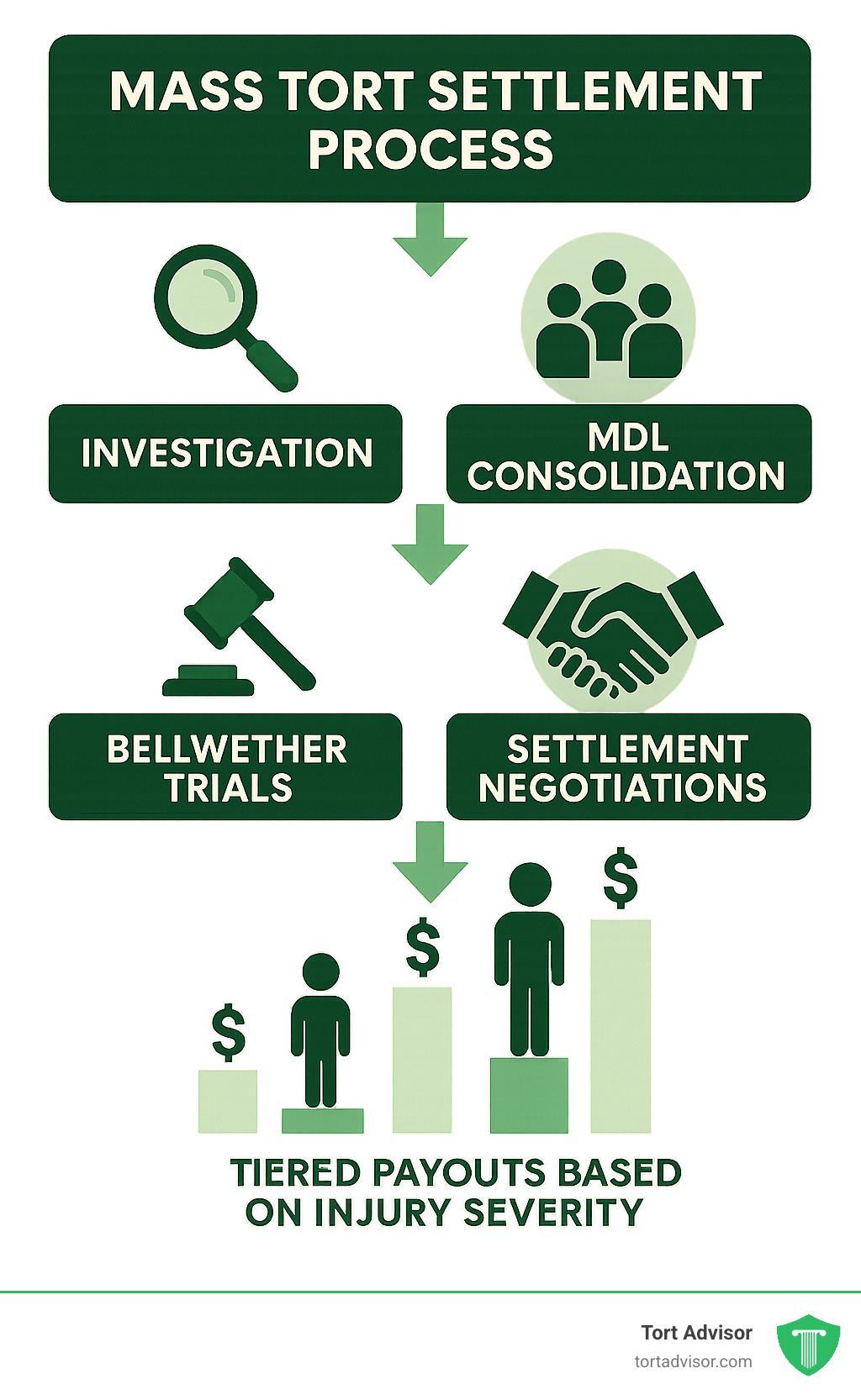
Mass torts are long and complicated, often lasting several years. The process is built to handle thousands of individual claims efficiently while protecting each plaintiff’s rights.

Investigation and Filing
It starts when attorneys link injuries to a shared cause, such as a defective device or harmful drug. They investigate in depth, collecting evidence, reviewing medical records, and identifying others who were hurt. Once a pattern of widespread harm is clear, individual suits are filed in courts around the country.
Grouping Cases in an MDL
To organize thousands of scattered cases, courts use Multidistrict Litigation (MDL). A judicial panel sends related cases to one federal judge, who manages all pretrial proceedings. The process is more efficient, yet each plaintiff’s case stays separate.
Discovery and Bellwether Trials
After consolidation, the parties exchange evidence in discovery, which includes document review, depositions (sworn testimony), and expert analysis.
A central feature of this phase is bellwether trials — sample cases tried first to show how juries may view the evidence. Big plaintiff wins push defendants toward settlement, while defense wins may encourage them to keep fighting. Either way, these results strongly shape negotiations by showing what may happen at trial.
Settlement Talks or Trial
With what they learn from discovery and bellwether trials, defendants often choose settlement over the cost and risk of thousands of trials. Talks may produce one large fund divided among qualifying plaintiffs, and judges frequently encourage these negotiations.
Most mass torts end in negotiated agreements. If talks break down, cases return to their original courts for individual trials, but that is uncommon because settlement usually benefits both sides.
How Mass Tort Lawsuit Settlements Are Valued
No two mass tort lawsuit settlements are the same, and your case’s value depends on several important factors. Amounts are not arbitrary; they are based on damages that can be proven.

What Drives the Value of Mass Tort Lawsuit Settlements
- How serious the injury is: The biggest factor. Injuries are often sorted into tiers, with the most catastrophic receiving the most.
- Medical costs: All past and future expenses, from surgery and hospitalization to rehab and long-term care.
- Lost income and earning ability: Wages missed because of the injury and any lasting drop in your ability to work.
- Pain and suffering: Non-economic harm such as physical pain, emotional distress, and lost enjoyment of life, sometimes estimated as a multiple of economic losses.
- Quality of the evidence: Clear medical records, expert testimony, and research tying your injury to the product make a claim stronger.
- How culpable the defendant was: When a company knowingly concealed risks or acted with gross negligence, settlements may rise and punitive damages may be possible.
- Where the case is filed: State law affects how damages are measured and whether your own conduct reduces your recovery.
- The defendant’s finances: Assets, insurance, and overall financial health shape how large a settlement fund can be.
How Payments Are Calculated and Paid Out
Many mass tort lawsuit settlements use a matrix or grid that assigns plaintiffs to tiers based on how severe their injuries are and other factors. People in the top tiers, with the worst injuries and strongest proof, receive the largest amounts. There is no reliable “typical” figure; individual values vary widely from one litigation to another.
Attorney fees (often 25–40%) and case costs come out of the gross award, and any liens from Medicare, Medicaid, or private insurers must also be repaid from the settlement.
Notable Mass Tort Lawsuit Settlements
- 3M Combat Arms Earplugs: A $6 billion settlement in 2023 for roughly 260,000 service members with hearing loss and tinnitus.
- Roundup: Bayer has paid more than $10 billion since 2020 to resolve claims that the weedkiller caused non-Hodgkin’s lymphoma.
- Johnson & Johnson Talc: Facing tens of thousands of claims that its talc caused cancer, J&J proposed a roughly $9 billion settlement in 2024 through bankruptcy; that plan was later rejected, and cases have returned to court.
- Vioxx: Merck agreed to pay $4.85 billion to resolve about 60,000 claims linking the painkiller to heart attacks and strokes.
- Metal-on-Metal Hip Implants: DePuy, Stryker, Biomet, and other manufacturers have paid billions to settle thousands of claims over failed hip replacements.
Benefits, Drawbacks, and Costs of Joining a Mass Tort
Joining a mass tort is a big decision. It offers a route to justice against large companies, but you should understand the advantages, the risks, and how the money works.
Advantages for Injured People
- Experienced Counsel: Mass torts call for attorneys skilled with complex science and procedure, and Legal Lawsuit can help you connect with experienced attorneys in our network.
- Shared Costs: Expert fees and research can be enormous, but in a mass tort those costs are spread across many plaintiffs, making a strong case affordable.
- Strength in Numbers: Thousands of people with similar injuries form a pattern of evidence that companies cannot easily brush aside, often pushing them toward meaningful settlements.
- A More Efficient Process: The MDL system organizes cases and can lead to faster outcomes than thousands of separate suits.
- Accountability: Taking part helps you and also pressures companies to put safety first, protecting future consumers.
Risks and Challenges
- Lengthy Process: Mass torts take time, typically 2–7 years.
- No Guaranteed Result: Litigation is unpredictable, and compensation can be affected by the science, bellwether results, and the defendant’s financial health.
- Less Control: Key strategy decisions are made by a Plaintiffs’ Steering Committee, so you have less say than in an individual lawsuit.
- Effect of Bellwether Outcomes: Weak results in early test trials can hurt everyone’s bargaining position.
- Bankruptcy: If a defendant files for bankruptcy, litigation can stall and the money available to victims can shrink.
Fees and Funding
Joining a mass tort does not require any upfront payment.
- Contingency Fees: Most mass tort attorneys are paid only if you recover, taking a percentage (often 25–40%) of the final settlement.
- Costs Advanced: The law firm typically fronts litigation expenses such as experts, filing fees, and discovery, allowing it to take on well-funded defendants.
- No Financial Risk: If the case does not succeed, you generally owe nothing for attorney fees or expenses.
A mass tort offers a practical way to hold negligent companies accountable while shielding you from financial risk.
Mass Tort Settlement Questions, Answered
Questions are natural when you are considering mass tort lawsuit settlements. Here are answers to several common ones.
Do I owe taxes on a mass tort settlement?
In general, federal law does not tax compensation for physical injuries or physical sickness, which usually covers most of a settlement, including amounts for medical expenses and pain and suffering tied to a physical injury.
Portions awarded for lost wages or punitive damages (meant to punish the defendant) may be taxable, especially money that replaces taxable income. Tax rules are complicated, so speak with a qualified tax professional about your own mass tort lawsuit settlement.
What kinds of mass torts are common?
Mass torts arise whenever corporate misconduct harms large numbers of people. Frequent categories include:
- Defective products: Faulty medical devices such as hernia mesh and hip implants, consumer goods, and vehicle parts; the 3M Combat Arms Earplugs case is a recent example.
- Harmful drugs: Claims against drug makers over serious side effects that were not disclosed, with active litigation involving Ozempic, Suboxone, and Tepezza.
- Toxic exposure: Harm from hazardous substances such as asbestos, AFFF firefighting foam (linked to cancer), and the herbicide Paraquat (linked to Parkinson’s disease).
- Other ongoing litigation includes hair relaxer cancer claims, Paragard IUD complications, and various defective implants.
Do I need an attorney to join a mass tort?
Yes. Pursuing a mass tort lawsuit settlement without an experienced attorney is nearly impossible, given the complex procedures (MDLs and bellwether trials), technical scientific evidence, and powerful corporate defense teams.
Statutes of limitations usually require filing within a few years of your injury or diagnosis, and missing the deadline permanently ends your claim regardless of its merit.
An experienced mass tort attorney handles everything — filing correctly, collecting evidence, proving damages, and negotiating for you. Most work on contingency, so you pay nothing unless there is a recovery. With so much at stake, skilled representation is essential.
Next Steps for Your Claim

Learning how mass tort lawsuit settlements work is the first step toward justice. These cases hold companies responsible when they put profits ahead of safety, and many people have recovered compensation through them, from the $6 billion 3M earplug settlement to more than $10 billion paid in Roundup claims — proof that people can stand together against major corporations and succeed.
Delay can cost you. Filing deadlines often allow just two to three years from the injury, and waiting too long can wipe out your right to compensation.
If you think a defective product, harmful drug, or toxic exposure injured you, your next move is to get experienced legal advice right away. These cases are too complex to manage alone, and you will face corporate legal teams focused on paying as little as possible.
Legal Lawsuit can help. As a legal-information site, we help you connect with experienced mass tort attorneys in our network who know how to build strong claims for mass tort lawsuit settlements.
A case review is free, confidential, and carries no obligation. Most mass tort attorneys work on contingency, so you pay nothing unless there is a recovery. The attorney will review your situation, gather evidence, and determine whether you qualify.
Don’t keep wondering whether you have a claim. Acting sooner strengthens your position, and the right legal team can help level the playing field.
See whether you have a case by browsing active personal injury lawsuits on Legal Lawsuit.
Additional Resources
Related Posts
Quick Answer: The Boy Scouts of America (BSA) filed for Chapter 11 bankruptcy in 2020 after facing tens of thousands [...]
Quick Answer: Survivors of sexual abuse by Catholic priests, nuns, or other Church personnel may be able to file a [...]
Quick Answer: Clergy abuse settlements vary enormously based on the severity of the abuse, the strength of evidence that the [...]