Short answer: This article explains the key facts, eligibility issues, settlement factors, deadlines, and source-backed updates related to this legal topic. Results vary by case facts, evidence, jurisdiction, and representation.
In This Guide
Hair Straightener Lawsuit Basics: What to Know Before You File
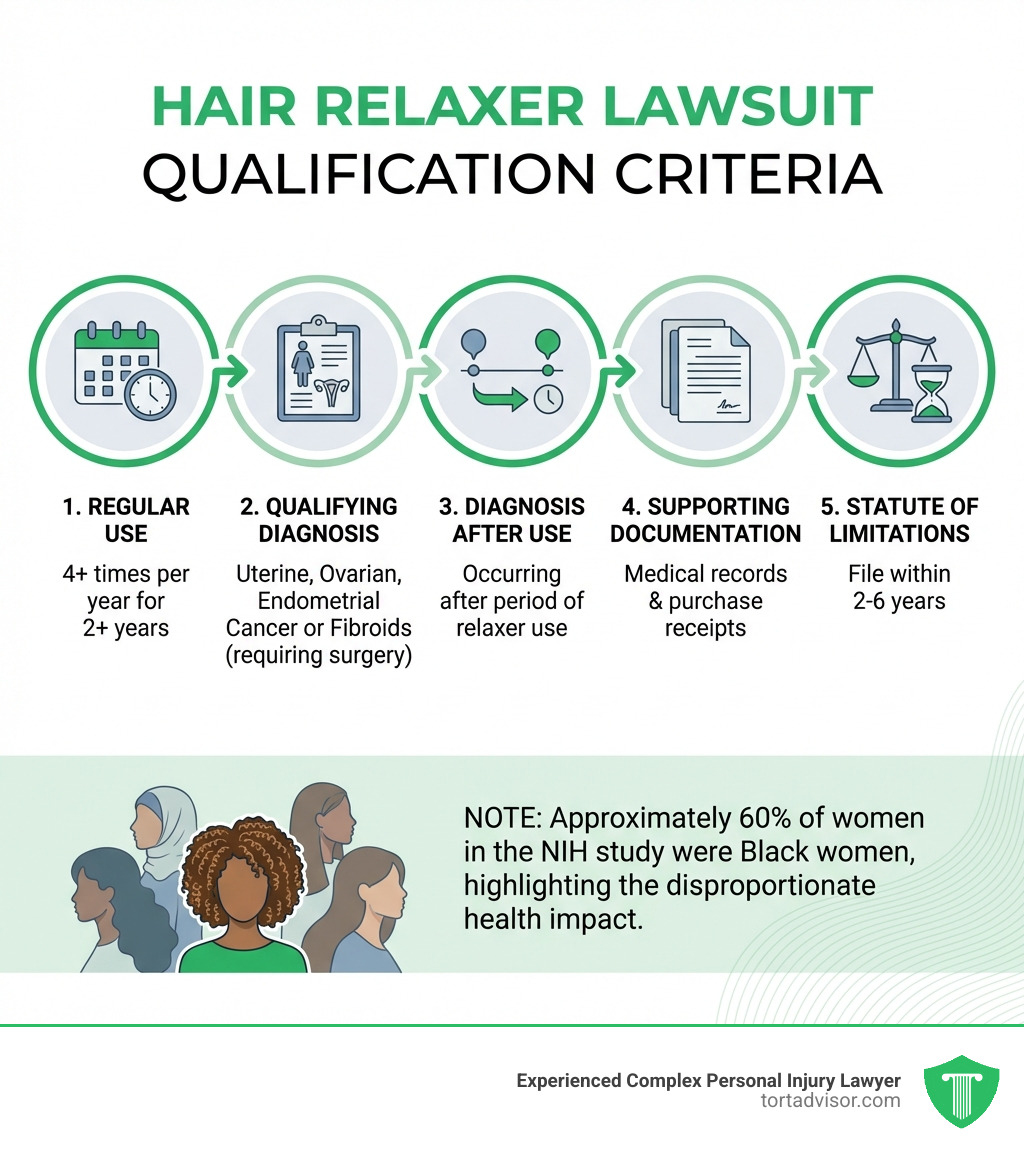
Who qualifies for a hair straightener lawsuit? The short version:
Most claims require every one of these elements:
- Regular use of chemical relaxers – four or more times a year for at least two years
- A qualifying diagnosis – uterine, ovarian or endometrial cancer, or uterine fibroids that needed surgery
- Use that came first – you used the products before the condition was diagnosed
- Proof to back it up – medical records, receipts, photos or a stylist’s statement
- Filing on time under state law – usually 2-6 years from diagnosis or from learning of the link
For decades, chemical relaxers were a fixture in countless homes. Growing scientific evidence now connects the ingredients in these products to serious reproductive cancers, and thousands of women have taken their cases to court.
The research is hard to ignore. A major NIH study found that women who used chemical relaxers four or more times a year faced a 2.4 times higher risk of uterine cancer than women who never used them, and frequent users also had a 50% higher risk of ovarian cancer. As of early 2026, more than 11,000 cases were pending in the federal Hair Relaxer Multidistrict Litigation (MDL 3060); that count changes as new claims are filed.
If you or a loved one used these products and were later diagnosed with cancer, you may have a claim, but the eligibility rules are specific. Using a relaxer does not automatically qualify someone, and only certain diagnoses are covered.
I’m Mason Arnao, a digital marketing and lead generation specialist with deep experience in the legal field, including research into mass tort questions like who qualifies for a hair straightener lawsuit. Below, I lay out what courts look for so you can decide on your next step with confidence.
The Science Connecting Chemical Relaxers to Cancer
Eligibility makes more sense once you understand why these products are facing such heavy legal scrutiny. It comes down to the chemical mix that breaks down hair’s natural structure so it lies straight.
Many widely sold relaxers contain Endocrine Disrupting Chemicals (EDCs), including phthalates such as DEHP, parabens and formaldehyde-releasing agents. These are more than harsh ingredients: their structure resembles hormones like estrogen, which allows them to disrupt the body’s endocrine system.
Relaxer applied to the scalp does not stay on the hair. The scalp has a rich blood supply, and many women get “relaxer burns” or tiny sores during treatment. Those small openings give EDCs a direct path into the bloodstream, where they may fuel the growth of hormone-sensitive cancer cells in the uterus and ovaries.
The turning point was the Sister Study from the National Institute of Environmental Health Sciences (NIEHS), which tracked more than 33,000 women for over ten years. Women who had never used straighteners had an estimated 1.64% chance of uterine cancer by age 70; among frequent users, the estimate rose to 4.05%.
Studies of endocrine-disrupting chemicals in hair products used by Black women also point to a serious environmental justice problem. Roughly 60% of the NIH study participants who reported straightener use were Black. Marketing built on Euro-centric beauty ideals led many Black women to start using these products very young, often as children.
For a deeper look, read the Legal Lawsuit guide to hair relaxer health risks.
Who Qualifies for a Hair Relaxer Lawsuit?
The easiest way to think about eligibility is as a checklist. Attorneys and judges look for particular “markers” showing the product is connected to the injury.
Using a relaxer and later getting sick does not by itself win a case. A claim has to show the exposure was heavy enough to cause harm, and that the harm is a recognized condition associated with these chemicals.

Eligibility usually rests on four elements:
- Exposure: You used chemical relaxers, whether at home or in a salon.
- Duration: Your use was frequent and lasted years.
- Injury: You were diagnosed with a hormone-sensitive reproductive condition.
- Timing: The record shows your use happened before the diagnosis.
The table below compares qualifying conditions with the proof each one usually calls for:
| Condition | Required Evidence | What Matters Most |
|---|---|---|
| Uterine Cancer | Oncology records and pathology reports | The most frequent qualifying diagnosis in MDL 3060 |
| Ovarian Cancer | Biopsy results and surgical records | Tied to 50% higher risk among frequent users |
| Endometrial Cancer | Medical history and imaging studies | Has to be a primary cancer, not one that spread from elsewhere |
| Uterine Fibroids | Hysterectomy or myomectomy surgical records | Generally needs surgery to qualify |
If these criteria fit your situation, the free Legal Lawsuit tool can estimate your potential settlement value based on your circumstances.
How Often and How Long You Used Relaxers
A question that comes up often: “I had a relaxer once before a wedding. Do I have a case?” Usually not. These lawsuits center on long-term, repeated exposure.
To meet the bar set by most attorneys and the federal MDL, you typically need to show:
- Regular Use: Four or more applications a year, which lines up with how the NIH study defined a “frequent user.”
- Years of Use: Claims generally involve multiple years of regular use, and many plaintiffs used relaxers for decades, some starting around age 10.
- Buildup Over Time: The legal argument is that the “cumulative chemical load,” or EDCs accumulating in the body over years, sets off the cell changes that lead to cancer.
It makes no difference to eligibility whether you used a drugstore “box kit” at home or had a stylist apply the relaxer at a salon. If you worked as a stylist applying these products to clients every day for years, your exposure may be viewed as even greater, which could make your claim stronger.
Diagnoses That Qualify for a Hair Straightener Lawsuit
The injury requirement is narrow. Right now, the cases focus mainly on hormone-sensitive cancers and conditions.
1. Uterine Cancer (Including Endometrial Cancer)
The scientific evidence is strongest here. Uterine cancer takes two main forms, endometrial cancer (more common and more treatable) and uterine sarcoma (rarer and more aggressive), and both can qualify. If you are unsure about symptoms, the American Cancer Society lists the signs and symptoms of endometrial cancer.
2. Ovarian Cancer
Studies have tied frequent relaxer use to a meaningfully higher chance of ovarian cancer. Review the research on hair products and ovarian cancer risk to see the connection.
3. Uterine Fibroids
Fibroids are benign, yet they can cause severe pain and upend daily life. Because they are so common, most cases are accepted only when the fibroids led to major surgery, such as a hysterectomy (uterus removal) or myomectomy (fibroid removal). Courts recognize lost fertility as a serious form of damages.
Which Companies and Brands Are Being Sued
Qualifying also means naming the “defendant,” the company behind the product. You do not need to have stuck with a single brand; many women changed brands over the years, and that does not hurt a claim.
Leading manufacturers facing suits include:
- L’Oréal: The largest cosmetics company in the world is a main defendant, particularly over its Dark & Lovely and SoftSheen-Carson product lines.
- Strength of Nature: Maker of Motions, Just for Me, African Pride and Soft & Beautiful.
- Namaste Laboratories: Behind the well-known ORS Olive Oil relaxer (once branded Organic Root Stimulator).
- Revlon: Despite its financial restructuring, claims involving Revlon products continue through designated legal channels.
If Dark & Lovely was your brand, keep an eye on how those claims develop as the MDL proceeds.
The lawsuits claim these companies knew or should have known their ingredients were risky yet did not warn customers. They kept promoting the products as “safe,” “natural” or “gentle,” even in marketing aimed at young children.
Evidence You Need and the Filing Deadline
Your word alone will not prove a claim. Because these cases are consolidated in a large federal MDL (MDL 3060) in the Northern District of Illinois, strict rules govern the evidence you must submit.
Try to collect as much of the following as you can:
- Medical Records: The single most important item. They should show your diagnosis, when it was made and how you were treated (surgery, chemotherapy and so on).
- Proof You Used the Products: Harder if your use was long ago, but receipts, card statements, salon invoices, or photos and videos of you applying or receiving a relaxer can all help.
- Witness Statements: Relatives or a longtime stylist can vouch for a “pattern of use” over the years.
- Old Packaging: If you still have a box or jar from a relaxer you used, hold on to it. It may help pinpoint the batch or formula.
Statute of Limitations
Think of this as the deadline on your right to sue. It differs widely by state, from 1 year in Tennessee to as long as 6 years elsewhere. Most states, though, apply the “discovery rule,” so the clock typically starts when you learned, or reasonably should have learned, that your cancer may be tied to relaxer use.
Because the major NIH study only came out in October 2022, many women still have time to file. Even so, waiting is risky; evidence is easier to gather early. For the latest developments, see the hair relaxer class action updates.
Hair Straightener Lawsuit Eligibility FAQs
How long do I have to file a claim?
It depends on your state. Georgia, for example, has seen a major dispute over its “statute of repose,” a hard 10-year limit measured from first use. In most states, from Florida to New York to California, the deadline instead turns on your diagnosis date and when you learned of the possible link. Check your own state’s statute of limitations to confirm your deadline.
Do “no-lye” relaxers count?
Yes, and many people get this wrong. Lots of women moved to “no-lye” formulas because they were advertised as gentler on the scalp. They may cause fewer immediate burns, but they still contain the same endocrine-disrupting chemicals, such as phthalates and parabens, that have been tied to cancer. Some researchers have also raised concerns that certain no-lye products contain higher levels of some harmful ingredients.
Can uterine fibroids lead to a settlement?
Possibly, but the bar is higher. Fibroids are common on their own, so a claim has to show relaxer use substantially worsened the condition, typically proven by a hysterectomy or myomectomy. If medication alone managed your fibroids, you may not fit the current MDL, but an attorney should still review your records.
Conclusion
The fight for accountability over chemical relaxers is well under way. For years, large cosmetics companies put profits ahead of women’s health, and Black women bore a disproportionate share of the harm.
At Legal Lawsuit, every woman deserves the facts about what she puts on her body. If this guide suggests you meet the criteria, your next move is a conversation with an attorney who can take on the hard work of a claim. Legal Lawsuit connects readers with experienced attorneys in our network who have the resources to stand up to companies like L’Oréal and Revlon.
Attorneys in our network work on a contingency fee basis, so there is nothing to pay upfront; they are paid only if your case recovers money. You have been through enough already, and the legal process should not pile on more stress.
Filing deadlines are real, so do not wait. Begin your free hair relaxer case review and take the first step toward the compensation and closure you deserve.
Related Posts
Quick Answer: The Boy Scouts of America (BSA) filed for Chapter 11 bankruptcy in 2020 after facing tens of thousands [...]
Quick Answer: Survivors of sexual abuse by Catholic priests, nuns, or other Church personnel may be able to file a [...]
Quick Answer: Clergy abuse settlements vary enormously based on the severity of the abuse, the strength of evidence that the [...]