How to Report a Work Injury to Your Employer in Writing
By Mason ArnaoPublished

By Mason ArnaoReviewed by Mason Arnao
Here is how to report a work injury to your employer: notify your employer promptly, then provide a short written account of when, where, and how the injury happened. Do this as soon as possible because notice deadlines vary by state—for example, California warns that failing to notify your employer within 30 days could cost you workers’ compensation benefits.
This guide walks you through getting care, telling the right person, and using a simple written-notice template. It also explains state deadline examples, reporting minor injuries, what to ask your employer to do next, what to do if your report is late or goes unanswered, and the separate reporting route for federal employees.
Start with care, then tell the right person
If you need emergency care, get it first. Tell your supervisor about the work injury as soon as you can. California’s employee guidance expressly recommends getting emergency treatment when needed and reporting the injury to your supervisor promptly.
Next, ask who handles injury reports at your workplace and how to send yours. Your supervisor may be the starting point, but there may also be a designated reporting contact. Utah’s reporting guidance identifies supervisors, managers, human resources, and other appropriate recipients for an injury report.
For your own records, follow a spoken report with a dated written copy. This gives you something concrete to refer to if questions come up later. A practical sequence is:
- Write down what you reported. Include when and where the injury happened, what you were doing, and what part of your body was hurt. If you already spoke with someone, include that person’s name and the date of the conversation.
- Send it to the reporting contact. Ask them to acknowledge that they received it. Keep any reply with your report.
- Save a copy you can access yourself. Do not rely only on an employer-controlled email inbox or reporting portal. Keep your own paper or electronic copy, along with any submission confirmation.
These recordkeeping steps can help you organize your report; they are not a substitute for checking your state’s notice requirements.
What to say: a short written-notice template
Keep your report short and factual. Build it around when, where, and how the injury happened—the information identified in New York’s injury-reporting guidance. You do not need to turn the report into a legal argument.
The Core Details of Your Injury Report
When
Identify when the incident happened.
Where
Identify the location.
How
Describe how the injury happened.
Adapt this template, replacing the bracketed prompts only with facts you can supply. If you do not know a detail, say so rather than guessing.
Subject: Work injury report — [name and incident date]
I am reporting an injury that happened while I was working on [date/time] at [location]. I was [task] when [what happened]. I noticed [symptoms/body area]. I reported this to [recipient] on [date/time]. Please confirm receipt and tell me the next reporting and claim-form steps.
If this is your first report, leave out the sentence about an earlier report. As a practical writing tip, describe symptoms in your own words, such as “my wrist hurts when I grip,” rather than guessing at a medical diagnosis.
If the location was a workplace parking area, describe the exact spot—for example, the entrance, parking space, or walkway. If you are unsure whom else to notify, Legal Lawsuit’s guide to who to contact after a parking-lot fall may help.
Keep a copy of what you send. Save the sent report, any attachments, and the acknowledgment together. If you later discover an error or remember another detail, send a dated follow-up explaining the correction rather than silently replacing the original.

Notice deadlines: examples of how states differ
Report the injury promptly, then check the notice requirements for the state that applies to your claim. These are state examples—not a nationwide deadline. Also check whether you need to submit separate claim paperwork rather than relying only on your initial report.
| State example | Notice window | Written or spoken? |
|---|---|---|
| California | Report right away. If your employer does not learn about the injury within 30 days, you could lose benefits if the delay prevents a full investigation. | The agency tells workers to notify their supervisor; that does not make a spoken report a universal substitute for claim paperwork. For symptoms that develop over time, report when you learn or believe the condition was caused by work. California employee guidance |
| New York | Give written notice within 30 days. | Written notice follows immediate notification to your employer or supervisor. Include when, where and how the injury happened. New York notice instructions |
| Utah | Report immediately. Failure to report within 180 days may disqualify you from benefits. | The agency emphasizes documenting the report without describing writing as the only reporting method. Utah reporting instructions |
As a practical recordkeeping step, keep a copy of your written notice and note when and to whom you sent it.
Report a minor injury even if it only needs first aid
Do not assume that first aid means there should be no written record. Telling your employer what happened and the employer sending a formal report to a workers’ compensation agency are separate steps.
For example, New York’s minor-injury guidance describes qualifying cases in which an employer completes an injury report but keeps it internally rather than submitting it to the Workers’ Compensation Board. This applies when the injury requires only first aid from someone other than a physician and does not cause the worker to lose more than one day of work beyond the day of the injury.
That is a New York employer-paperwork rule—not a nationwide exemption from an employee’s responsibility to give notice. Do not take “we don’t need to send a report” to mean that you should leave the incident undocumented.
As a practical follow-up, keep your own written account and ask for a copy of the employer’s incident record. Include what happened, when and where it happened, the symptoms you noticed, and any first aid you received. If symptoms change or additional treatment becomes necessary, send a dated written update and keep a copy with your original notice. Describe the changes plainly rather than trying to diagnose the injury yourself.
What to ask your employer to do next
Ask your employer to explain the next paperwork step—not just confirm that your injury report was received. Keep the request practical:
- “Which workers’ compensation claim form should I complete, and where can I get it?”
- “Who should receive my completed form, and how should I submit it?”
- “How can I get a copy with the employer’s portion completed?”
- “Which insurer or claims administrator will handle the claim, and whom can I contact about its status?”
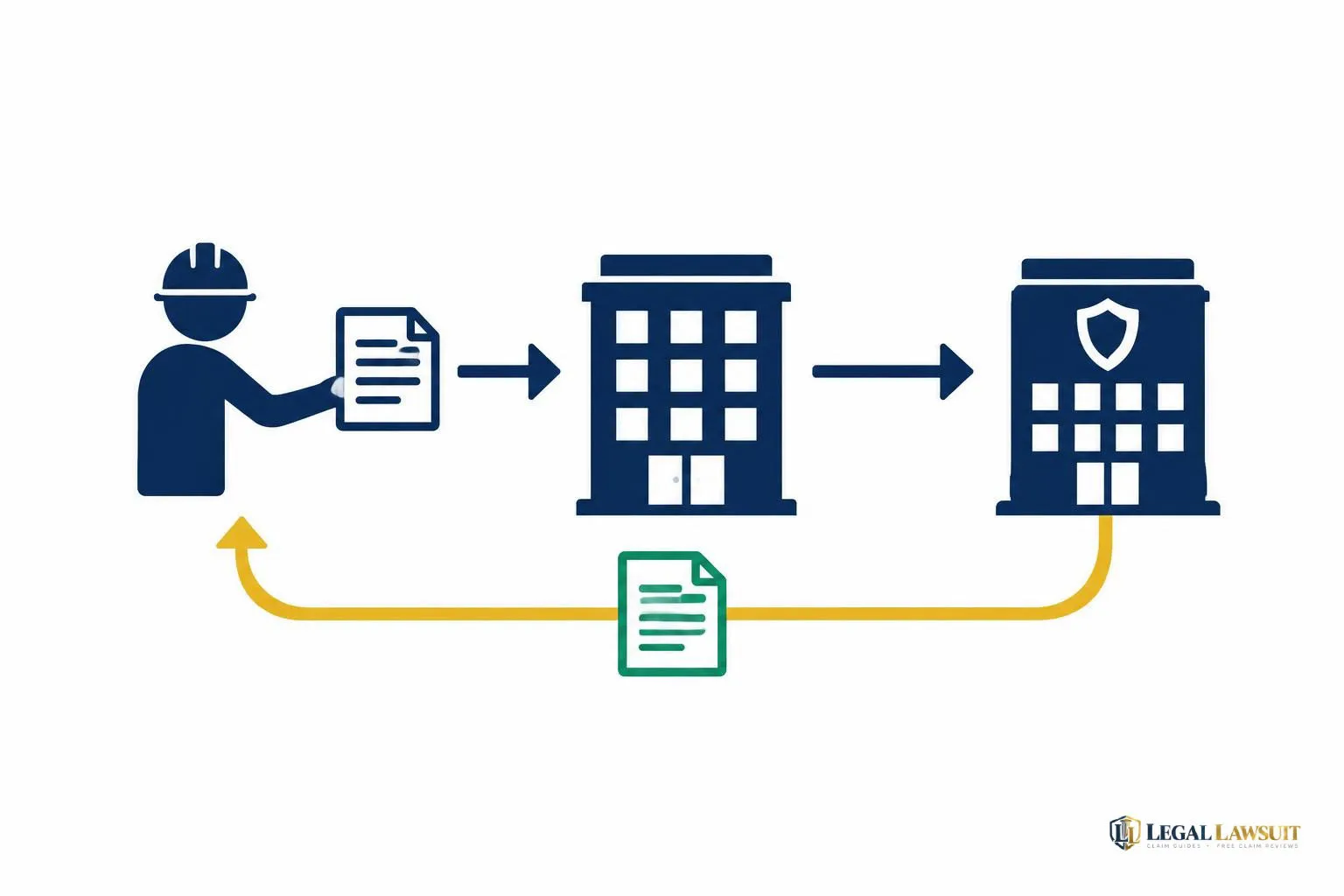
The employer’s duties and timing depend on the state. In California, the employer must provide a claim form within one working day after learning about the injury or illness. After receiving your completed form, the employer must complete its portion, give you a completed copy, and forward the form to the claims administrator within one working day. These are California employer responsibilities, not a nationwide timetable.
In Utah, the employer has seven days after receiving notice of the injury to report the claim to its workers’ compensation insurer. Ask when that report was sent and which insurer received it so you can follow Utah’s employer reporting sequence.
Keep your paperwork and follow-up messages together. For help understanding the steps beyond this initial handoff, see Legal Lawsuit’s guide to filing a workers’ compensation claim after giving notice.
If the report is late or your employer will not respond
If your report has stalled, send a short, factual written follow-up. State when and how you first reported the injury, who received the report, and what you need now—such as a claim form or confirmation of the next step. Keep a copy of your message and any delivery confirmation, email acknowledgment, or other record showing when you sent it.
Do not assume that a missed reporting date means no options remain. At the same time, do not assume that sending a follow-up fixes late notice. Ask the workers’ compensation agency in your state for guidance about your circumstances.
In California, if your employer does not provide a claim form, you can download one yourself. The state’s Information and Assistance Unit can also answer questions and help with the workers’ compensation process. See California’s employee assistance guidance for the form and ways to get help.
In Utah, an employer may not interfere with a worker’s efforts to claim workers’ compensation benefits. If an employer is blocking your report or discouraging a claim, Utah’s unlawful-interference guidance explains the protection and provides agency contact information.
If threats, discipline, or dismissal are your concern, Legal Lawsuit’s guide to retaliation concerns after reporting a work injury can help you understand the issues to raise when seeking advice.
Federal employees use a different reporting route
If you are filing a federal employee injury claim under the Federal Employees’ Compensation Act (FECA), register for the Employees’ Compensation Operations and Management Portal (ECOMP). You can initiate your claim without waiting for supervisor approval. Choose the form that matches how your condition developed: Form CA-1 is for a traumatic injury occurring during a single workday or shift, while Form CA-2 is for an occupational disease caused by work exposure over a longer period. Follow the Department of Labor’s filing and form-selection instructions.
Starting a Federal Work Injury Claim
Register
Create an ECOMP account.
Choose the form
Use CA-1 for traumatic injury or CA-2 for occupational disease, according to the Department of Labor’s definitions.
Initiate the claim
Supervisor approval is not required to start your FECA claim.
Before you begin, organize a short account of what happened. For a single incident, note the date, location, and task you were doing. For a condition that developed over time, describe the work activities or exposure you believe contributed to it. Keep this account clear and factual rather than trying to use legal language.
For a fuller walkthrough of the federal process, continue with Legal Lawsuit’s guide to how federal employees file a FECA injury claim.
Frequently asked questions
Is telling my supervisor enough, or should I report the injury in writing?
Tell your supervisor promptly, then follow up in writing so you have a record of what you reported. Do not assume a verbal conversation completes the process. For example, Utah’s Labor Commission advises reporting an injury immediately and documenting the report. Save your message and any acknowledgment, including the date and the recipient’s name.
What should I include in a work injury report email?
Include the date, time, location, and a short description of what happened and what was injured. New York’s Workers’ Compensation Board directs workers to explain when, where, and how the injury happened and provide written notice within 30 days. You can close with: “Please confirm receipt and tell me what forms or reporting steps I should complete next.”
Should a first-aid-only workplace injury still be documented?
Yes—make a written record rather than deciding that first aid makes reporting unnecessary. Note what happened, what hurt, and what first aid you received. Ask your supervisor to confirm that the incident was recorded, and keep your own copy. If you notice additional symptoms afterward, send a dated update describing them without guessing at a diagnosis.
What can I do if my employer does not give me a claim form?
In California, your employer must give or mail you a claim form within one working day after learning about your injury or illness. If you do not receive it, you can download the form or contact a Division of Workers’ Compensation Information and Assistance office. Keep a copy of your request and the completed form for your records.
Do federal employees use the same reporting forms as other workers?
No. Federal employees follow a separate process. The Department of Labor’s federal filing instructions explain how to register in ECOMP and choose Form CA-1 for a traumatic injury or Form CA-2 for an occupational disease. You can initiate a claim without your supervisor’s approval. Follow those instructions rather than assuming a state workers’ compensation form applies.
Sources
- Answers to Frequently Asked Questions About Workers’ Compensation for Employees · California Department of Industrial Relations, Division of Workers’ Compensation
- Workplace Injuries: What to Do When an Injury Happens · New York State Workers’ Compensation Board
- Injured Workers · Utah Labor Commission, Industrial Accidents Division
- How to File a Workers’ Compensation Claim if You Were Hurt on the Job (Federal Employees) · U.S. Department of Labor, Office of Workers’ Compensation Programs
This article is general information, not legal advice. Laws and deadlines vary by state and change over time; check the linked sources or speak with a licensed attorney about your situation.
Related Posts

Una guía para familias de Broward, Florida, que buscan entender los datos sobre muertes laborales y organizar sus preguntas, documentos y próximos pasos.
A workers' comp denial is usually the start of a dispute process, not the end of your claim. Here is the path most states use, from the denial letter to a judge's decision, and what to do at each step.
The 2020 Watson Grinding blast in Houston killed two workers and a neighbor. Here is what federal investigators found, and how Texas families file for workers' comp death benefits before the one-year deadline.