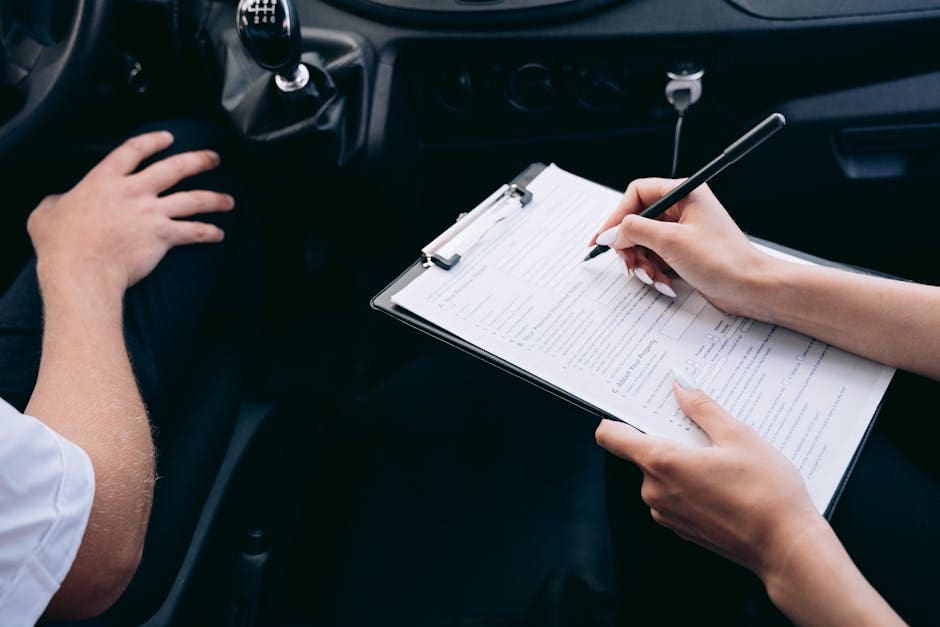
Short answer: This article explains the key facts, eligibility issues, settlement factors, deadlines, and source-backed updates related to this legal topic. Results vary by case facts, evidence, jurisdiction, and representation.
In This Guide
Why a Motor Vehicle Accident Report Matters So Much
Here is a quick breakdown of how to get a motor vehicle accident report, where it comes from and when it is due:
| Item Required | Where to Request It | Filing Timeline |
|---|---|---|
| A state-specific crash form (for example, California’s SR-1) | Your state DMV site, the local police department or your insurer | Usually 5 to 10 days after the crash, depending on the state |
| The police report or incident number | The city police department or state highway patrol | Ask for it once the crash has been reported |
| Details on every driver and vehicle | Gathered at the scene of the collision | Record it right after the crash |
| The fee for a copy | Online portal or by mail (commonly $10-15) | Paid at the time you request a copy |
A motor vehicle accident report is the official record of a traffic collision. It captures who was driving, which vehicles were involved, how the crash unfolded and, in many cases, who appears to be at fault. That single document can shape your insurance claim, your driving record and any lawsuit that follows. For most drivers, filing it is not optional paperwork; it is a legal duty, and ignoring it can carry real penalties.
National Highway Traffic Safety Administration figures suggest nearly every driver will be in at least one crash over a lifetime, and that 1 in 3 people will be hurt or killed in a collision. Given those odds, knowing how crash reporting works is basic knowledge every motorist needs.
In most states, a report is required when a crash involves:
- Someone hurt or killed
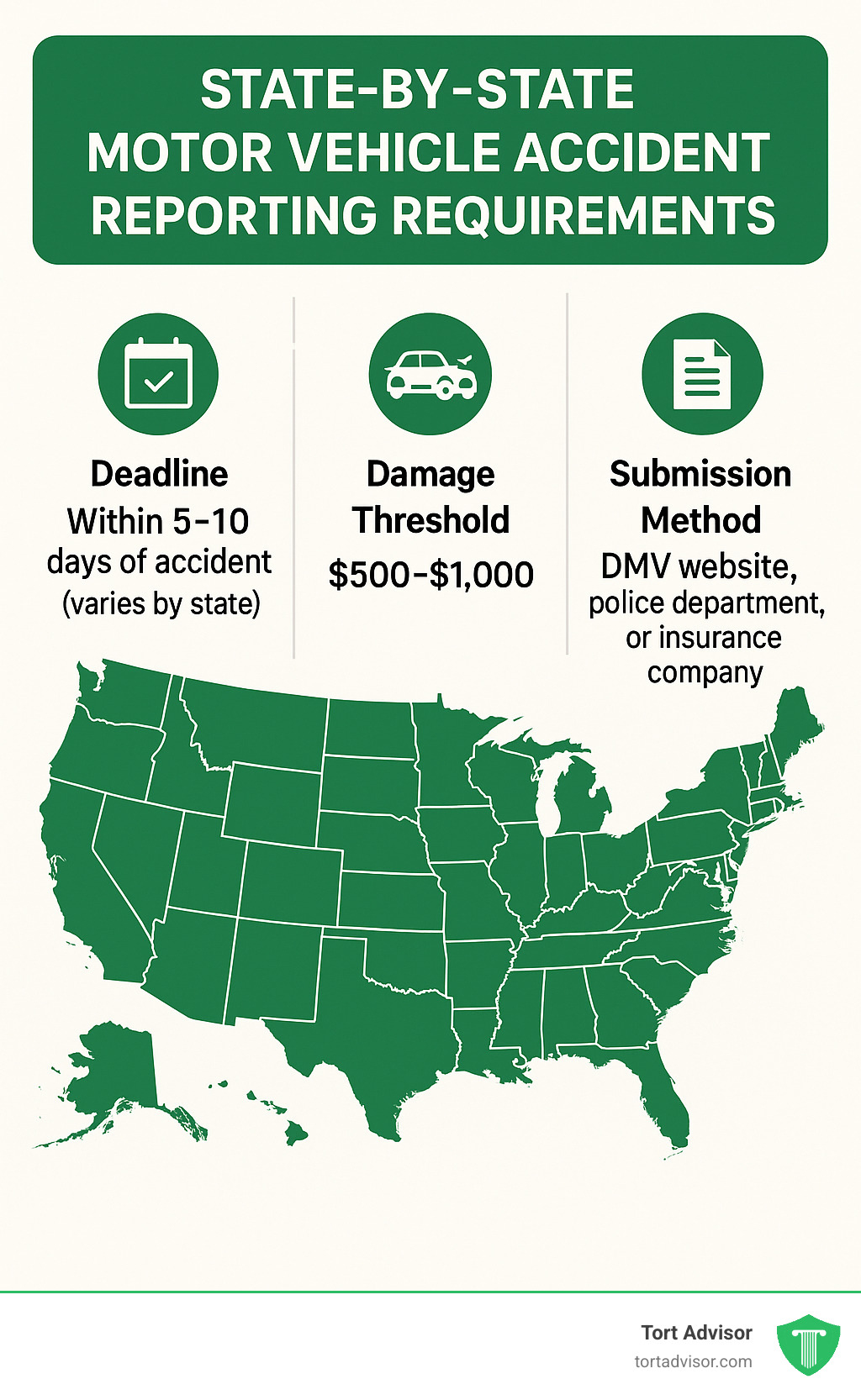
- Property damage above a state threshold (often $500-$1,000)
- A driver without insurance
- Damage to public or government property
Skipping a required report can lead to problems such as:
- License suspension
- Registration suspension
- Fines and other penalties
- Denied insurance claims
- Trouble proving fault in a legal case
I’m Mason Arnao. My background is in technology and data management, including systems much like the ones agencies use to process motor vehicle accident report data, so I know firsthand how much accurate crash documentation matters.
Who Should Read This Guide
Few drivers make it through life without a crash. The data points to almost everyone having at least one collision, and roughly one in three people being injured or killed in one. The point is not to scare you; it is to show why understanding crash reporting deserves a few minutes of your time.
There is also a compliance side. California, for instance, can suspend your license if you fail to send in a required SR-1 within 10 days. Most other states have comparable penalties, so knowing the correct reporting steps is a practical necessity rather than a nice-to-know.
Types of Crash Reports and Who Prepares Them
Right after a collision, forms are probably the last thing you want to think about. Even so, the motor vehicle accident report ranks among the most important records you will deal with, and its exact form depends on your state and the circumstances of the crash.
A crash report is essentially the official account of what happened. It may be written by the officer who came to the scene, by you for the state DMV, by your insurer, or on a federal form when a government vehicle was involved.
| Form Type | Primary Purpose | Prepared By | Typical Deadline |
|---|---|---|---|
| SR-1 (California) | DMV notification | Driver | 10 days |
| SF-91 (Federal) | Records for crashes involving government vehicles | Federal employee | Immediately |
| New York’s MV-104 | DMV notification | Driver | 10 days |
| FLHSMV Form | Crash records for Florida collisions | Driver | 10 days |
These records matter long after they are filed. They establish an official account used to sort out responsibility, they support insurance claims, they can become court evidence, and they even help officials spot dangerous intersections and road hazards.
Although they hold personal details, crash reports are not public to everyone. Access is usually limited to the people involved, their lawyers and insurers. They are a key piece of proof when liability is disputed in a Motor Vehicle Accident case.
What Exactly Is a Motor Vehicle Accident Report?
Put simply, a motor vehicle accident report is the official write-up of your crash: the who, what, when, where and how, gathered in one document.
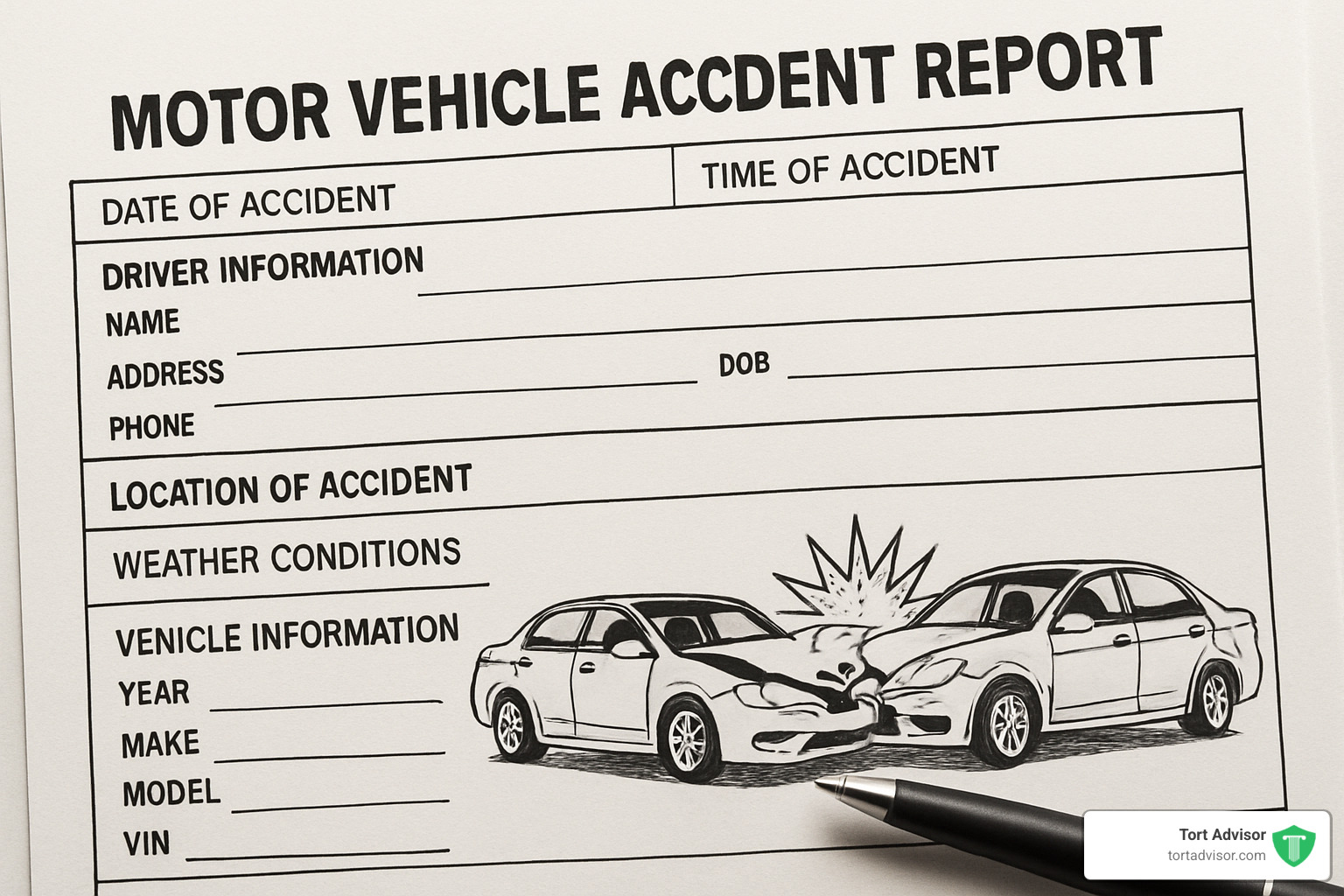
Most include the date, time and location, weather and road conditions, every driver, passenger and vehicle involved, the damage and injuries, and frequently a sketch showing where each vehicle was.
Many also contain statements from drivers and witnesses, the responding officer’s observations and, in some jurisdictions, an early opinion on fault.
Why Filing a Motor Vehicle Accident Report Is Worth It
Is filing a motor vehicle accident report really worth the effort? Yes, for several concrete reasons:
It keeps your license safe. Most states can suspend driving privileges when a required report is never filed. California is a clear example: miss the 10-day SR-1 deadline after a qualifying crash and the DMV may suspend you.
It supports your insurance claim. Without an official record, insurers may stall or deny payment for damage and injuries. The report gives an objective version of events that keeps your claim moving.
It helps make roads safer. Crash data is pooled to flag risky intersections, poor road design and traffic patterns that need attention.
It carries weight in court. If your case goes to litigation, judges and juries tend to treat the official report as a dependable account, which makes it a cornerstone of your legal protection.
Filing Duties and State Deadlines
Once the shock of a crash wears off, the next question is who has to file and how fast. In general, the duty to file a motor vehicle accident report belongs to:
- Every driver involved in the crash
- The vehicle’s owner, when an injured driver cannot file
- The employer, when a work vehicle was involved
- Government agencies, when a public vehicle was involved

Reporting becomes mandatory once certain thresholds are met. Virtually all states require a report whenever someone is hurt or killed. Damage thresholds differ a lot, with anywhere from $500 to $3,000 in property damage triggering a required filing depending on the state.
Always report a hit-and-run, no matter how small the damage; it creates an official record and protects you legally. Commercial drivers should also know that federal reporting rules may apply on top of state requirements.
Deadlines start running the moment the crash happens. Some states want serious crashes reported from the scene, while others allow a short window. Massachusetts allows just 5 days; California, Florida and New York allow 10 days; and a handful of states permit up to 30 days for certain report types.
A missed deadline is not a small slip. California can suspend your license for a late SR-1 even when the crash was not your fault, and other consequences can include fines and holds on your registration that cause trouble later.
Reporting Deadlines in Major States
Here is how several of the largest states handle crash reporting:
California: file an SR-1 within 10 days when a crash causes injury, death or more than $1,000 in property damage.
Massachusetts: report within only 5 days if there is injury, death or property damage above $1,000.
Florida: file within 10 days for any injury, death or property damage above $500.
New York: submit form MV-104 within 10 days for injury, death or property damage above $1,000.
Wisconsin: the state does not mandate a driver report, but your insurance policy almost certainly requires you to notify the insurer quickly.
Keep in mind that a police report at the scene usually does not replace your own filing with the state DMV.
Extra Requirements for Government and Commercial Vehicles
Drivers of government vehicles or commercial trucks face reporting obligations beyond those that apply to everyday motorists.
Government vehicle drivers must fill out Standard Form 91 (SF-91) after a crash. Federal agencies bring in an investigator once property damage reaches only $500, a lower bar than many states use for private drivers.
Commercial drivers carry even more responsibility. Anyone holding a Commercial Driver’s License (CDL) must tell their employer right away after any crash. Because CDL holders are held to higher safety standards, their reporting duties are stricter: federal rules call for extra documentation on commercial vehicle crashes, and most employers layer their own internal procedures on top of government requirements.
Getting, Reading and Using Your Motor Vehicle Accident Report
After a crash, you will likely need a copy of the official report for your insurer, a legal claim or your own files. The good news is that getting one is usually straightforward. Here is how to handle it with as little hassle as possible.
The Fastest Ways to Get a Copy
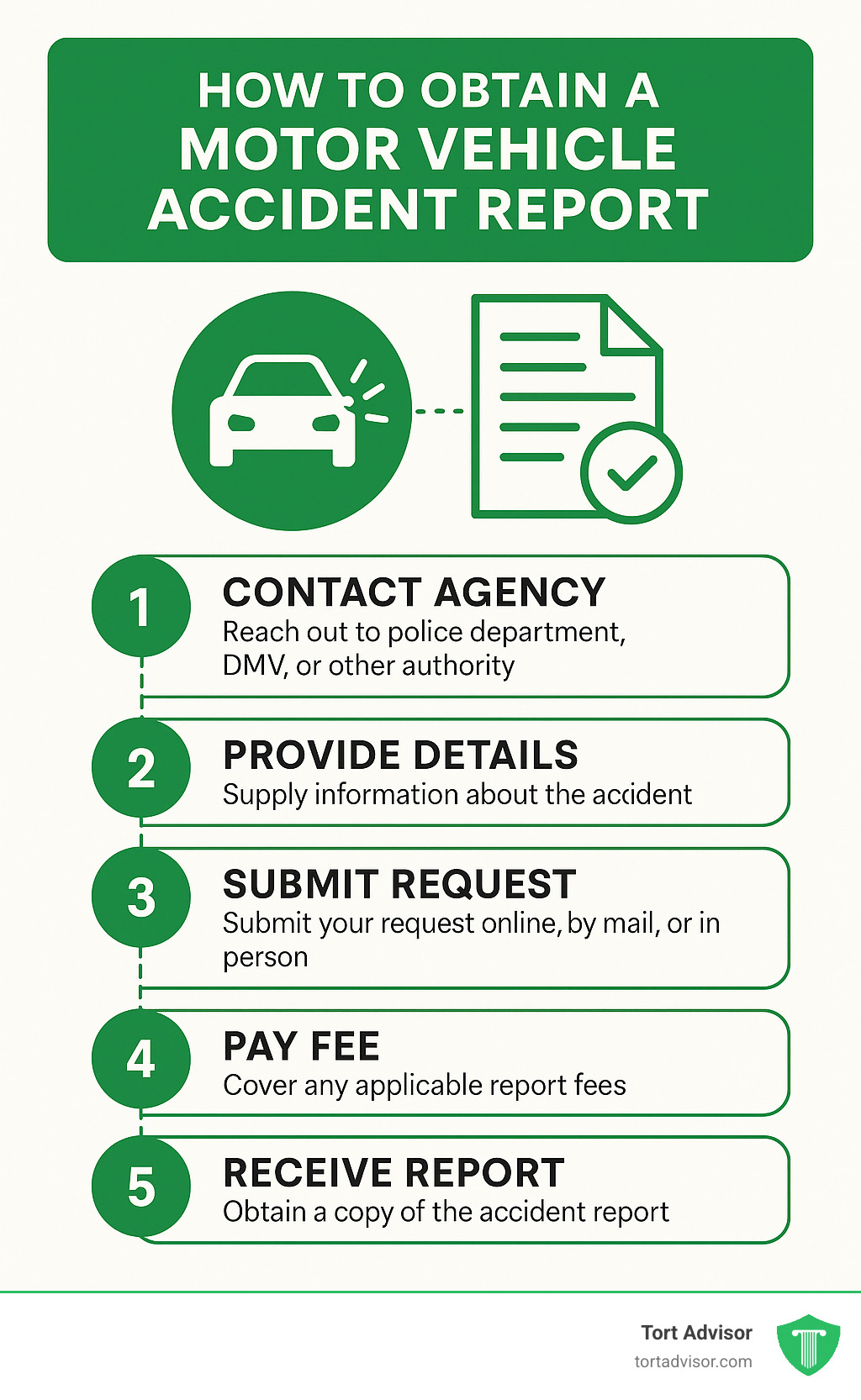
Requesting a motor vehicle accident report is far easier today than it once was. Most states now offer online options that save time:
Online portals tend to be the quickest option. Reports are commonly available through your state DMV website, your local police department’s portal or third-party services such as LexisNexis BuyCrash, which collect reports from many jurisdictions.
Florida drivers, for instance, can order reports through the Florida Highway Safety and Motor Vehicles (FLHSMV) website, and California drivers can use the state DMV portal.
Expect to pay roughly $10-15 per report at most agencies. Some places also impose a 60-day wait for people who were not directly involved. Have your name, date of birth and the report number ready when you ask.
You can also request a copy by mail or in person. Bring the crash date and location, the names of those involved, your connection to the crash and payment for any fee.
How Your Motor Vehicle Accident Report Affects Insurance
This one document has an outsized effect on your insurance. Here is how:
A motor vehicle accident report can drive up your premiums. Crashes recorded in official reports usually land on your driving record, which insurers check when setting rates. If you are found at fault, expect a higher price at renewal.
The fault finding matters a great deal. In California, any crash that law enforcement reports to the DMV appears on your record unless the officer notes that another driver was at fault. Insurers lean heavily on these findings to decide who pays.
Every detail in the report, from damage descriptions to injury notes and contributing factors, affects how your claim is handled. Adjusters study these reports closely to judge liability and coverage.
How to Correct or Add to a Motor Vehicle Accident Report
Errors happen, including on official crash forms. If your motor vehicle accident report has mistakes or leaves something out, you can usually fix it:
Many states have dedicated correction forms. California lets you attach a written statement to your SR-1, and some jurisdictions ask for a notarized statement explaining what needs to change.
You may also be allowed to submit photos, witness statements or other evidence that was not available when the report was first filed, which is especially useful if new facts have emerged.
Act quickly: most states set correction deadlines ranging from about 30 days to a year after filing. Procedures differ by state, so check with your local DMV or the agency that took the original report.
Common Errors and Crash-Scene Tips
The minutes after a crash can rattle anyone. What you do in that window has a direct effect on how easy your motor vehicle accident report will be to complete later.
Five Reporting Errors to Avoid
Blowing the deadline tops the list. Stress makes it easy to forget that your state’s filing clock is already running, so set a calendar reminder right after the crash.
Wrong insurance details cause needless delays. The three-digit NAIC codes on California forms look trivial, but an incorrect code can hold up the whole claim. Copy details straight from a current insurance card instead of working from memory.
Sloppy diagrams invite confusion. Slow down, use the standard symbols provided and show vehicle positions and movements as precisely as you can.
Surprisingly, many motor vehicle accident reports are rejected just because they were never signed. Before you submit, confirm every required signature is there; one missing line can send you back to the start.
Drivers often document only the cars and forget other property. A damaged guardrail, fence or utility pole should be recorded as well. Even minor damage can matter later in the claim or if you are also dealing with common motor vehicle accident injuries.
A Crash-Scene Checklist That Makes Reporting Easier
Your phone is the most useful tool at a crash scene. Before you leave, photograph every vehicle and all damage from several angles, then capture the wider scene: road surface, signs, weather and evidence such as skid marks or debris. Photos often preserve details your memory will lose.
Swap information thoroughly, even if it feels awkward. Go beyond names and numbers: get license details, full addresses and dates of birth. For each vehicle, note the plate, make, model, year and, if you can, the VIN. Insurance details are essential: insurer name, policy number, the NAIC code mentioned above and effective dates.
Do not let witnesses slip away. In the chaos it is easy to lose them, yet their accounts can be decisive. Get names and contact details from anyone who saw the crash, plus a quick note on what each person observed.
If officers respond, write down the officer’s name, badge number and agency, and above all ask for the report or incident number and how to get a copy. That one step can spare you hours on the phone later.
Motor Vehicle Accident Report FAQs
If the police already wrote a report, do I still have to file one?
In most states, yes. You generally must file your own motor vehicle accident report with the DMV even when officers wrote one at the scene. Many people assume the police report covers them, but the two belong to separate systems with different jobs.
The police report deals with possible traffic violations and criminal issues; your DMV report fulfills your administrative duty as a licensed driver.
California’s DMV states it directly: “even if a law enforcement officer or California Highway Patrol files a report, you must file this DMV report.” People regularly run into avoidable trouble because they assumed the officer’s paperwork was enough.
The only real exception is when an officer explicitly says the DMV report was filed for you, and that is uncommon and depends heavily on the jurisdiction and the officer.
Who is allowed to see my motor vehicle accident report?
A motor vehicle accident report is not open to the merely curious. State privacy rules restrict access to parties with a legitimate interest:
Anyone directly involved, including drivers, passengers and property owners, can obtain the report. So can their lawyers and insurers, along with government bodies such as courts and regulators.
Florida law (Florida §316.066) adds a 60-day period during which only those involved and their representatives may get crash reports. California Vehicle Code §16005 likewise limits public disclosure while letting necessary parties review the records.
If you are concerned about privacy, most states require sensitive data to be blacked out before a report is released to outsiders. Your Social Security number, for instance, would not be shown to someone without a valid need.
What if I miss the filing deadline?
Filing your motor vehicle accident report late can set off a chain of problems. How serious they are depends on your state, but none of them are good.
California’s DMV can suspend your driving privilege if the SR-1 is not filed within the required 10 days. Losing the right to drive over a late form is an entirely avoidable outcome.
You may also face fines, insurance complications including denied claims, and a harder time proving fault if a dispute comes up. Without a timely official record, your account of the crash carries less weight.
Conclusion
No one enjoys dealing with motor vehicle accident reports, least of all right after a crash. Still, understanding them is far more than red tape; it is one of the most important ways to protect yourself legally and financially.
Keep these key points in mind:
- Learn your state’s rules cold. California allows 10 days and Massachusetts just 5, and a missed deadline can cost you your driving privileges.
- Spend a few extra minutes documenting the scene. When it is time to fill out forms, you will have every detail at hand.
- File promptly. A surprising number of license suspensions and denied claims come down to nothing more than delayed paperwork.
- Save copies of everything. Photograph finished forms, scan documents and keep them in one folder on your phone or computer so you can find them weeks or months later.
Most of all, ask for help when you need it. A crash can overwhelm even the most organized person.
At Legal Lawsuit, we see accident reporting as one part of a bigger picture. We connect readers with attorneys in our network who focus on motor vehicle accidents and know how to guide people through every step.
If report requirements are confusing you, or a filing problem is causing consequences, we can help connect you with an attorney experienced in cases like yours through a free, confidential case review. We are careful about which attorneys join our network because you deserve someone who truly understands this area.
To learn more about finding the right attorney for your situation, see our Car Accident Lawsuits page.
A motor vehicle accident report can look like routine paperwork, yet it often becomes the foundation of your whole claim. Treat it seriously and fill it out carefully, and you will be in a strong position for whatever follows, whether an insurance claim or a lawsuit.
You do not have to sort this out by yourself. Legal Lawsuit is here to help you find clear legal guidance when it matters most.
Internal reference code (please disregard): xQ27vPl93zB
Additional Resources
Related Posts
Quick Answer: The Boy Scouts of America (BSA) filed for Chapter 11 bankruptcy in 2020 after facing tens of thousands [...]
Quick Answer: Survivors of sexual abuse by Catholic priests, nuns, or other Church personnel may be able to file a [...]
Quick Answer: Clergy abuse settlements vary enormously based on the severity of the abuse, the strength of evidence that the [...]