
Short answer: This article explains the key facts, eligibility issues, settlement factors, deadlines, and source-backed updates related to this legal topic. Results vary by case facts, evidence, jurisdiction, and representation.
📋 Table of Contents
Depo-Provera Claim Money Tools
Depo-Provera Settlement Calculator — Get a rough estimate of your claim’s value based on your meningioma diagnosis and injuries.
Depo-Provera Settlement Amounts — See what is publicly known about Depo-Provera case values and the factors that drive them.
Your Legal Rights After a Meningioma Diagnosis Linked to Depo-Provera
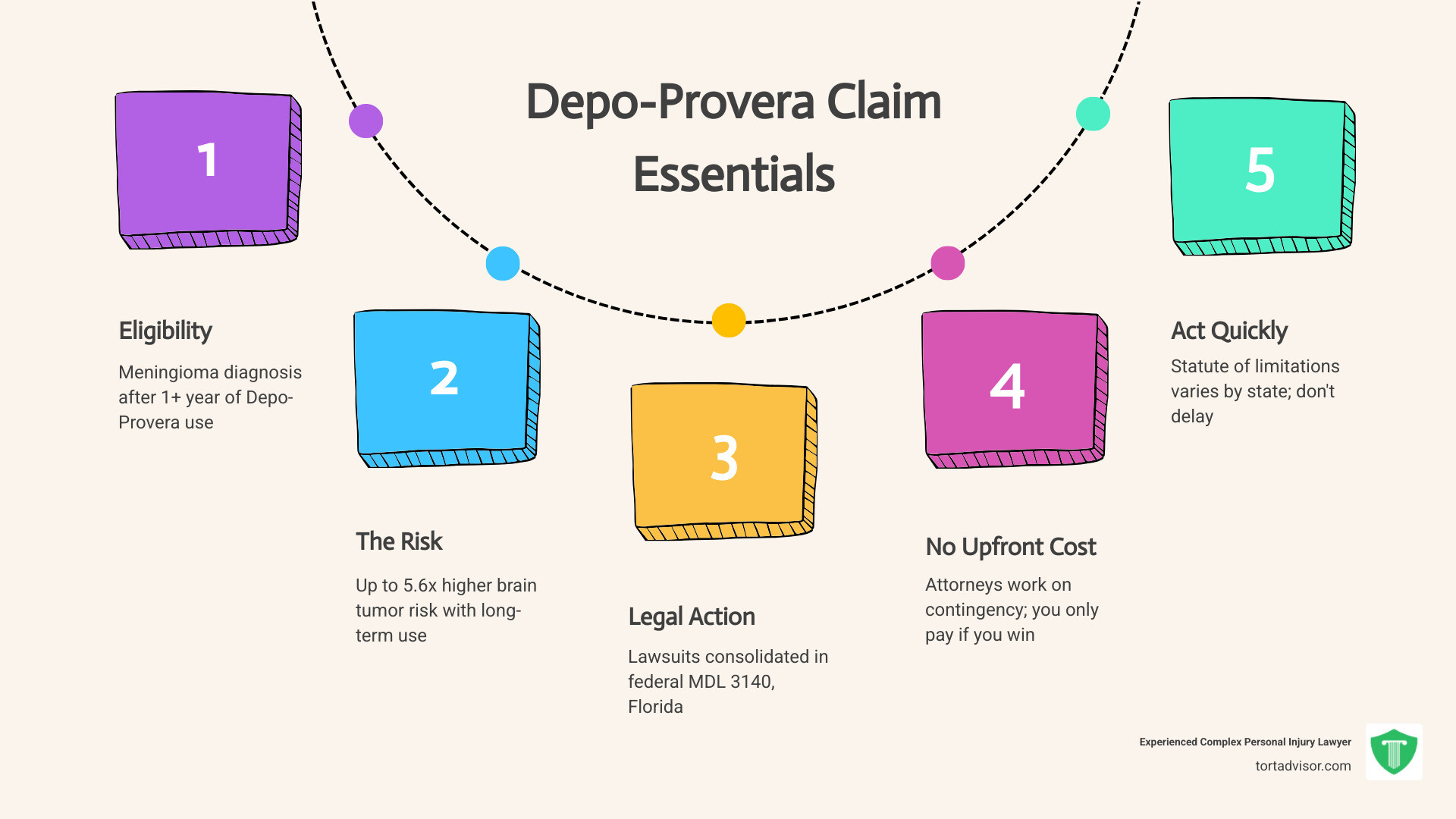
You may have a Depo-Provera injury claim if a meningioma brain tumor developed after you used this widely prescribed birth control shot. Start with the basics: Depo-Provera Claims at a Glance:
- Who May Qualify: Women diagnosed with meningioma after one year or more of Depo-Provera use
- The Risk: Research links long-term use to as much as a 5.6-fold increase in brain tumor risk
- Where Cases Are: Consolidated in federal MDL 3140 in Florida
- No Upfront Cost: Attorneys work on contingency — no fee unless money is recovered
- Deadlines: Filing windows differ by state, so move promptly
Millions of women have received Depo-Provera, an injectable contraceptive given once every 12 weeks. Recent research, however, has uncovered a worrying association between the shot and a higher chance of meningioma brain tumors — especially for women who used it for long stretches. At the heart of the litigation: plaintiffs allege that Pfizer, the maker, was aware of the risk but didn’t properly warn American patients and doctors, even as it revised warning labels abroad in countries such as Canada. If you or a loved one developed a brain tumor after Depo-Provera, you have company — thousands of women are coming forward to hold Pfizer responsible through product liability suits seeking payment for medical costs, lost income, pain and suffering, and the heavy toll these tumors take on everyday life. I’m Mason Arnao. My background is in technology and SaaS architecture, and I’ve focused on helping people make sense of complicated legal processes and connect with attorneys who handle matters like Depo-Provera injury claims. Knowing your rights is the first step toward accountability and compensation.
What the Science Says About Depo-Provera Risks
To understand a Depo-Provera lawsuit, it helps to know how the drug works and what studies have found about its dangers.
How Does Depo-Provera Work?
Depo-Provera is the trade name for medroxyprogesterone acetate (MPA), a man-made form of the hormone progestin, and is commonly known as “the shot.” It prevents pregnancy by stopping ovulation, thickening cervical mucus so sperm can’t pass, and thinning the uterine lining so a fertilized egg can’t implant. It’s given every 12 weeks — about every three months — typically in the arm or buttock. The FDA approved it in 1992, and its convenience made it common: close to one in four sexually active U.S. women used it between 2015 and 2019. Doctors also prescribe it to manage menstrual disorders, endometriosis and other hormonal conditions. It was considered a dependable option until newer research raised serious safety questions.
What Is a Meningioma?

A meningioma is a growth in the meninges, the protective layers surrounding the brain and spinal cord. They are the most frequently diagnosed primary brain tumor, making up roughly 40% of cases. Most are benign and slow-growing, yet even a non-cancerous tumor can do real damage if it grows large enough to press on the brain, spinal cord or nerves, triggering a variety of neurological symptoms. Notably for Depo-Provera users, meningiomas are more common in women than in men — a pattern that points to a hormonal role.
Research Connecting Depo-Provera and Meningiomas
The Depo-Provera–meningioma connection rests on decades of research. Since the 1980s, scientists have known that many meningioma cells carry progesterone receptors, and a 1991 Journal of Neurosurgery study found that blocking progesterone could slow tumor growth — raising the question of what happens when the body is flooded with synthetic progesterone like the kind in Depo-Provera. Recent landmark research supplied an answer. A 2024 British Medical Journal study reviewed data on more than 18,000 women who had surgery for meningioma and found that women using medroxyprogesterone acetate products (such as Depo-Provera) for over a year had a 5.6-fold higher risk of intracranial meningioma than non-users. In 2025, JAMA Neurology published “Depot Medroxyprogesterone Acetate and Risk of Meningioma in the US,” a Cleveland Clinic analysis of more than 10 million women that found long-term injectable MPA users had nearly 2.5 times the risk, rising further for women who began after age 31 or used it beyond four years. Other work points the same way: one 2024 study found MPA raised the risk of meningioma needing surgery 5.6-fold, and another found women on Depo-Provera for over a year had 3.5 times the risk of those on combination birth control pills. Specialists have increasingly stressed that patients deserve clear information about the risks of long-term contraceptive use. Taken together, these studies offer strong evidence that Depo-Provera may cause brain tumors, particularly meningiomas, and their consistency across respected journals makes the link hard to dismiss.
Meningioma Warning Signs to Watch For
Since meningiomas grow gradually, early symptoms can be mild and easy to overlook. As a tumor presses harder on the brain or spinal cord, symptoms worsen and can disrupt daily life. If you’ve had Depo-Provera, be alert for ongoing headaches that are new or getting worse, vision problems such as blurred or double vision, hearing loss or tinnitus (ringing in the ears), seizures with no prior history, and memory trouble or confusion. Other signs include weakness or numbness in the arms or legs, trouble speaking, persistent nausea and vomiting, and dizziness or balance issues. Some women also notice irregular periods or unexplained weight gain, which deserve medical attention alongside neurological symptoms. Get evaluated right away if any of these appear, particularly if they’re new or worsening. An MRI usually confirms a meningioma. Many can be removed surgically, but some are inoperable and need radiation or other treatment that can diminish quality of life. Catching it early gives you the best treatment odds and the firmest footing for a Depo-Provera injury claim.
Who Qualifies for a Depo-Provera Injury Claim?
Whether you qualify for a Depo-Provera injury claim turns on a few key factors. A meningioma diagnosis following Depo-Provera use may give you grounds to sue.
Eligibility Requirements for a Depo-Provera Lawsuit

Strong cases generally share these features. First, a documented history of Depo-Provera use — at least two injections of brand-name Depo-Provera, Depo-SubQ Provera or an authorized generic. Most important is a meningioma or other brain tumor diagnosis made during or after your use of the shot, which helps establish a possible connection. Studies show extended use carries the greatest risk: women who used Depo-Provera for a year or more face notably higher odds, and multi-year use makes a case stronger still, since the highest risks appear after more than four years. Claims involving surgery to remove the tumor or serious neurological symptoms generally carry more weight; brain surgery or severe, life-changing effects such as vision loss, seizures or memory problems strengthen a claim. Using Depo-Provera years ago doesn’t necessarily rule you out. Many states apply the “discovery rule,” under which the deadline begins only when you knew, or should have known, about the injury and its link to the drug. If you were diagnosed recently and only just learned of the connection, you may still have time to act. For more on eligibility, see our guides Who may qualify to file a Depo-Provera lawsuit? and the full Depo-Provera lawsuit criteria guide.
How Causation Is Proven in a Depo-Provera Case
Establishing causation in a product liability case is complicated, but experienced attorneys and their medical experts handle it. The legal test is whether Depo-Provera can cause meningiomas — something the research supports — and whether it’s more likely than not that it caused yours. The case starts with medical and pharmacy records that build a timeline of your injections, the onset of symptoms and your diagnosis. Next is expert testimony from oncologists, neurologists and epidemiologists explaining how medroxyprogesterone acetate (MPA) can fuel tumor growth through progesterone receptors on meningioma cells, drawing on the published causation research and other studies. Last comes differential diagnosis: Pfizer will argue something else caused your tumor, and your legal team methodically eliminates those alternatives using your medical history and expert analysis to show Depo-Provera is the most probable cause. Attorneys in our network understand this process and how to build a thorough case showing Pfizer’s product caused your harm.
Can I File If I Used Generic Depo-Provera?
People often ask whether a generic shot counts. It can. The litigation covers generic products containing medroxyprogesterone acetate (MPA) because the active ingredient and its risks are identical. Under a doctrine called innovator liability, recognized in a number of states, you may be able to sue the original brand maker (Pfizer) even if you received a generic, since generic makers depend on the brand company’s research and warning labels; if Pfizer’s warnings were inadequate, it can be held liable for harm from generics too. Some generics are “authorized generics” — exact copies of Depo-Provera, sometimes produced in Pfizer-owned plants — and companies such as Greenstone LLC and Prasco Labs are frequently named alongside Pfizer. Whether you received brand-name Depo-Provera, Depo-SubQ Provera or a generic, you may have a claim; what matters is the active ingredient and the alleged failure to warn. Learn more about how these cases are organized on our Depo-Provera lawsuits page.
Taking Legal Action Against Pfizer
Going up against a drug company the size of Pfizer can feel daunting, but an experienced attorney can walk you through every step.
Your Options: Suing Pfizer Over Depo-Provera
If a meningioma developed after you used Depo-Provera, you can bring a product liability suit against Pfizer, which holds the rights to the drug. The central allegation is failure to warn — that Pfizer knew or should have known about the heightened brain tumor risk but didn’t adequately alert American women and their physicians. The contrast is stark: Depo-Provera labels in Canada and Europe have carried meningioma warnings for years, while U.S. prescribing information said nothing about it, which plaintiffs argue shows Pfizer understood the danger yet withheld the same warning in the U.S. Suits also claim negligence — carelessness in designing, testing or marketing the drug — and strict product liability, which makes manufacturers answerable for harm from defective products. Pursuing a Depo-Provera injury claim against a major drug maker takes specialized legal skill, so connecting with an experienced Depo-Provera Injury Lawyer is a key step.
Depo-Provera Lawsuit Update: Where the MDL Stands

Federal Depo-Provera cases have been grouped into Multidistrict Litigation (MDL). An MDL is not a class action: rather than merging everyone into a single case, it gathers many individual suits before one court for pretrial matters while each case stays separate and keeps its own value — important because injuries differ in severity. On February 7, 2025, the Judicial Panel on Multidistrict Litigation created MDL 3140 IN RE: Depo-Provera (Depot Medroxyprogesterone Acetate) Products Liability Litigation, centralizing all federal cases in the U.S. District Court for the Northern District of Florida before Judge M. Casey Rodgers. The docket has grown fast: as of October 22, 2025, 1,785 women had sued Pfizer, with 1,346 cases in the federal MDL, up from 435 that July, and plaintiffs’ attorneys reported close to 10,000 claims not yet filed — so many more women may join. As the MDL moves forward, the court is expected to choose a handful of cases for bellwether trials, test runs that show how juries respond to the evidence and often steer settlement talks for everyone else. For the latest developments, see our Depo-Provera lawsuit updates page.
Depo-Provera Claim Deadlines: The Statute of Limitations
Every claim carries a filing deadline known as the statute of limitations, and missing it can end your right to compensation no matter how strong your case is. The period differs by state, usually one to three years for product liability claims, so knowing your state’s rule is essential. For injuries that aren’t obvious right away — such as a slow-growing brain tumor — many states use the “discovery rule,” starting the clock only when you learned of the injury and its likely tie to Depo-Provera. Because the connection became widely known only through studies published in 2024 and 2025, many women are just now realizing their tumor may be related to their birth control. The discovery rule can help, but it isn’t guaranteed: courts read it differently, and some states impose “statutes of repose” that set hard outer limits. The safest move is not to wait. Talking with an attorney early protects your rights and keeps your claim on schedule. With a Depo-Provera injury claim, timing truly matters, and acting now could make the difference.
Pursuing Accountability and Compensation
For anyone who developed a meningioma after Depo-Provera, a Depo-Provera injury claim is about more than a payout — it’s about making a negligent manufacturer answer for the harm and securing the justice you’re owed.
What Compensation a Depo-Provera Claim Can Include
A Depo-Provera injury claim seeks payment for the real harm you’ve suffered, aiming to restore you as fully as possible after a life-changing diagnosis. Damages generally fall into three groups. Economic damages cover concrete financial losses such as bills for diagnosis, surgery, radiation and ongoing care — costs that can be substantial — along with lost income, whether you missed work for treatment or had to leave your job because neurological symptoms made it impossible. Non-economic damages address harms that are harder to measure but just as real: physical pain and suffering from headaches, seizures, vision loss and other symptoms; emotional distress such as the anxiety and depression that often follow a brain tumor diagnosis; and diminished quality of life when you can no longer enjoy favorite activities or sustain important relationships. In some cases, punitive damages may be awarded — not to compensate you, but to punish especially egregious conduct, such as allegedly warning patients abroad while keeping American women in the dark — sending a clear message that corporate negligence has consequences. Each case is different, and value depends on factors like how serious the tumor is, whether surgery was needed, your age and earning capacity, and your continuing medical needs. For a better sense of potential value, try our Depo-Provera settlement calculator and read the in-depth Depo-Provera lawsuit compensation guide.
How Pfizer Is Defending the Cases: Preemption
Pfizer has vast resources and a powerful legal team, and it won’t make these cases easy. A main line of defense is preemption: the argument that because the FDA approved Depo-Provera and its label, Pfizer can’t be liable under state law for failing to warn — in other words, that federal rules override state product liability law and compliance with FDA requirements should shield the company. That argument has real weak spots. Manufacturers have a continuing duty to monitor their products and strengthen warnings as new safety data emerges, so if Pfizer knew or should have known about the meningioma risk and didn’t inform the FDA or seek a label change, preemption may not protect it. Even more important, Pfizer added meningioma warnings in Canada and Europe but not in the U.S., which plaintiffs say shows awareness of the danger and a choice not to warn American women. Plaintiffs’ lawyers plan to answer preemption with evidence that Pfizer had risk information long before acting, didn’t carry out adequate post-market monitoring and put profits ahead of patient safety; the gap between foreign and U.S. labels is especially powerful. For more on how these disputes are playing out, see what’s the legal status of the Depo-Provera lawsuits?
What Does a Depo-Provera Lawyer Cost?
A top worry for anyone considering a lawsuit is whether they can afford a lawyer. Pursuing a Depo-Provera injury claim costs nothing up front. Attorneys in our network work on contingency, so you owe nothing unless your case settles or wins; the fee comes out of the recovery as a percentage, often around 33–40% depending on whether the case settles or goes to trial. That lets you take on a company like Pfizer without worrying about legal bills piling up. You also won’t pay up front for filing fees, experts, medical records or other case expenses — the attorney advances them and is repaid only if the case succeeds, so the financial risk sits with the attorney, not you. You can also request a free, confidential case review with no obligation, in which an experienced attorney looks at your situation, explains your options and tells you whether you appear to have a viable claim, at no cost. Contingency fees exist for precisely these cases, where people harmed by big corporations need access to justice without money standing in the way. You shouldn’t have to choose between pursuing compensation and paying your bills — and with attorneys in our network, you don’t have to.
Depo-Provera Injury Claim FAQs
Who is eligible for a Depo-Provera lawsuit?
People who used Depo-Provera for a long period — usually a year or more — and were later diagnosed with a meningioma brain tumor may be eligible. An attorney can check your medical and injection records to confirm.
What is the deadline to file a Depo-Provera claim?
It depends on your state’s statute of limitations for product liability and personal injury cases, which usually runs from the diagnosis date. Waiting too long can permanently bar the claim, so talk to an attorney soon.
Is there a Depo-Provera settlement yet?
As of mid-2026, Pfizer had reached a global agreement in principle (June) and signed a Master Settlement Agreement for eligible claims (July). Cases remain consolidated in MDL No. 3140 in the pretrial stage, and bellwether trials are expected to influence future settlement talks. Check the latest updates, as this can change quickly.
Will I have to pay anything to start a claim?
Most attorneys who handle Depo-Provera cases charge on contingency, so nothing is due up front and fees are owed only if the case produces a settlement or verdict.
Related Posts
Quick Answer: The Boy Scouts of America (BSA) filed for Chapter 11 bankruptcy in 2020 after facing tens of thousands [...]
Quick Answer: Survivors of sexual abuse by Catholic priests, nuns, or other Church personnel may be able to file a [...]
Quick Answer: Clergy abuse settlements vary enormously based on the severity of the abuse, the strength of evidence that the [...]