
Short answer: This article explains the key facts, eligibility issues, settlement factors, deadlines, and source-backed updates related to this legal topic. Results vary by case facts, evidence, jurisdiction, and representation.
What This Guide Covers
- Why Recognizing Brain Tumor Warning Signs Could Save Your Life
- What is Depo-Provera and Its Link to Brain Tumors?
- A Comprehensive Guide to Depo-Provera Brain Tumor Symptoms
- What to Do If You Suspect a Depo-Provera Related Brain Tumor
- Pfizer’s Failure to Warn and Your Legal Options
- Frequently Asked Questions about Depo-Provera Brain Tumor Symptoms
- Taking Control: Your Next Steps After a Meningioma Diagnosis
Depo-Provera Lawsuit Money Tools
Depo-Provera Settlement Calculator — See which factors, such as your diagnosis and treatment, may shape the value of a claim.
Depo-Provera Settlement Amounts — Learn what is known so far about how Depo-Provera claims may be valued and resolved.
Why Spotting Brain Tumor Warning Signs Early Can Protect Your Life
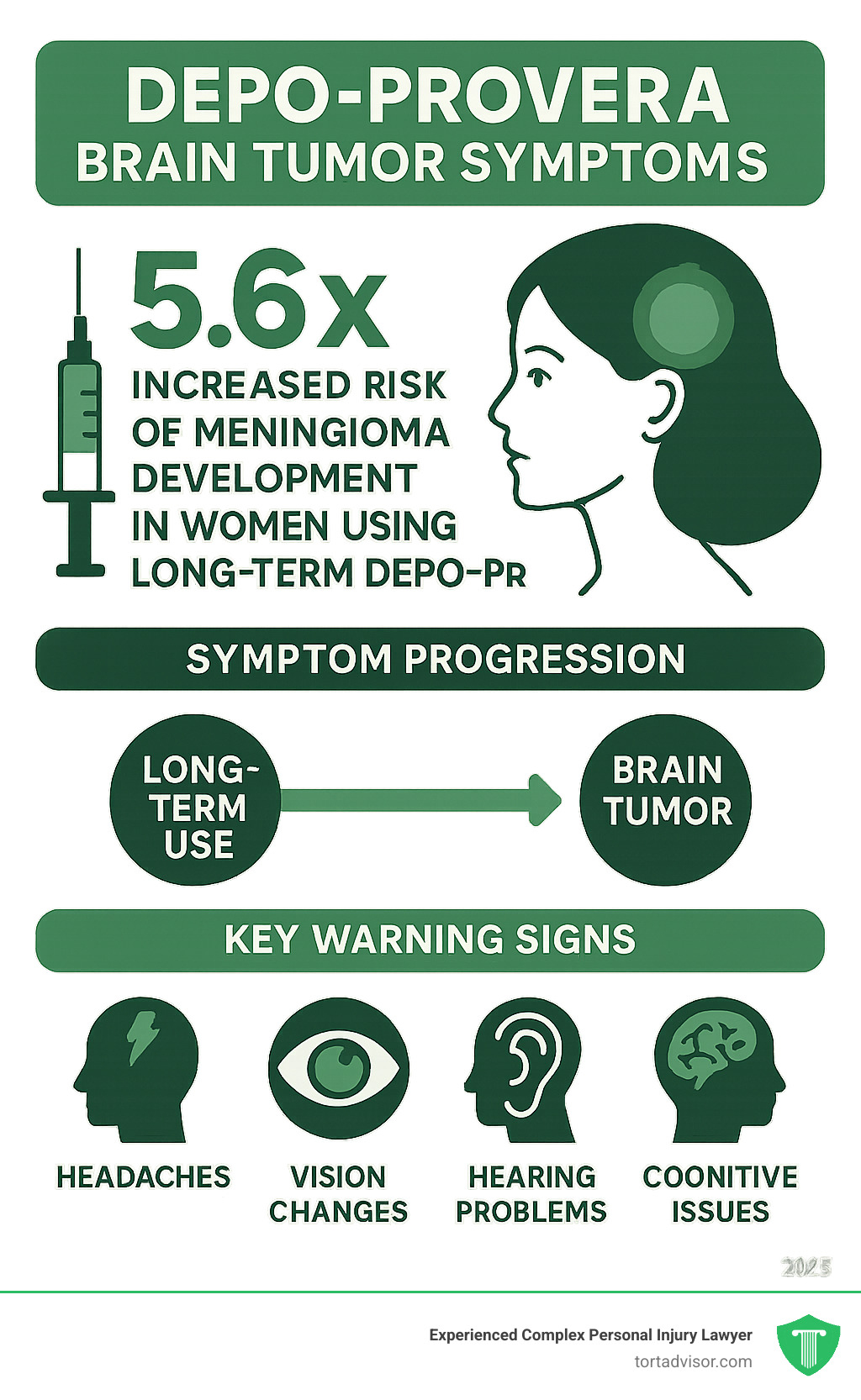
Depo provera brain tumor symptoms can be easy to miss, yet dangerous if ignored. Research published in 2024 found that women who used this contraceptive injection for more than a year had a 5.6 times higher risk of meningioma, a type of brain tumor. Depo-Provera Brain Tumor Symptoms to Watch For:
- Ongoing headaches that get worse when you lie down
- Changes in vision, such as blurring or seeing double
- Hearing loss or ringing in the ears (tinnitus)
- Memory lapses and trouble focusing
- Seizures or tremors with no clear cause
- Numbness or weakness in the face, arms, or legs
- Dizziness or trouble with balance
Because meningiomas grow slowly, symptoms may not show up until a year or more of Depo-Provera use. Notably, at the time lawsuits were filed, Pfizer’s labels in Europe and Canada warned of brain tumor risk while the U.S. label did not. In one reported case, a woman who used Depo-Provera for almost 20 years developed memory loss and headaches, and an MRI found a brain tumor that needed major surgery. Helping injured people connect with qualified attorneys has taught me how much early recognition matters — it can separate a treatable problem from a life-changing one.
Key terms related to depo provera brain tumor symptoms:
- Depo Provera severe side effects
- Depo Provera injury lawyer
- Depo Provera lawsuit compensation
What Is Depo-Provera, and How Is It Linked to Brain Tumors?
Anyone who has received Depo-Provera deserves to understand its risks. Millions of women count on the shot for birth control, but newer research has found a worrying association between long-term use and brain tumors. Here is what is currently known.
How the Birth Control Shot Works
Depo-Provera is a hormonal contraceptive injection given once every three months. Its single active ingredient, medroxyprogesterone acetate, is a synthetic progestin that stops ovulation and thickens cervical mucus. Its convenience has made it popular with millions of women around the world, but researchers suspect the same hormone may encourage brain tumor growth in some users. For a broader look at health effects, see our resource on Depo-Provera Severe Side Effects.
What Exactly Is a Meningioma?
A meningioma is a tumor that forms in the meninges, the protective membranes covering the brain and spinal cord. Most are benign (non-cancerous) and slow-growing, but benign does not mean harmless. The skull leaves no room to expand, so even a slow tumor can press on brain tissue, nerves, and blood vessels, and that pressure produces depo provera brain tumor symptoms. A meningioma can grow for years before causing problems, sometimes becoming quite large first. The Mayo Clinic’s overview of meningiomas explains in detail how they develop.
What Research Says About Depo-Provera and Meningiomas
Serious medical research supports the link. A March 2024 study in the British Medical Journal found that women who used Depo-Provera for longer than one year had a 5.6 times greater risk of meningioma than women who did not, with risk climbing as use continued. Scientists think meningiomas respond to progesterone, and Depo-Provera delivers a large dose of a synthetic form of that hormone — a bit like feeding fertilizer to a weed. Adding to concerns, Pfizer, which makes Depo-Provera, had added brain tumor warnings to labels in Europe and Canada but not, at that time, for U.S. patients. The full findings are available in the British Medical Journal study. The research has raised hard questions about drug-company transparency, and our article Does Depo-Provera Cause Brain Tumors? explores them further. The key point: the evidence is worrying, and if you have neurological symptoms and a history of Depo-Provera use, it is time to see a doctor.
Depo-Provera Brain Tumor Symptoms: A Complete Overview
Knowing the depo provera brain tumor symptoms matters because they often resemble common, everyday complaints that are easy to brush off. Since meningiomas grow slowly, the signs tend to build gradually over years as the tumor increases pressure inside the skull and interferes with normal brain function.

Early and Frequent Warning Signs
Among the first signs are ongoing headaches that feel stronger than usual and worsen when lying down, sometimes appearing as new or different migraines. Vision changes are another major warning, including blurred or double vision or partial loss of sight. Ear symptoms can include slowly worsening hearing loss, tinnitus, and dizziness or balance trouble. Repeated nausea and vomiting, particularly alongside headaches, may also point to rising pressure in the skull.
Neurological and Cognitive Symptoms of a Depo-Provera Brain Tumor
As a meningioma enlarges, symptoms can become more alarming. A first-ever seizure is a serious red flag, and some people develop tremors with no explanation. Weakness, numbness, or tingling often affects only one side of the body as the tumor presses on particular nerve pathways. Cognitive changes can be especially upsetting, starting with small memory lapses and advancing to real confusion and trouble concentrating, like living in a fog. Personality shifts, mood swings, and depression may also appear, often more intense than ordinary hormonal changes. Our article on the Depo Shot Brain Tumor covers these brain-related symptoms in more detail.
When Do Symptoms Start After Beginning Depo-Provera?
One difficulty is that depo provera brain tumor symptoms are delayed. Because meningiomas grow so slowly, symptoms generally take a year or longer to surface, with the synthetic hormone gradually fueling growth. Studies show risk rises meaningfully after one year of use and continues to climb with longer use, so you may notice subtle changes, such as more frequent headaches or vision problems, well after your first injections. Because onset is gradual, keep track of changes in your health; a symptom diary can be very helpful to your doctor. For more on how and when these symptoms develop, see our guide with More info on the Depo Shot Brain Tumor.
What to Do If You Think Depo-Provera Caused a Brain Tumor
Worry is natural if you are noticing depo provera brain tumor symptoms, and acting promptly can make a real difference in diagnosis and treatment.
Immediate Steps
Put your health first. If you suspect a Depo-Provera-related tumor:
- See a Healthcare Provider: Make an appointment and explain both your symptoms and your Depo-Provera history.
- Don’t Stop Without Medical Guidance: Quitting abruptly can cause other problems, so follow your doctor’s advice.
- Keep a Symptom Diary: Record when each symptom began, how often it happens, and how severe it is — your doctor will find this very useful.
- Write Down Your Injection History: Be prepared to share when and how often you received the shot.
How Meningiomas Are Diagnosed and Treated
Diagnosis starts with your medical history and a neurological exam that checks vision, hearing, balance, and thinking. Imaging is the main diagnostic tool:
- MRI (Magnetic Resonance Imaging): Produces detailed images showing the tumor’s size and position. Read more about magnetic resonance imaging (MRI).
- CT (Computed Tomography) Scan: Sometimes used as well.
- Biopsy: A small sample of tissue may be removed to determine the tumor’s grade.
Treatment is guided by the tumor’s size, location, and how fast it is growing:
- Active Monitoring (“Watch and Wait”): Small tumors without symptoms may simply be tracked with periodic MRIs.
- Surgery: The main treatment for tumors that cause symptoms or keep growing.
- Radiation: Used after surgery to destroy leftover cells, or when surgery is not an option.
Long-Term Outlook and Possible Complications
Even though most meningiomas are benign, where they sit can lead to serious complications. Lasting effects depend on the tumor’s size and location and on the treatment used, and some patients live with ongoing memory problems, motor difficulties, or chronic headaches that affect daily life. The outlook is usually good, particularly when a benign tumor is fully removed, and many people live for decades afterward. Regular follow-up is still important to catch any recurrence, and recovery can be hard, so support from others matters.
Pfizer’s Alleged Failure to Warn and Your Legal Options
If you are living with depo provera brain tumor symptoms after using this contraceptive, you deserve to know your legal rights.

What Lawsuits Claim Pfizer Did
A central issue is that Depo-Provera packaging in Canada and the UK warned about brain tumors while U.S. labeling, at the time the lawsuits were filed, did not. Canadian labels have referenced meningiomas for nearly ten years. Plaintiffs’ lawyers contend that Pfizer knew about the tumor risk but did not tell U.S. patients, as Bloomberg Law reported: Pfizer accused of hiding tumor link. Women therefore made choices without complete information, which forms the basis of a “failure to warn” claim. U.S. labeling may have changed since; check the current label for the latest.
How a Depo-Provera Lawsuit Works
If you developed a brain tumor after using Depo-Provera, you may have a product liability claim based on the argument that Pfizer did not adequately warn U.S. patients about known risks. You may qualify if you received Depo-Provera for a year or longer and were later diagnosed with an intracranial meningioma; our Depo-Provera Lawsuit Criteria Guide explains more. Filing deadlines (statutes of limitations) matter and can be as short as one year from when you discovered the connection, so act promptly. These cases are coordinated in multidistrict litigation (MDL), which keeps each case separate while grouping similar ones for efficiency. See What’s the Legal Status of the Depo-Provera Lawsuits? for more.
What Damages Can a Lawsuit Seek?
A lawsuit aims to address everything the diagnosis has cost you. Medical costs are a large part, covering past and future scans, surgery, and therapy, along with lost income and reduced future earning power. Damages for pain and suffering, emotional distress, and lost enjoyment of life account for the non-financial harm, and punitive damages may be possible where a company acted with gross negligence. Families who lost a loved one may pursue wrongful death claims. Every case is different; our Depo-Provera Settlement Amounts Lawsuit Guide explains more. Most injury attorneys work on contingency, so there is no fee unless they recover money for you.
Depo-Provera Brain Tumor Symptoms: Common Questions
Worrying about depo provera brain tumor symptoms can be overwhelming. These answers address the questions people ask most.
Can Depo-Provera lead to cancerous brain tumors?
Nearly all meningiomas associated with Depo-Provera are benign (Grade 1) — slow-growing and not cancerous. A small share can be more aggressive: atypical (Grade 2) or, rarely, malignant (Grade 3). The main BMJ study did not specifically report cancerous tumors among users, but even a benign brain tumor can cause serious health problems because of pressure inside the skull.
Should I keep using Depo-Provera?
Make this decision together with your doctor. Talk through your health history, how long you have received the shot, and any symptoms you have. Your doctor can help you weigh benefits against risks for your circumstances and suggest alternative birth control methods if needed, so you can decide with all the facts in hand.
What does it cost to file a Depo-Provera lawsuit?
Filing should not cost you anything out of pocket. Most injury attorneys, including those in the Legal Lawsuit network, work on contingency: there are no upfront charges, and the fee is a percentage of any settlement or verdict. If the case does not succeed, you owe nothing, so you can pursue justice without financial risk.
Your Next Steps After a Meningioma Diagnosis
A meningioma diagnosis is overwhelming, especially when it may be tied to a medication you trusted. But you still have power here, and information is your strongest tool. Knowing that long-term Depo-Provera users face a 5.6 times higher meningioma risk can guide your next decisions. Catching depo provera brain tumor symptoms early is crucial — persistent headaches, vision changes, and memory problems should not be ignored, and now you know what to look for. Reach out to your medical team right away about worrying symptoms; most meningiomas are treatable, and early care can greatly improve your outlook. You have legal rights as well. Lawsuits allege Pfizer warned patients abroad about tumor risk but not in the U.S., and companies can be held responsible for failing to warn. Legal Lawsuit is a legal-information site that helps people understand these claims and connect with attorneys in our network who handle complex drug injury cases through a free, confidential case review. A claim can help you recover medical costs, lost pay, and compensation for suffering, and it reinforces that patient safety must come first. The next step is straightforward. Connect with an experienced Depo-Provera injury lawyer through our network to review your situation and explain your options. Learning about your rights was the first step; let us help you with the next.
Related Posts
Quick Answer: The Boy Scouts of America (BSA) filed for Chapter 11 bankruptcy in 2020 after facing tens of thousands [...]
Quick Answer: Survivors of sexual abuse by Catholic priests, nuns, or other Church personnel may be able to file a [...]
Quick Answer: Clergy abuse settlements vary enormously based on the severity of the abuse, the strength of evidence that the [...]