Short answer: This article explains the key facts, eligibility issues, settlement factors, deadlines, and source-backed updates related to this legal topic. Results vary by case facts, evidence, jurisdiction, and representation.
📋 Table of Contents
Roundup Lawsuit Verdicts and the Billion-Dollar Fight Against Bayer
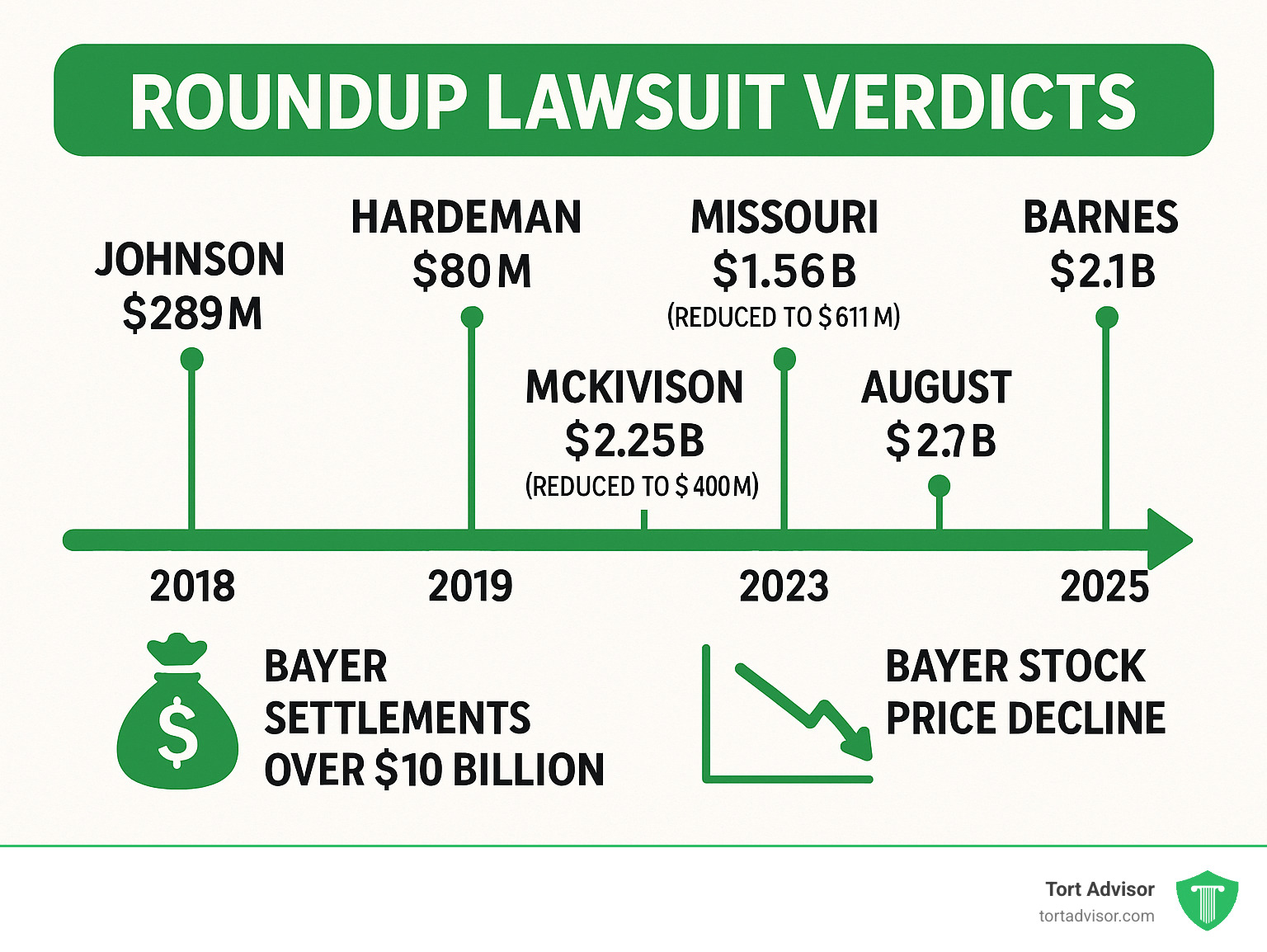
Each major Roundup lawsuit verdict has rattled corporate America, as juries have awarded billions to people who say the well-known weed killer gave them cancer. The largest verdicts to date:
Biggest Roundup Lawsuit Verdicts:
- $2.25 billion – McKivison (Philadelphia; later cut to $400 million)
- $2.1 billion – Barnes (Georgia)
- $2.055 billion – Pilliod (California)
- $1.56 billion – Missouri plaintiffs (later cut to $611 million)
- $289 million – Johnson (California; the first verdict)
Bayer’s $63 billion purchase of Monsanto in 2018 came with what CEO Bill Anderson would later call an “existential threat”: thousands of lawsuits alleging that glyphosate, Roundup’s active ingredient, causes non-Hodgkin’s lymphoma. Although Bayer has won 17 of the last 25 trials, the huge losses have driven more than $10 billion in settlements and forced the company to reserve billions more for future claims.
These jury awards mean more than dollar figures; they reflect findings that Monsanto didn’t warn consumers about possible cancer risk and, in some cases, acted with “malice and oppression.”
I’m Mason Arnao. My background in technology and data management has let me follow Roundup lawsuit verdict trends and outcomes closely as they reshaped corporate liability, and I use that data experience to turn complicated legal developments into clear, practical information for people seeking justice.
Roundup lawsuit verdict related topics:
- average Monsanto settlement
- Roundup settlement payout
- when will i get my roundup settlement check
The Largest Roundup Plaintiff Verdicts
When jurors hear the human stories behind a Roundup lawsuit verdict, the awards have been anything but modest. Some have climbed into the billions, a strong statement about corporate accountability and what cancer does to families.
The figures show juries that weighed the evidence and concluded Monsanto’s alleged failure to warn deserved real consequences. Here are the cases that grabbed headlines and alarmed boardrooms.
The $2.25 Billion McKivison Roundup Lawsuit Verdict
One of the most stunning Roundup lawsuit verdict awards came in Philadelphia in John McKivison’s case. The jury awarded $250 million in compensatory damages for his suffering and losses and then added a punitive award that grabbed every executive’s attention: $2 billion.

The jury plainly found Monsanto’s failure to warn about possible cancer risk unacceptable. As is common with huge punitive awards, a judge later lowered the total to $400 million, but the verdict still stands as a forceful statement on corporate responsibility.
Courts have safeguards to keep punitive damages proportionate, yet $400 million remains a life-altering sum that signals serious wrongdoing in the jury’s view.
The $2.1 Billion Barnes Verdict in Georgia
A Georgia jury connected with John Barnes, who developed non-Hodgkin’s lymphoma, and awarded him nearly $2.1 billion: $65 million in compensatory damages plus $2 billion in punitive damages, making it one of the biggest verdicts for a single plaintiff in Roundup litigation.
This Roundup lawsuit verdict was about more than money. It showed the jury believed Roundup use was genuinely linked to Barnes’ cancer, and the large punitive award reflected their view that Monsanto’s behavior deserved severe consequences.
The $2.055 Billion Pilliod Verdict
Some of the most moving cases involve couples. Alva and Alberta Pilliod of California both developed non-Hodgkin’s lymphoma after spraying Roundup on their property for decades, believing it was as harmless as “sugar water.”
Years of steady exposure formed the basis for a $2.055 billion verdict: $55 million compensatory and $2 billion punitive. Jurors heard how the couple was never given the chance to make an informed decision about the risk.
The case resonated because it showed that cancer harms whole families, not just one person, especially when they believed the product was safe.
The $1.56 Billion Missouri Verdict
In Cole County, Missouri, three plaintiffs took on Monsanto’s lawyers. The trial judge reduced the original $1.56 billion award to $611 million, and the Missouri Court of Appeals then issued an important finding about Bayer’s conduct.
The court found Bayer’s conduct highly reprehensible, meaning the judges viewed it as especially egregious. Even after the reduction, $611 million is an enormous penalty and a clear judicial message on accountability.
Together, these verdicts reveal a pattern: juries in different states keep reaching similar conclusions about Monsanto’s duty to warn of possible cancer risk.
Recent Roundup Lawsuit Verdict Trends
Some early Roundup lawsuit verdict numbers were astonishing, but the litigation keeps evolving, with huge plaintiff wins mixed with more recent defense victories for Bayer. Following these trends gives a clearer view of where things stand.
Breaking Down the $611 Million Missouri Roundup Lawsuit Verdict
A Missouri appeals court upheld the $611 million Roundup lawsuit verdict for Daniel Anderson, Jimmy Draeger, and Valorie Gunther, an important development. On appeal, Bayer (Monsanto) argued the trial court erred by allowing testimony about a ruling from the 9th U.S. Circuit Court of Appeals in San Francisco in a different case, and it argued that federal law, the Federal Insecticide, Fungicide, and Rodenticide Act (FIFRA), should bar state failure-to-warn claims under “federal preemption.”
The Missouri Court of Appeals disagreed. It held that judicial opinions aren’t automatically inadmissible at trial and rejected the preemption defense, finding federal law doesn’t necessarily block state failure-to-warn claims about Roundup. That was a major setback for Bayer’s preemption strategy, and it means plaintiffs in Missouri, at least, can keep pursuing claims that Monsanto didn’t adequately warn about cancer risk. In short, the appellate court sided with the plaintiffs on both arguments Bayer raised. For more on Monsanto Roundup Lawsuits, explore our full resources.
Where It Started: The Early Landmark Cases
Before the billion-dollar awards, a few pioneering cases laid the groundwork. The first Roundup lawsuit verdict came in the case of Dewayne “Lee” Johnson, a former school groundskeeper. In August 2018, a San Francisco jury awarded him $289 million, finding that Roundup caused his non-Hodgkin’s lymphoma and that Monsanto acted with “malice.” It was the first time a jury tied the weed killer to cancer, and although the award was cut to $78.5 million, it opened the door to thousands of similar suits.
Edwin Hardeman’s case followed with another major Roundup lawsuit verdict: in March 2019, a jury awarded him $80 million after finding Roundup contributed to his non-Hodgkin’s lymphoma. These early wins set precedent and showed juries were willing to side with plaintiffs against a chemical giant. Read more about them in Jury orders Monsanto to pay $290 mln in California Roundup cancer trial.
Original Jury Awards vs. Final Amounts After Reduction
Big jury verdicts often shrink substantially through post-trial motions and appeals. The table below shows how some initial awards were reduced:
| Case Name | Original Jury Award | Final Amount (After Reduction or Appeal) |
|---|---|---|
| McKivision | $2.25 Billion | $400 Million |
| Missouri (Cole County) | $1.56 Billion | $611 Million |
| Johnson | $289 Million | $78.5 Million |
| Pilliod | $2.055 Billion | $87 Million (punitive damages reduced on appeal) |
| Hardeman | $80 Million | $25 Million |
Note: In Pilliod, punitive damages started at $2 billion and were reduced on appeal, leaving a total of $87 million, which the plaintiffs accepted instead of a new trial.
Bayer’s Wins in Court
Headlines focus on billion-dollar losses, but Bayer has actually won many Roundup lawsuit verdict cases that reached trial, 17 of the last 25 by available counts. That mixed record is essential to understanding the overall pattern of Roundup verdicts.
In Young v. Monsanto, for instance, a Philadelphia jury found Monsanto not liable, rejecting the claim that Roundup caused the plaintiff’s non-Hodgkin lymphoma. That defense win showed not every jury accepts the plaintiffs’ case. Bayer often chooses to try cases it sees as weaker, hoping defense verdicts will offset losses in stronger ones, a risky approach that has produced some wins.
Science and Legal Arguments in Conflict
The fights behind each Roundup lawsuit verdict come from a divide much deeper than courtroom theater: two sharply different readings of the science, the risk, and corporate responsibility.
On one side are families shattered by cancer who believe a trusted product helped cause it. On the other is a global corporation pointing to regulatory approvals and insisting the product is safe when used as directed.
The Plaintiffs’ Argument: Failure to Warn
Every plaintiff’s Roundup lawsuit verdict rests on a simple, powerful idea: people have a right to know. Plaintiffs say Monsanto took away their ability to make an informed decision by not warning about possible cancer risk.
The case isn’t only about whether glyphosate causes non-Hodgkin’s lymphoma; it’s about corporate honesty. Plaintiffs offer evidence suggesting Monsanto knew of potential health risks and chose to minimize or hide them instead of warning users.
The failure-to-warn theory resonates with jurors because it’s about basic fairness. As one plaintiff’s lawyer told a jury, “They had a duty to tell people the truth so they could make their own decisions about their health and safety.”
Plaintiffs commonly present science on how glyphosate might lead to cancer through cell damage. Substantial research connects oxidative damage to cancer, and experts often testify about that pathway. The claim isn’t that every exposure causes cancer, but that users deserved to know the risk existed.
The corporate misconduct element adds weight. Plaintiffs’ attorneys show internal Monsanto records suggesting the company tried to shape scientific studies and regulatory decisions, and those documents have often been decisive in driving large punitive awards.
Bayer’s Position: Science and Federal Preemption
Bayer’s defense rests on two pillars: what it calls a strong scientific consensus and federal legal protection. It argues decades of research back glyphosate’s safety, citing EPA conclusions that the chemical is unlikely to cause cancer in people.
On the science, Bayer stresses the weight of regulatory findings worldwide, noting that agencies in Europe, Canada, Australia, and Japan have concluded glyphosate poses no unreasonable cancer risk when used as labeled.
Its most important legal tool, though, is federal preemption, the argument that once the federal government approves a label under the Federal Insecticide, Fungicide, and Rodenticide Act (FIFRA), states can’t require extra warnings or punish companies for following federal rules.
In effect, it’s a legal shield: if the EPA deems a label adequate without a cancer warning, Monsanto shouldn’t be liable for omitting one. If higher courts accept this preemption defense, it could end thousands of state lawsuits.
That’s why the Supreme Court’s June 2026 decision in Monsanto v. Durnell, which held label-based failure-to-warn claims preempted, matters so much. Bayer has repeatedly asked the Court for a definitive ruling granting broad preemption for FIFRA-regulated products, and the Court has asked the Department of Justice for its views on the latest petition, a sign it is taking the question seriously.
A ruling in Bayer’s favor could reshape product liability law, potentially shielding companies from state suits when they comply with federal labeling rules, with effects reaching far beyond Roundup to federally regulated products across many industries.
The Missouri appeals court’s rejection of preemption in the $611 million case showed not every court accepted the defense, but in June 2026 the U.S. Supreme Court sided with Monsanto on label-based failure-to-warn claims in Monsanto v. Durnell. As Roundup lawsuits continue in state courts, the legal picture remains unsettled.
This tension between federal approval and state-court accountability keeps the litigation going and helps explain why Roundup lawsuit verdict outcomes vary so much from one jurisdiction to the next.
Roundup Lawsuit Verdict FAQs
Roundup litigation can be hard to follow, particularly with billion-dollar Roundup lawsuit verdict headlines and complicated legal fights. People nationwide ask us the same questions, so here are clear answers.
How many Roundup lawsuits remain pending?
When Bayer paid $63 billion for Monsanto in 2018, it likely didn’t foresee inheriting one of the largest mass torts ever. The numbers tell a striking story of persistence and accountability.
Bayer has resolved a large share of claims. In 2020 it agreed to settle much of the litigation for $10.9 billion, and as of May 2025, Monsanto had reached settlements in close to 100,000 Roundup lawsuits, paying about $11 billion in total.
Even so, the fight continues. Roughly 67,000 cases remain across federal and state courts, and Monsanto’s own estimates put active Roundup lawsuits at around 61,000.
Adding to the complexity, new suits keep arriving every week. Non-Hodgkin’s lymphoma can appear long after Roundup use, so people who sprayed it years ago may only now be diagnosed and are understandably looking for answers.
What does a typical Roundup lawsuit pay?
It’s the question we hear most, and one of the hardest to answer, because each Roundup lawsuit verdict and settlement is as individual as a fingerprint.
Settlements are usually confidential, but they’re known to vary widely under a “points system” that scores the strength of each case, essentially a formula that weighs several factors.
Cancer type and severity matter a lot, with aggressive or later-stage cancers generally earning more. Age matters too: younger plaintiffs with longer life expectancy often receive more because they face decades of lost income and diminished quality of life.
How long and how heavily you used Roundup is also critical; a commercial applicator who sprayed for twenty years typically has a stronger case than an occasional home gardener. The system also looks at how the illness affected daily life, ability to work, and medical costs.
Early settlement programs were set before the latest run of huge jury verdicts, and individual amounts depend on the factors above. Even though appeals courts often trim billion-dollar awards, those verdicts clearly influence how settlement talks unfold today.
Why does the IARC call glyphosate a probable carcinogen when the EPA doesn’t?
This scientific split is at the center of every Roundup lawsuit verdict, and it’s one of the most confusing parts for anyone trying to understand whether Roundup is safe.
In 2015, the World Health Organization’s International Agency for Research on Cancer (IARC) classified glyphosate as a “probable human carcinogen” (Group 2A). After reviewing published, peer-reviewed studies, it found “limited evidence” of non-Hodgkin lymphoma risk in people and “sufficient evidence” of cancer in lab animals.
The U.S. Environmental Protection Agency (EPA), by contrast, has consistently said glyphosate is “not likely to be carcinogenic to humans” when used as labeled, a position it has kept through several reviews.
The gap comes down to what each agency measures and how. The IARC assesses “hazard,” asking whether a substance can cause cancer under some conditions. The EPA performs “risk assessment,” asking how likely it is to cause cancer under real-world conditions.
The IARC relies mainly on public research, while the EPA also reviews proprietary studies submitted by manufacturers and factors in typical exposure levels and how most people actually use the product.
This disagreement has played out in courtrooms across the country, with both sides calling expert witnesses. Juries have had to weigh the conflicting science and, as the verdicts show, have frequently sided with plaintiffs despite the EPA’s stance.
What Comes Next for Roundup Litigation, and Your Options
Roundup lawsuit verdict losses have changed Bayer’s course as a company. When it bought Monsanto for $63 billion in 2018, it likely never expected its CEO to call the resulting litigation an “existential threat.” The toll is sobering: Bayer’s share price has fallen sharply since the deal, billions have gone to verdicts and settlements, and billions more are reserved for future claims.
Bayer is still fighting hard, appealing adverse rulings wherever it can and lobbying state legislatures for laws that would protect pesticide makers from these suits. It has even weighed the controversial “Texas Two-Step,” in which the Monsanto subsidiary would file for bankruptcy to contain litigation while the parent company carries on.
What matters most is this: these Roundup lawsuit verdict results show ordinary jurors holding one of the world’s biggest chemical companies accountable, weighing the evidence and deciding that corporate responsibility and consumer safety are worth protecting with serious financial consequences.
If you or a loved one developed non-Hodgkin’s lymphoma after using Roundup, you have rights worth protecting. These cases are extremely complex, with preemption fights, scientific disputes, and procedural hurdles that can overwhelm anyone going it alone.
That’s why experienced legal help is so important. Legal Lawsuit understands how overwhelming it is to find the right lawyer while coping with cancer, so we connect people with experienced attorneys in our network who understand the science and the law and have handled these demanding cases.
You shouldn’t have to face this alone or let legal complexity keep you from justice. Attorneys in our network have the experience and resources to take on major corporations and pursue compensation for medical bills, lost income, and the pain you’ve suffered.
See your options for Monsanto Roundup Lawsuits and take the first step with a free, confidential case review. Your case matters, and with the right legal team you can hold Bayer accountable just as the juries in these landmark verdicts did.
Related Posts
Quick Answer: The Boy Scouts of America (BSA) filed for Chapter 11 bankruptcy in 2020 after facing tens of thousands [...]
Quick Answer: Survivors of sexual abuse by Catholic priests, nuns, or other Church personnel may be able to file a [...]
Quick Answer: Clergy abuse settlements vary enormously based on the severity of the abuse, the strength of evidence that the [...]