Short answer: This article explains the key facts, eligibility issues, settlement factors, deadlines, and source-backed updates related to this legal topic. Results vary by case facts, evidence, jurisdiction, and representation.
📋 Table of Contents
The Nationwide Legal Fight Against Bayer and Monsanto
Before looking at Roundup lawsuit requirements, it helps to know the scale: Monsanto Roundup lawsuits rank among the biggest mass torts the U.S. has seen, with many thousands of people claiming the weed killer gave them cancer. The highlights:
Roundup Litigation at a Glance:
- The claim: glyphosate, Roundup’s active ingredient, causes Non-Hodgkin’s Lymphoma and other cancers
- The defendant: Bayer AG, which bought Monsanto in 2018
- Status as of this update: roughly 165,000 lawsuits filed, about 61,000 still unresolved
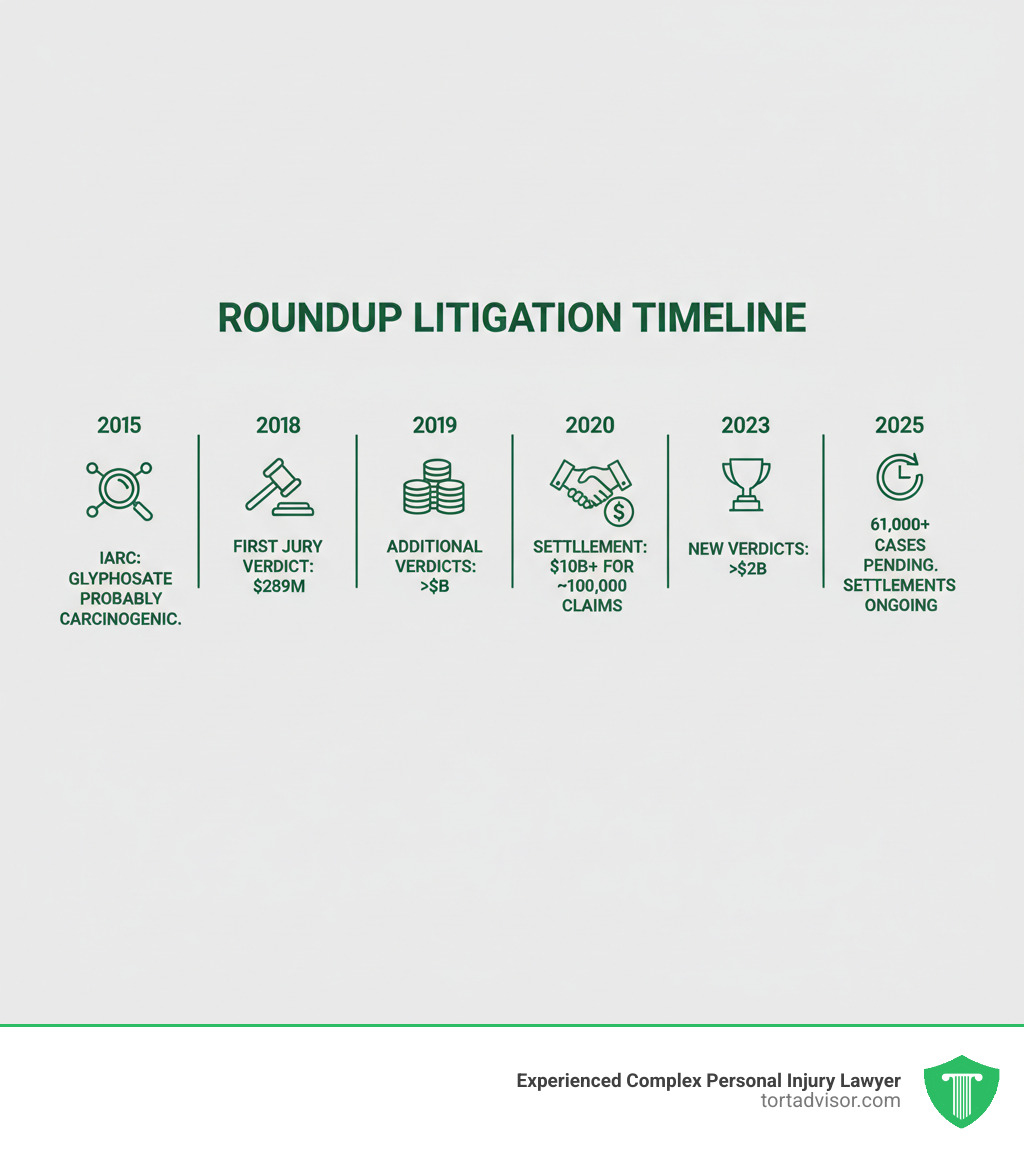
- Settlements so far: more than $11 billion paid to resolve close to 100,000 claims
- Recent verdicts: plaintiffs won more than $2 billion in jury awards in 2023 alone
- Who may qualify: people who used Roundup regularly and were later diagnosed with Non-Hodgkin’s Lymphoma or a related cancer
The dispute revolves around glyphosate, which the International Agency for Research on Cancer labeled “probably carcinogenic to humans” in 2015. Plaintiffs say Monsanto understood the cancer risk for decades and never warned buyers, pointing to internal “Monsanto Papers” that allegedly reveal ghostwritten studies and public deception.
Bayer insists glyphosate is safe and relies on the EPA’s view that it is “not likely to be carcinogenic to humans.” Juries have nonetheless sided with plaintiffs again and again, resulting in billions in verdicts and settlements.
I’m Mason Arnao, and my work focuses on helping people find experienced lawyers for complicated personal injury matters. I know how confusing Monsanto Roundup lawsuits can feel. Learning your legal options is the first move toward the compensation you may be owed.
Why Roundup Is So Controversial
The Roundup fight boils down to two basic questions: is the widely used weed killer harmful, and did the company know? Here is what’s at stake in Monsanto Roundup lawsuits.
What Roundup Is and How It’s Linked to Cancer
Roundup was for decades the best-selling weed killer on the planet, a staple for farmers and homeowners. Its active ingredient, glyphosate, kills plants by disabling an essential enzyme, and Monsanto maintained for years that it posed no danger to people.
In March 2015, the World Health Organization’s International Agency for Research on Cancer (IARC) classified glyphosate as “probably carcinogenic to humans,” setting off tens of thousands of lawsuits. The IARC identified a significant association between glyphosate exposure and Non-Hodgkin’s Lymphoma (NHL), a cancer of the immune system. A University of Washington study later reported a 41% higher NHL risk among people exposed to glyphosate.
The lawsuits connect Roundup to multiple NHL subtypes, among them Diffuse Large B-cell lymphoma (DLBCL) and Follicular lymphoma. Early signs can feel like the flu: enlarged lymph nodes, fever, night sweats, unexplained weight loss, and exhaustion. A cancer diagnosis turns life upside down, adding physical, emotional, and financial pressure from treatment and time away from work.

The Legal Grounds for Monsanto Roundup Lawsuits
Monsanto Roundup lawsuits rest on three main legal theories, each claiming Monsanto knew Roundup was hazardous yet sold it without adequate warnings.
- Failure to warn is the central claim: plaintiffs say Monsanto deliberately misled people about cancer risk, since its labels carried no cancer warning.
- Design defect claims argue the product itself was unreasonably dangerous, with research suggesting other ingredients in the formula may make glyphosate more toxic.
- Negligence claims say Monsanto worked to bury the truth. Dewayne Johnson’s complaint, for example, accused Monsanto of misleading both the public and regulators about cancer risk.
Internal records unsealed in litigation, known as the “Monsanto Papers,” became critical evidence. They allegedly show Monsanto ghostwriting research, hiding unfavorable results, and pressing regulators to minimize safety concerns, pointing to a deliberate effort to put profits ahead of public health.
How Bayer and Monsanto Defend the Cases
Since buying Monsanto in 2018, Bayer has fought back hard.
Its centerpiece is the EPA’s stance. The agency has said glyphosate is not likely to be carcinogenic to humans, and Bayer argues that because the EPA never required a cancer warning, it can’t be blamed for leaving one off.
That feeds into Bayer’s federal preemption defense: the claim that federal labeling rules enforced by the EPA override state laws that might demand a cancer warning. Several courts have rejected it, but Bayer won an important ruling on this issue in the 3rd Circuit in August 2024, and the question is still being fought.
Bayer also points to research and to regulators around the world that found no glyphosate-cancer link, calling the IARC an outlier. In its formal answer to complaints, Monsanto has denied every allegation and maintains Roundup is safe when used according to the label. The collision of science, regulation, and internal records has produced a tangled legal fight affecting thousands of lives.
Major Verdicts and Where Monsanto Roundup Lawsuits Stand Today

When Bayer paid $63 billion for Monsanto in 2018, it also took on an enormous legal exposure. Juries have since handed cancer patients billions of dollars across a run of dramatic trial wins.
Key Trials and Jury Awards
The first big verdict arrived in August 2018, when a jury awarded former school groundskeeper Dewayne Johnson $289 million, finding Roundup caused his non-Hodgkin’s lymphoma. Appeals cut the award to $20.5 million, but the message stood: jurors believed Roundup caused cancer and that Monsanto failed to warn.
Edwin Hardeman won the first federal bellwether in March 2019 with an $80 million verdict, later lowered to $25 million. Two months later, in May 2019, jurors awarded married couple Alva and Alberta Pilliod an astonishing $2.055 billion. Their complaint contended that the product’s dangers outweighed its benefits. A judge reduced the award to $86.7 million, but the original figure showed how angry the jury was.
In October 2023, a jury in Missouri, Monsanto’s home state, awarded four plaintiffs $1.56 billion. That was cut to $611 million, and the judgment became largely final when the Missouri Supreme Court refused to take Bayer’s appeal.
Big verdicts kept coming. Plaintiffs won more than $2 billion in 2023. A Pennsylvania jury awarded John McKivison $2.25 billion in January 2024 (later reduced to $400 million), and a Georgia jury awarded John Barnes $2.065 billion in March 2025. The heavy punitive damages in these cases reflect juries repeatedly finding that Monsanto acted with malice or reckless disregard for safety.
How Bayer Has Responded
Confronted with verdict after verdict, Bayer has combined settlements, product changes, and appeals. In 2020 it announced plans to pay more than $10 billion to resolve around 100,000 lawsuits, and its total settlement payments now top $11 billion.
Under its five-point plan, Bayer also took glyphosate-based Roundup off the U.S. residential market by 2023, a step meant to limit future liability without conceding the product was unsafe.
At the same time, Bayer has appealed verdicts aggressively on the theory that EPA rules preempt state-law claims. For years the U.S. Supreme Court declined its appeals, but in June 2026 it ruled 7-2 for Monsanto in Monsanto v. Durnell, holding that state failure-to-warn claims based on an EPA-approved label are preempted.
Where Monsanto Roundup Lawsuits Stand Now
For all of Bayer’s efforts, Monsanto Roundup lawsuits remain a huge legal problem. As of this update, roughly 165,000 Roundup cases have been filed. Close to 100,000 have settled, leaving about 61,000 still pending.
Many federal cases are grouped in a multidistrict litigation (MDL) in the Northern District of California to simplify proceedings and promote settlement, and thousands of others are moving through state courts, especially in Missouri and California.
Results vary. Plaintiffs have won eight major trials and Bayer has won ten, yet large plaintiff verdicts continued through 2023, 2024, and 2025. Bayer keeps settling and new suits keep arriving. For people with heavy Roundup use and an NHL diagnosis, filing is still possible, but that window won’t stay open indefinitely.
Roundup Lawsuit Requirements: Are You Eligible to File?
A cancer diagnosis after using Roundup may give you grounds for a claim, and knowing the Roundup lawsuit requirements is where to begin. Legal Lawsuit connects people with experienced attorneys in our network who can review a potential Monsanto Roundup lawsuit.
The Core Roundup Lawsuit Requirements
Whether you qualify depends on a few key elements, and a strong case must prove each one:
- You need substantial Roundup exposure. That generally means regular, repeated use over months or years; on-the-job use, such as spraying daily or weekly, is considered substantial.
- You need proof of that exposure. Receipts, photos, work records showing occupational use, and statements from coworkers, friends, or relatives can all help.
- You need a qualifying cancer diagnosis. Most viable cases involve Non-Hodgkin’s Lymphoma (NHL) or one of its subtypes, including Diffuse Large B-cell Lymphoma (DLBCL), Follicular Lymphoma, and Chronic Lymphocytic Leukemia (CLL). An attorney can check your medical records to see whether your diagnosis fits.
- You need to show causation. The claim must establish that Roundup exposure was a substantial factor in your cancer. This is usually the hardest piece and depends on expert medical testimony tying together your exposure, health history, and diagnosis.
Who Can Bring a Roundup Claim?
People who used Roundup routinely at work or at home are most affected. You may have a claim if you belong to one of these groups and have a qualifying diagnosis:
- Farmers and farmworkers with long-term, heavy exposure.
- Landscapers and groundskeepers who used Roundup on the job.
- Professional gardeners and nursery workers who handled it often.
- Homeowners who used it heavily over many years.
- Relatives bringing wrongful death claims after a loved one died of a qualifying cancer tied to significant Roundup exposure.

Filing Deadlines: The Statute of Limitations
Time to sue is limited. Each state sets a statute of limitations, a legal cutoff for filing, and missing it forfeits your right to compensation.
Deadlines differ by state and are usually one to three years. The clock generally starts not at exposure but when you were diagnosed, or when you reasonably should have connected your illness to Roundup, a principle called the “discovery rule.”
Say you were diagnosed in 2023 but didn’t learn about the Roundup connection until 2024; your clock might begin in 2024. These rules are complicated and vary from state to state.
Bottom line: act now. Talking to a lawyer quickly is critical. An attorney can pin down your state’s deadline and file before it passes, and delay makes evidence harder to collect. If you were diagnosed with Non-Hodgkin’s Lymphoma after using Roundup, a free, confidential case review is the best way to protect your rights.
Roundup Lawsuit FAQs
Thinking about a Monsanto Roundup lawsuit? Here are answers to the questions people ask most.
What compensation is available in a Roundup lawsuit?
Successful Monsanto Roundup lawsuits can recover three main categories of damages:
- Economic damages cover measurable money losses: past and future medical costs (treatment, drugs, hospital care), lost income, and diminished earning ability.
- Non-economic damages address harder-to-measure harm like pain, emotional distress, and lost enjoyment of life, recognizing the deep personal toll of cancer.
- Punitive damages can be imposed to punish reckless or malicious behavior. The very large punitive awards in many Roundup trials reflect jury findings that Monsanto knowingly hid cancer risks.
What any one case is worth depends on its facts: the type and stage of cancer, the extent and length of exposure, medical costs and lost income, the strength of the evidence, and whether the claim settles or goes to trial.
What does a Roundup lawyer cost?
Usually nothing upfront. Most attorneys handling Monsanto Roundup lawsuits work on contingency.
You pay no out-of-pocket fees; instead, the lawyer receives an agreed percentage of any settlement or verdict. No recovery means no attorney fee. That arrangement lets you pursue a claim without financial risk.
Will my case go to trial?
Most likely not. Filing a Monsanto Roundup lawsuit rarely means a courtroom appearance. The multidistrict litigation (MDL) structure is built to encourage group settlements, and most cases end in negotiated deals; with nearly 100,000 lawsuits already settled, the majority of plaintiffs never saw a trial.
Still, trial remains an option if a settlement offer falls short. With your attorney’s advice, the choice to settle or go to trial is yours.
If you or a family member developed Non-Hodgkin’s Lymphoma after Roundup exposure, contact Legal Lawsuit to be connected with an experienced personal injury attorney for a free, confidential case review and learn whether you qualify.
Conclusion
Monsanto Roundup lawsuits are a landmark fight over corporate accountability. Juries have awarded billions to people who developed cancer after using Roundup, a strong statement about a company’s duty to protect the public.
Bayer has resolved close to 100,000 claims for more than $11 billion, yet roughly 61,000 remain pending as of this update, and new plaintiffs keep stepping forward as they connect a cancer diagnosis to past Roundup use. Each case stands for someone whose life was upended by an illness that may have been avoidable.
If you or someone you love was diagnosed with a qualifying cancer such as Non-Hodgkin’s Lymphoma after heavy Roundup exposure, move quickly. State statutes of limitations set firm filing deadlines, and understanding the Roundup lawsuit requirements is the first step toward holding the company responsible.
Legal Lawsuit connects people with experienced attorneys in our network who handle complex Monsanto Roundup lawsuits. They work on contingency, so there’s nothing to pay upfront and nothing at all if the case doesn’t succeed. They will review your situation, assemble the evidence, and pursue the compensation you deserve.
Reach out to Legal Lawsuit for a free, confidential case review with an experienced personal injury attorney. Your health has already put you through enough; let us help you approach the legal process with clarity and confidence.
Related Posts
Quick Answer: The Boy Scouts of America (BSA) filed for Chapter 11 bankruptcy in 2020 after facing tens of thousands [...]
Quick Answer: Survivors of sexual abuse by Catholic priests, nuns, or other Church personnel may be able to file a [...]
Quick Answer: Clergy abuse settlements vary enormously based on the severity of the abuse, the strength of evidence that the [...]