
Short answer: This article explains the key facts, eligibility issues, settlement factors, deadlines, and source-backed updates related to this legal topic. Results vary by case facts, evidence, jurisdiction, and representation.
📋 Table of Contents
- Understanding the Addicted to Video Games Lawsuit Landscape
- What is Video Game Addiction and Who is Affected?
- How Game Developers Are Accused of Engineering Addiction
- The Legal Battleground of an Addicted to Video Games Lawsuit
- Frequently Asked Questions about Video Game Addiction Lawsuits
- What to Do if You Believe You Have a Case
The Addicted to Video Games Lawsuit: An Overview
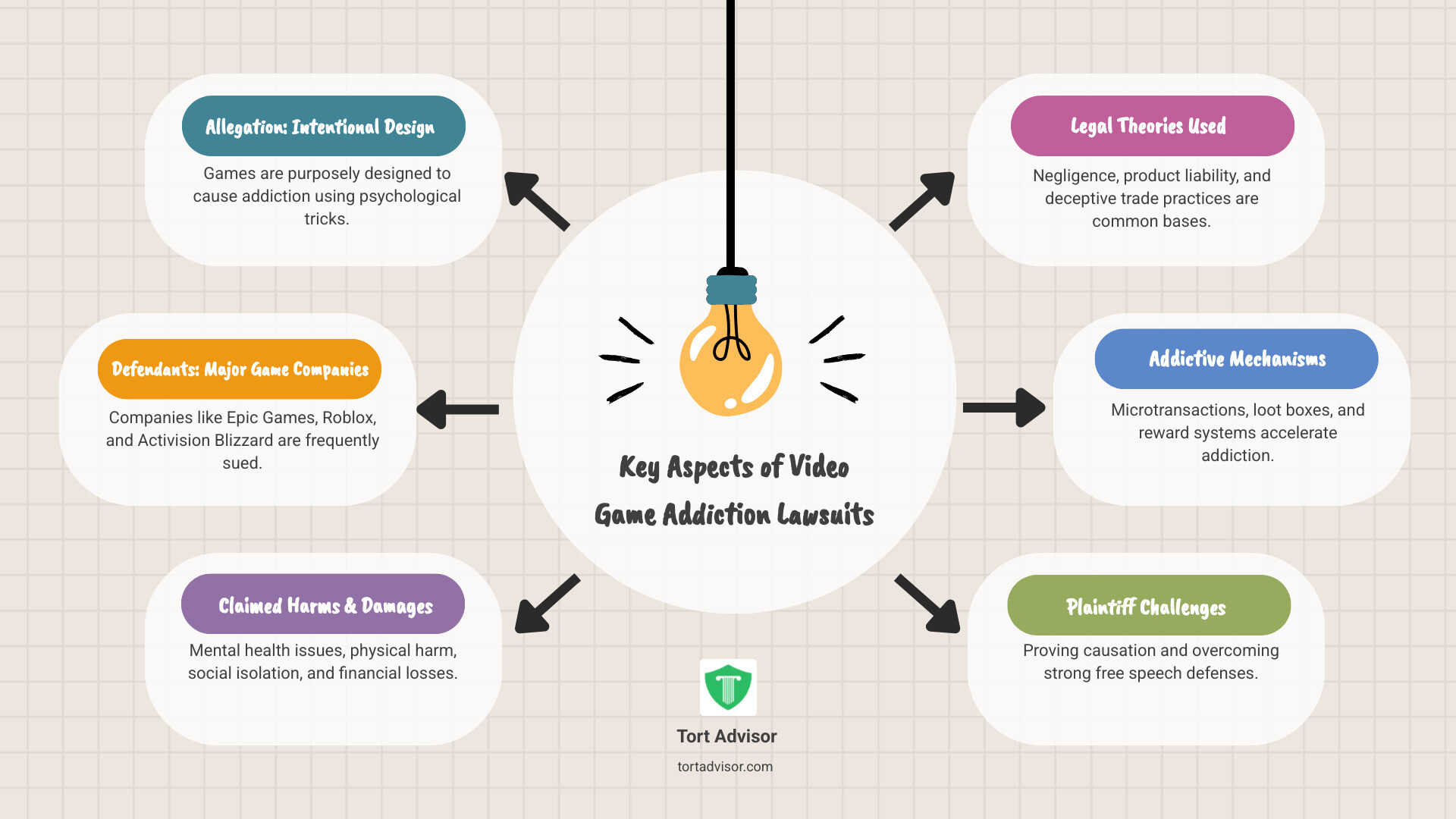
An addicted to video games lawsuit is a claim brought against game companies alleging they purposely build games to hook players, causing real harm. The essentials:
- What’s Alleged: Developers rely on psychological techniques to make their games habit-forming.
- Who’s Being Sued: Big names such as Epic Games, Roblox and Activision Blizzard are commonly named over titles like Fortnite, Call of Duty and Minecraft.
- Harms Claimed: Mental health problems (anxiety, depression), physical ailments, isolation from others and heavy financial losses from in-game spending.
- Legal Grounds: Typically negligence, product liability and deceptive trade practices.
- Features Under Fire: Microtransactions, loot boxes and reward loops are singled out as the main drivers of compulsive play.
- Hurdles: Causation is hard to prove, and companies fight back hard, including with free speech defenses.
As the gaming industry has exploded worldwide, so has concern about gaming addiction, and more than a dozen personal injury suits around the country now claim companies intentionally created “gaming addicts.” I’m Mason Arnao. My work in SaaS cloud architecture and internet lead generation gives me an inside view of the digital systems at the heart of the addicted to video games lawsuit trend, and analyzing complex online behavior helps me explain the technical side of these cases.
Key video game addiction lawsuit terms:
- lawsuit against video game maker
Video Game Addiction: What It Is and Who It Affects
Video game addiction is more than an enthusiastic hobby; it is a harmful behavioral pattern in which gaming takes over a person’s life, and medicine takes it seriously. After years of study, the World Health Organization (WHO) added “gaming disorder” to its International Classification of Diseases in 2018; you can read about its recognition of gaming disorder on the WHO website. The American Psychiatric Association has likewise flagged “Internet Gaming Disorder” as a condition warranting further research, recognition that underscores how serious the problem is. Kids and teens face the greatest risk because the brain regions that govern impulse control are still developing, leaving them more susceptible to addictive design. The numbers are striking: as much as 10% of the U.S. population may struggle with gaming addiction, and with 85% of teens gaming and 40% doing so every day, a huge number of young people are exposed. These trends have prompted families to sue, believing their children were deliberately targeted. To learn how injury claims work, see more info about personal injury lawsuits.
Warning Signs of Gaming Disorder
Gaming disorder often creeps in gradually and then intensifies. Clinicians look for signs such as:
- Fixation on gaming: Thinking about the game constantly, even when away from it.
- Withdrawal: Becoming anxious, irritable or upset when gaming isn’t possible.
- Losing control: Being unable to cut back despite wanting to, with “just a few minutes” stretching into marathon sessions.
- Dropping other activities: Losing interest in friends, hobbies and school.
- Hiding and escaping: Lying about how much they play and using games to avoid real-life problems.
- Putting relationships and futures at risk: Choosing games over important relationships, school or work. In the most extreme cases, teens have gamed as much as 20 hours a day, and some experts liken the dependency to hard-drug addiction.
The Cleveland Clinic provides detailed information about these warning signs.
Harms Plaintiffs Say They Suffered
The fallout from gaming addiction can reshape lives, and it is the foundation of every addicted to video games lawsuit.

Serious financial damage is common, fueled by nonstop in-game purchases; some children have run up thousands of dollars on a parent’s credit card. Families can also lose income when addiction disrupts work. The emotional cost runs deep, often including lasting depression, anxiety and withdrawal from others, and research on gaming and suicidal ideation has tied internet gaming disorder to suicidal thoughts. Physical problems show up too, including carpal tunnel syndrome, chronic eye strain and sleep disorders, and intense play has occasionally triggered seizures. Plaintiffs contend these harms flow directly from design decisions by companies that put revenue ahead of player safety.
How Game Makers Allegedly Build Addiction Into Their Games
Claims in an addicted to video games lawsuit say that the struggle to stop playing is no accident. Plaintiffs allege developers use behavioral psychology and neuroscience to engineer compulsive play, with “psychological tricks” like unpredictable rewards and dopamine-firing sound effects that keep players coming back. These tactics are said to work best on minors, whose prefrontal cortex, the part of the brain that handles impulse control, is not yet fully developed. Lawsuits claim some companies work with behavioral scientists and neuroscientists to fine-tune these features and have even patented methods to stretch playtime and spending, and they argue that profiting from addiction, especially children’s, crosses a line. Read more about the companies involved: More info on Top Video Game Developer Hit with Major Lawsuits.
Monetization and Reward Systems Under Scrutiny
Every addicted to video games lawsuit zeroes in on how today’s games keep players spending and engaged long after they buy or download them.

These systems draw the most criticism:
- Microtransactions and Virtual Currency: Small purchases made with tokens like V-Bucks or Robux blur what players are really spending and nudge them to buy more.
- Loot Boxes: Randomized prize packs that critics call digital gambling. The FTC concerns over loot boxes note their potential to promote gambling-like habits in kids.
- Pay-to-Win: Designs that push players to pay for a competitive edge, sparking an escalating spending race.
- Variable Rewards: Unpredictable payouts modeled on slot machines that keep players chasing the next big win.
- FOMO Tactics: Daily login bonuses and limited-time events play on the “fear of missing out” to pull players back often and keep them online longer.
Plaintiffs say these features are not just revenue strategies but intentional tools to create compulsive behavior for profit.
Companies and Titles Named in the Lawsuits
The addicted to video games lawsuit wave is aimed at the industry’s biggest players, accusing them of building deliberately addictive products.
- Epic Games: Sued over Fortnite, whose free-to-play format and heavy microtransactions are alleged to be engineered for addiction, particularly among kids.
- Activision Blizzard: Named over Call of Duty and World of Warcraft, cited for intense reward cycles and competitive pressure.
- Roblox Corporation: Sued over its kid-focused platform, with claims of addictive design and gambling-style mechanics tied to Robux.
- Microsoft: Named in suits involving Minecraft and Xbox, accused of addictive features despite Minecraft’s creative image.
- Electronic Arts (EA): Criticized for loot boxes in sports series such as FIFA and Madden.
- Take-Two Interactive: Cited for habit-forming gameplay and in-game purchases in Grand Theft Auto V and NBA 2K.
Sony, Nintendo, Ubisoft, Google and Apple have also been named for developing or distributing these games or processing in-app purchases. Together the suits ask whether the industry has put profits ahead of its users’ well-being. Learn more: Is a Video Game Addiction Lawsuit Legit?.
The Legal Fight in an Addicted to Video Games Lawsuit
Bringing an addicted to video games lawsuit means taking on a large corporation in a complicated case. The central challenge is showing that a game was intentionally designed to be addictive and that it directly caused the plaintiff’s injuries, which requires linking specific features to the addiction while facing companies with enormous legal budgets.

These suits are breaking new legal ground, with little precedent for winning addiction claims, so each case helps shape the law. For more, visit: Category: Video Game Addiction.
Legal Theories Plaintiffs Rely On
Plaintiffs in an addicted to video games lawsuit use several legal theories to hold companies responsible:
- Negligence: Developers owed users, children above all, a duty to guard against foreseeable harms like addiction and failed to meet it.
- Product Liability: Both defective design (the game is unreasonably dangerous because it is addictive) and failure to warn (the company knew the risks and didn’t disclose them).
- Deceptive Practices: Companies misled consumers, for example by promoting a game as family-friendly while concealing addictive mechanics.
- Unjust Enrichment: Companies profited unfairly from players’ addiction.
- Intentional Infliction of Emotional Distress: Raised where a company’s conduct is alleged to be extreme and outrageous.
Most complaints combine several of these theories.
How Game Companies Defend Themselves
Companies facing an addicted to video games lawsuit rely on several strong defenses:
- First Amendment: Their lead argument is that games are artistic expression protected as free speech, a position the Supreme Court endorsed in Brown v. Entertainment Merchants Association.
- Arbitration Clauses: Terms of service frequently require private arbitration, blocking lawsuits and class actions.
- Personal Responsibility: Companies say players and parents are responsible for managing screen time.
- No Scientific Consensus: Defendants point to continuing scientific debate over how to define video game addiction and what causes it.
- Section 230: Platforms featuring user-generated content may claim immunity for content created by third parties.
These defenses make the cases difficult for plaintiffs.
Where Video Game Addiction Litigation Stands Now
The addicted to video games lawsuit landscape is still taking shape, with more than a dozen suits filed against major game companies around the country. In an important ruling, the federal MDL panel chose to decline to consolidate the cases into one federal proceeding because they differed too much, which lets each case move forward on its own in state courts, a possible advantage for plaintiffs relying on strong state consumer protection laws. As of this update, cases have been active in states including Arkansas, Missouri and Florida. There have been setbacks, including some early dismissals; one closely watched case was thrown out after evidence showed the account had barely been used, though that ruling did not address the core arguments about addictive design. As one commentator noted, the first video game addiction lawsuit got knocked out, but the litigation continues, and each case helps set precedent in this new area of law.
Video Game Addiction Lawsuit FAQs
Considering an addicted to video games lawsuit naturally raises questions, especially in such a new area of law. Here are answers to the most common ones.
What evidence does an addicted to video games lawsuit need?
A strong addicted to video games lawsuit rests on solid proof of how the addiction affected the person. Important evidence includes:
- Medical Records and Expert Opinions: A formal gaming disorder diagnosis from a doctor or therapist is critical, and therapy notes, psychiatric evaluations and expert testimony can show how severe it is.
- Financial Records: Credit card and bank statements documenting heavy spending on microtransactions and loot boxes show the financial damage.
- Gameplay Data: Platform logs can show extreme hours played and use of the features alleged to be addictive.
- Witness Accounts: Family members, friends or teachers can describe changes in behavior, withdrawal and other effects.
- School and Work Records: Falling grades or a lost job help show real-world harm.
Together, this evidence ties the harm to the game’s design.
What compensation can plaintiffs pursue?
An addicted to video games lawsuit can seek money for the harm the addiction caused, including:
- Compensatory Damages: For measurable losses like:
- Medical costs for therapy, rehab and treatment.
- Lost income and reduced future earning ability.
- Pain and suffering from emotional distress, anxiety and depression.
- Education costs tied to academic setbacks.
- Punitive Damages: Possible where a company acted with extreme negligence or malice, to punish and deter.
- Disgorgement of Profits: Requiring companies to give up money earned through deceptive or addictive practices.
Because these cases are so new, there is no track record of settlements to point to, and Legal Lawsuit does not publish estimated payout ranges. What a claim might be worth will depend on factors such as how severe and well documented the addiction and its harms are, the age at which it began, the amount of money spent in-game, the cost of treatment, effects on school or work, the state where the case is filed and how courts rule on the companies’ defenses.
Can I sue if my child is now an adult but became addicted as a minor?
Often, yes. An addicted to video games lawsuit may be possible if the addiction began and caused harm while your child was a minor, since these cases center on the vulnerability of young, developing brains. Keep a few key points in mind:
- Statute of Limitations: Every state sets a firm filing deadline, which differs by state and often runs from when the injury was discovered. Talk to an attorney to find out whether you are still within it.
- Evidence From the Minor Years: A case’s strength depends on proof of when the addiction started, how much they played as a minor and the harm documented during that time.
- Legal Advice: State laws vary widely. An experienced attorney can evaluate the claim, apply local law and recommend the best path.
Think You Have a Video Game Addiction Case? Here’s What to Do
If you believe an intentionally addictive game has harmed you or someone you love, there are practical steps to take. First, keep records of everything: credit card statements showing in-game purchases, gameplay data showing excessive hours, medical records with a gaming disorder diagnosis, and any drop in grades or job performance. Second, cut back on gaming and get professional help; treating the addiction matters, and a formal diagnosis from a mental health professional is central to any addicted to video games lawsuit. Most important, talk with an experienced attorney. These are complex cases against well-funded companies, and you shouldn’t take them on alone. Legal Lawsuit connects families with experienced attorneys in our network who handle cases against large corporations and understand the laws in your state. Filing deadlines vary by state, so don’t wait if you believe addictive game design has harmed your family. Find out if you qualify for a Video Game Addiction Lawsuit with a free, confidential case review today.
Related Posts
Quick Answer: The Boy Scouts of America (BSA) filed for Chapter 11 bankruptcy in 2020 after facing tens of thousands [...]
Quick Answer: Survivors of sexual abuse by Catholic priests, nuns, or other Church personnel may be able to file a [...]
Quick Answer: Clergy abuse settlements vary enormously based on the severity of the abuse, the strength of evidence that the [...]