Short answer: This article explains the key facts, eligibility issues, settlement factors, deadlines, and source-backed updates related to this legal topic. Results vary by case facts, evidence, jurisdiction, and representation.
📋 Table of Contents
What Is COCSA? A Clear Definition and What It Means for Families
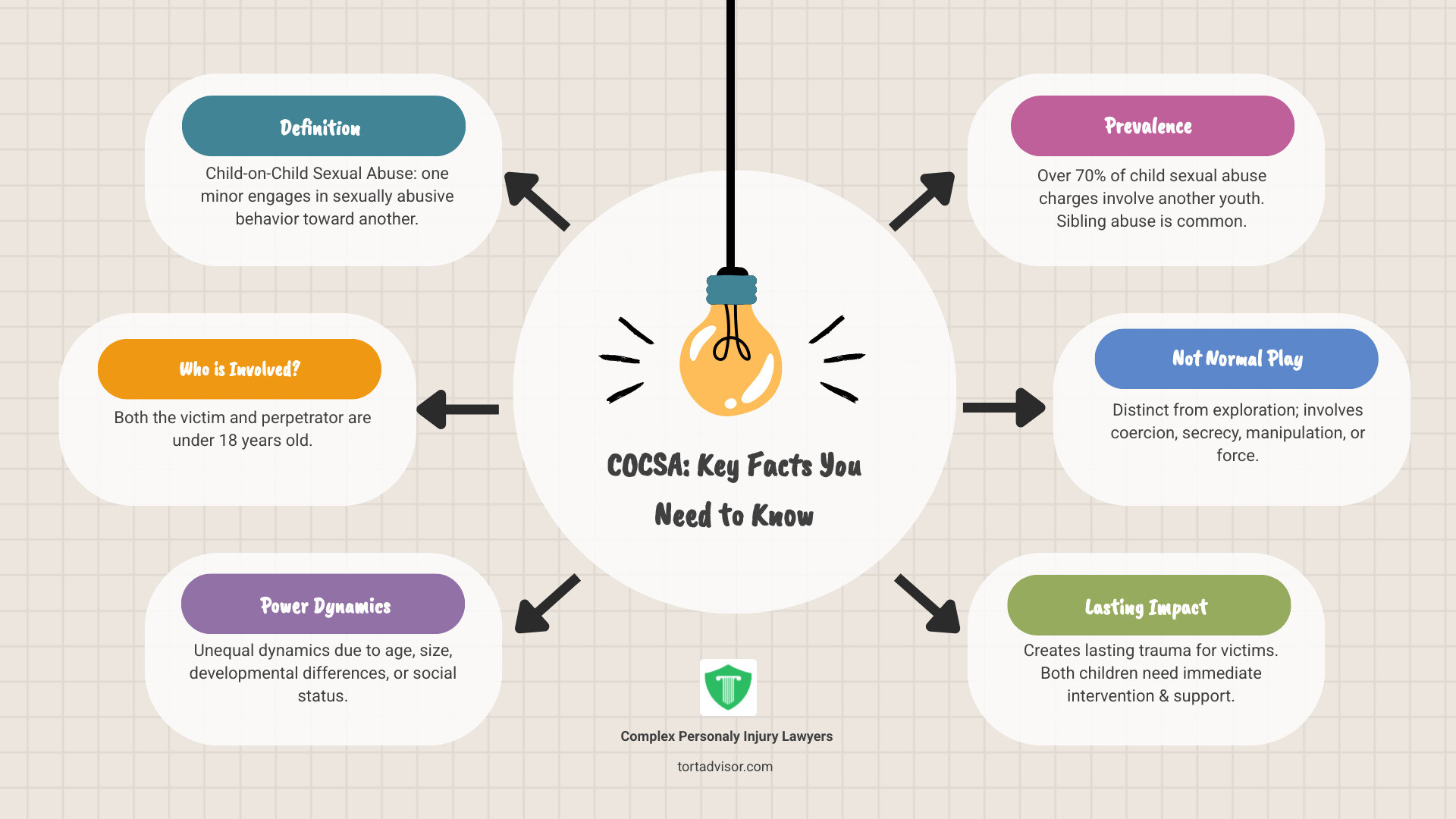
So, what is COCSA? Child-on-Child Sexual Abuse describes sexually abusive behavior that one minor directs at another minor. The essentials:
- Everyone involved is a minor: the child harmed and the child causing harm are both younger than 18.
- Unequal power is central: gaps in age, physical size, or development tilt the relationship.
- It happens often: more than 70% of child sexual abuse charges involve another young person.
- It frequently happens at home: abuse between siblings is one of the most common kinds of abuse within families.
- Each child needs support: the child who caused harm frequently carries trauma of their own.
COCSA is not ordinary childhood curiosity. It involves pressure, force, or enforced secrecy, and it leaves trauma that calls for intervention. The numbers are hard to read: other children are the perpetrators in at least one-third of child sexual abuse cases, and survivors of sibling abuse carry a higher risk of depression, eating disorders, and suicidal thinking.
Spotting it early and stepping in quickly helps stop further harm and begins recovery for every child involved.
I’m Mason Arnao, and through Legal Lawsuit I’ve worked with many families facing difficult legal questions after child sexual abuse. That work has shown me how much it matters to understand what COCSA is and how it affects every person in the family.
What Is COCSA? Understanding Child-on-Child Sexual Abuse in Depth
Learning what COCSA is can feel like a lot to take in. The term covers any situation in which one minor sexually abuses another, whether between peers or, most often, between brothers and sisters as sibling sexual abuse.
Because the person who caused harm is also a child, survivors frequently feel isolated and unsure, and the experience can seem less clear-cut than abuse by an adult. Understanding COCSA starts with seeing the imbalance of power between the children.
That imbalance sits at the heart of COCSA. It can show up as a difference in age, physical size, strength, maturity, or social standing. A gap of only a year or two can still create real dominance, and a bigger child may rely on physical intimidation. Gaps in development or social status can also be used to manipulate.
Threats, tricks, and emotional pressure are defining features of this abuse, and they rule out any real consent.
Families who want a fuller overview can turn to the guide Get the Facts About COCSA: Child-on-Child Sexual Abuse for helpful direction.
How COCSA Differs From Normal Childhood Curiosity
Telling COCSA apart from ordinary curiosity is not always easy. Some sexual play is a typical part of growing up, but there is a firm boundary between healthy exploration and abuse.
Putting the two side by side makes that boundary easier to see:
| Feature | Typical Sexual Play | Harmful Sexual Behavior (COCSA) |
|---|---|---|
| Motivation | Innocent curiosity and learning | Control, power, and domination |
| Participation | Mutual and freely chosen | One-sided, pressured, or forced |
| Power Balance | Both children take part equally, without intimidation | One child controls the other through age, size, or status |
| Secrecy | Can be talked about openly, without shame | Kept secret, often through fear or threats |
| Emotional Impact | Curious or neutral feelings | Fear, anxiety, distress, shame, or pulling away |
| Behavior Type | Age-appropriate, spontaneous, and easy to redirect | Persistent, compulsive, and adult-like even when a child is uncomfortable |
Red flags for abuse include pressure or force, a large gap in age or development, and one child controlling another.
Parents can find more detail in the “Developmental and Harmful Sexual Behaviour Continuum at a Glance” guide.
Myths and Stigma That Get in the Way
False beliefs about COCSA keep it from being recognized and handled properly. Brushing it off as “kids being kids” does the most damage, because it excuses abusive behavior and lets it grow worse.
People tend to downplay the harm because it is hard to picture a child as an abuser. Survivors can absorb that disbelief and start doubting what happened to them, and the resulting confusion and shame can stall recovery.
Questions such as “Why didn’t you tell anyone?” shift blame onto the survivor and deepen the shame and silence.
Abuse between siblings is particularly tangled because of family loyalty and pressure to keep quiet. It may be the most frequent type of abuse within families, yet it goes badly underreported.
These myths block access to help and limit research, which makes COCSA harder for families and professionals to address. If you are sorting through legal questions, “Personal Injury Lawsuits Explained” offers useful background.
Spotting the Warning Signs and Understanding the Harm
Parents and caregivers need to know the warning signs of COCSA. They are often subtle, so watch for patterns over time and trust your gut. Catching it early is the best way to limit trauma and long-term damage.
Warning Signs of COCSA
COCSA signs usually look like those of other child sexual abuse. Pay attention to clusters of signs rather than a single event:
- Changes in behavior: new secrecy, dropping out of activities, more aggression, or steering clear of particular people or places.
- Emotional upset: anxiety or sadness with no clear cause, sharp mood swings, or sudden outbursts.
- Going backward: returning to younger habits such as thumb-sucking or bedwetting, often a sign of serious stress.
- Sexual knowledge beyond their age: sexual behavior or understanding that does not fit the child’s age.
- Physical clues: unexplained injuries, genital pain, or symptoms of STIs need prompt medical care.
- Shifts at school or with friends: falling grades, trouble focusing, or abrupt changes in friend groups.
None of these proves abuse on its own, but they are reason to bring in a professional.
How COCSA Affects Survivors Now and Later
COCSA can do serious, lasting damage, which is why stepping in early matters so much.
In the short term, children may show physical illness, slipping grades, mood shifts, regressive habits, trouble sleeping or eating, poor self-image, nightmares, and self-harm.
Over the long term, the effects can run deep. PTSD, depression, and anxiety are common outcomes, and survivors of sibling abuse face elevated risk for these along with substance misuse and suicidal feelings. Many struggle to trust others, which makes intimacy and healthy relationships harder. Lingering feelings of worthlessness and low self-esteem are common too.
Some survivors turn to eating disorders or substance use to cope, and the chance of suicidal thoughts rises sharply, so professional care is essential. How an adult reacts when a child discloses makes a major difference: a supportive response can substantially lessen the trauma.
The paper “The Traumatic Impact of Child Sexual Abuse” offers deeper insight for readers who want it.
Legal Options and Next Steps

When your family is dealing with COCSA, the legal side can feel crushing. The justice system was not built with child-on-child abuse in mind, and rules such as the statute of limitations differ widely by state. Keep your attention on your child’s safety while you look for support and accountability.
How COCSA Gets Reported
Know who is obligated to report. Mandatory reporters, including doctors, teachers, social workers, and police, must by law report any reasonable suspicion of abuse.
Reports usually go to Child Protective Services (CPS) or local police. CPS looks into the allegations and acts to keep every child involved safe.
Keeping a record is essential. Write down behavior changes, what your child said, and the dates and times, and keep these notes private so you can share them with professionals who need them to make sound decisions.
Not sure whether you need a lawyer? Our guide “Do I Need a Personal Injury Lawyer?” explains when legal help makes sense.
What to Do If You Suspect COCSA
If you think your child has experienced COCSA, the steps you take right away shape both their safety and their recovery.
- Make safety the priority: separate the children right away. It may be hard within a family, but it creates the safe space healing requires.
- Listen and believe: when your child tells you, stay calm, take them at their word, and tell them it is not their fault. How you respond lays the groundwork for recovery.
- Write things down: privately note behavior changes, statements, and physical signs along with dates and times, so professionals have what they need.
- Get expert help: reach out to a trauma-informed therapist who specializes in child sexual abuse. They can help your child work through the trauma and guide you as a parent.
- Hold off on confrontation: don’t confront the child who caused harm without a professional’s guidance. A trained specialist can manage those conversations in a way that supports healing.
Report your concerns to the proper authorities. They are trained for these sensitive cases and work to make sure every child gets protection and help.
For help locating a qualified lawyer, see our practical guide “How to Find a Good Personal Injury Lawyer.”
Healing, Treatment, and Prevention
Once COCSA comes to light, building a safe environment for recovery comes first. The child who was harmed and the child who caused harm both need help, and professional support is a must because few parents can manage this alone.
Helping a Child Who Was Harmed
How you react when your child tells you matters enormously. Above all, believe them, listen without judging, and let them set the pace of the conversation. Keep telling them it is not their fault; that responsibility belongs to the child who caused harm.
Therapy grounded in trauma care is key to recovery. A specialist helps your child make sense of what happened and build coping skills, and support groups can ease the sense of being alone. For help right now, the RAINN National Sexual Assault Hotline offers confidential support around the clock.
Responding to a Child Who Caused Harm
It is hard to hear, but children who cause sexual harm frequently have trauma in their own past. That does not excuse what they did, yet it shapes how to intervene. Getting an immediate professional assessment is the first move toward finding the underlying problems.
Prior trauma matters. A child who was abused may engage in “sexual acting out,” repeating what happened to them. The emphasis belongs on treatment and rehabilitation rather than punishment alone: the child must be accountable, but the aim is to stop future harm.
Targeted treatment programs for young people with problematic sexual behavior work. They tackle root causes and build empathy, and youth who finish them reoffend at low rates. Restorative models, such as Hidden Water restorative justice circles, center healing for everyone affected.
Preventing COCSA at Home, at School, and in the Community
Prevention begins with early conversations, suited to a child’s age, about bodies, boundaries, and consent. Teaching body safety, including the correct names for body parts, gives children the words to speak up when something feels wrong.
Build honest, open communication so kids feel safe raising uncomfortable subjects. Schools should have clear policies and staff training on spotting and responding to COCSA, plus lessons for students on healthy relationships.
Community awareness efforts help lower stigma. Stopping COCSA takes parents, schools, and communities working together to end the silence and encourage early action. Saprea prevention tools are one source of helpful material for families.
Common Questions About COCSA
Finding out what COCSA is can raise a flood of questions. Below are answers to those families ask most often.
What is COCSA when it happens between siblings?
Child-on-Child Sexual Abuse between siblings is identified the same way as any other COCSA case: by coercion, manipulation, secrecy, or unequal power. Sibling cases are especially hard because of family loyalty and the fact that the children live together, which can leave a victim never feeling safe. This form of abuse goes heavily underreported, though it may be the most common abuse within families. The warning signs that separate it from curiosity are secrecy, threats, power gaps, and distress.
Can a child who was abused later abuse another child?
Yes. This pattern is called the cycle of abuse. Trauma that goes untreated can lead to “sexual acting out,” in which a child repeats their own abuse or uses sexual behavior to cope. It doesn’t excuse the behavior, but it is essential to choosing the right response. Often, the child who caused harm is a hurt child who needs help. With the right intervention and therapy for each child, the cycle can end.
Where can COCSA survivors get support?
If COCSA happened to you, what you went through is real and help exists. You deserve care. Some places to start:
- The RAINN National Sexual Assault Hotline (1-800-656-4673) offers free, confidential help 24 hours a day and can connect you with local services.
- Survivors of Incest Anonymous runs peer support groups for people abused by family members, which can help with the complicated emotions involved.
- Online spaces such as Our Wave offer safe communities and specialized resources for connecting with fellow survivors.
Reaching out is an important part of healing. This is not something you have to carry by yourself.
Moving Forward After COCSA
Knowing what COCSA is opens the door to both prevention and recovery. Understanding how complicated it is lets adults respond with the care and insight that both children need. Stigma tends to keep families silent, yet recovery is truly possible with the right help and professional guidance.
A child who was harmed needs to be believed, validated, and told it was not their fault. Trauma-informed therapy and a supportive family can help them heal and flourish.
A child who caused harm needs understanding and treatment, not punishment alone, because they frequently carry trauma too. Each child deserves help and a path toward a healthier life.
Schools and communities are essential to prevention: they can teach boundaries and consent, make it safe for children to speak up, and train adults to notice red flags.
The legal side can be overwhelming, with state laws and the statute of limitations adding complexity. An experienced attorney can safeguard your child’s rights and help make sure the right intervention takes place.
If your family is facing the legal side of a COCSA case, Legal Lawsuit can connect you with attorneys in our network who handle child sexual abuse cases with the sensitivity and skill they demand. We know how delicate these situations are, and a free, confidential case review is a simple first step.
Recovery can happen. So can justice. With the right help, families can make it through even the hardest of times.
Get experienced legal help with a child sexual abuse lawsuit.
Additional Resources
Related Posts
Quick Answer: The Boy Scouts of America (BSA) filed for Chapter 11 bankruptcy in 2020 after facing tens of thousands [...]
Quick Answer: Survivors of sexual abuse by Catholic priests, nuns, or other Church personnel may be able to file a [...]
Quick Answer: Clergy abuse settlements vary enormously based on the severity of the abuse, the strength of evidence that the [...]