Short answer: This article explains the key facts, eligibility issues, settlement factors, deadlines, and source-backed updates related to this legal topic. Results vary by case facts, evidence, jurisdiction, and representation.
Assaulted During an Uber Ride? What Survivors Should Know First
📋 Table of Contents
Learning how to qualify for an Uber sexual assault lawsuit is where the path to accountability begins after a traumatic ride.
Here is a short summary of who is eligible:
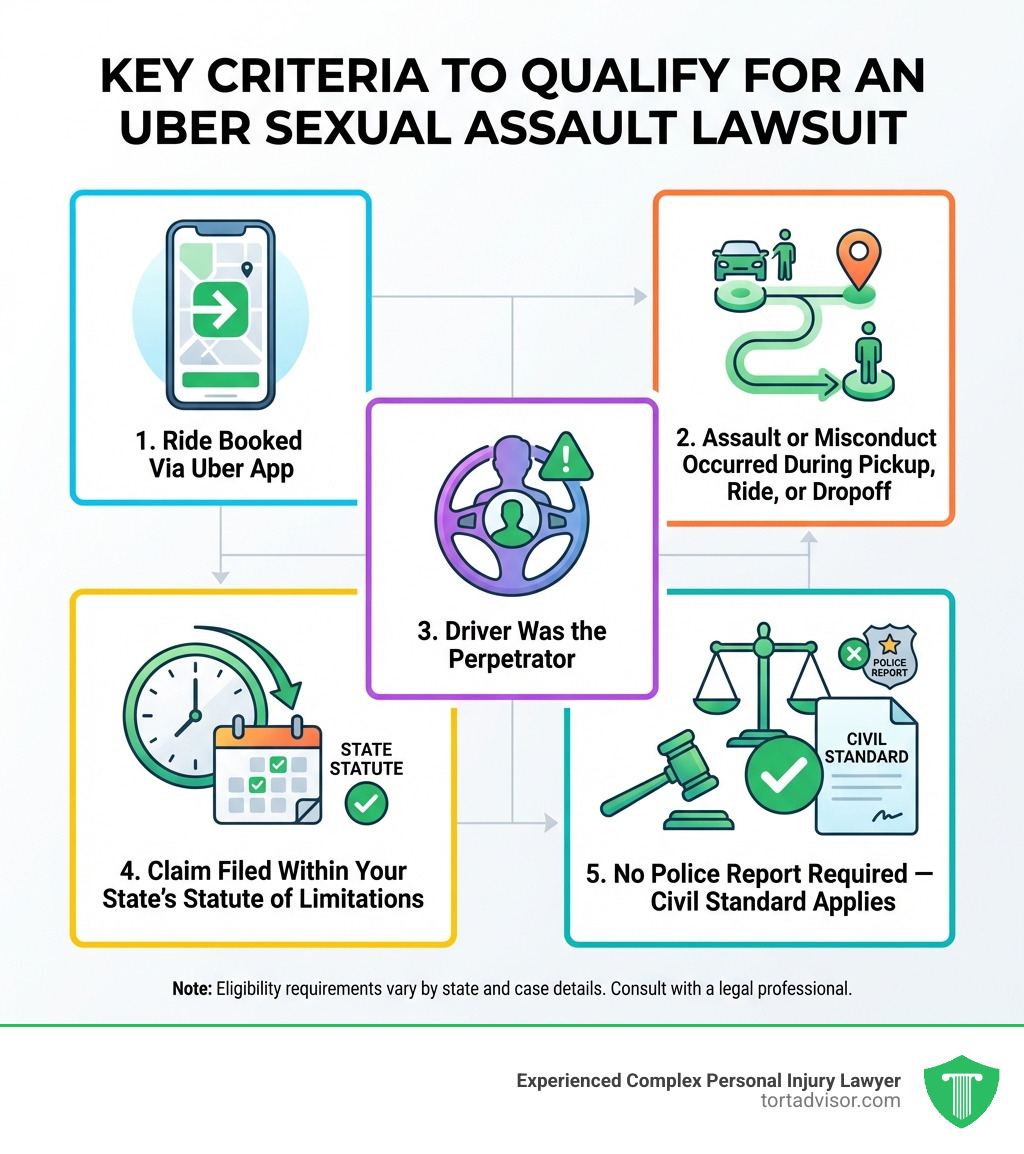
You may have a claim if:
- You requested the ride in the Uber app rather than setting it up privately
- The driver sexually assaulted, harassed, or engaged in misconduct at pickup, during the trip, or at dropoff
- You endured rape, attempted assault, unwanted touching, sexual comments, or a forced change of route
- The incident falls inside your state’s statute of limitations, which differs from state to state
- A civil claim does not require a police report or a criminal conviction
As of this update, Uber faces more than 3,700 sexual assault lawsuits grouped into a federal MDL (Multi-District Litigation No. 3084) in San Francisco. Company records showed 400,181 reports of sexual assault or misconduct from 2017 through 2022, about one every eight minutes, while Uber’s public safety reports labeled just 12,522 of them “serious.”
That difference speaks volumes, and judges have noticed.
The first bellwether trial, held in early 2026, ended with an $8.5 million verdict in compensatory damages. Additional trials are on the calendar, and survivors nationwide continue to come forward.
If an Uber driver assaulted you, others have been through this too, and you may still have a solid case even without a police report.
I’m Mason Arnao. My work in SEO, internet marketing, and legal lead generation has focused for years on helping survivors learn how to qualify for an Uber sexual assault lawsuit and find the right lawyers. This guide lays out, one step at a time, what a qualifying claim requires.
The Uber Sexual Assault MDL: How the Litigation Works
When large numbers of people bring the same kind of claim against one giant company, federal courts frequently group them in Multidistrict Litigation (MDL). The Uber Technologies Passenger Sexual Assault Litigation (MDL No. 3084) was formed because so many survivors were seeking accountability.
Judge Charles Breyer of the Northern District of California presides over this MDL, which pulls together cases from all over the U.S. It is not a class action that hands everyone a small, identical payment. It lets lawyers share discovery into Uber’s internal records while every survivor keeps a separate, individual lawsuit.
At the heart of these Uber sexual assault lawsuits is corporate negligence. Survivors claim Uber breached its duty of care by:
- Relying on name-only background screening rather than FBI fingerprint checks.
- Brushing aside or minimizing hundreds of thousands of internal misconduct complaints.
- Waiting far too long to roll out basic protections such as matching riders with female drivers.
Momentum has moved toward survivors. The early 2026 bellwether, a test trial that shows how juries respond to the evidence, produced an $8.5 million verdict for the plaintiff. The message was clear: jurors saw Uber’s push for growth as the source of a broad safety breakdown.
Who Qualifies for an Uber Sexual Assault Lawsuit
To qualify for an Uber sexual assault lawsuit, a claim has to clear certain legal hurdles. What matters is not only what happened, but showing that the connection among you, the driver, and Uber gave rise to legal responsibility.
The single biggest factor is whether the trip was booked through the app. If you met a driver on Uber and later arranged an “off-app” ride, paying cash or Venmo directly, Uber will probably win the argument that it isn’t responsible. Liability flows from your use of Uber’s platform to find a ride you were told was safe.
Situations That Qualify and Those That Usually Don’t
| Scenario | Qualification Status | Why? |
|---|---|---|
| Assault took place during a live, GPS-tracked Uber trip | Qualifies | The platform was used directly, so Uber owed a duty of care. |
| The driver ended the trip in the app, then assaulted the rider before they got out | Qualifies | The assault is tightly tied to the Uber booking. |
| Rider took a private trip with a driver first met through Uber | Probably Won’t Qualify | Skipping the app cut off the “contract” with Uber. |
| Driver made sexual remarks and touched the rider inappropriately | Qualifies | Fits the definition of sexual harassment and misconduct. |
Uber frequently leans on the “independent contractor” argument, saying it isn’t to blame for crimes by drivers who aren’t technically employees. Courts have rejected that more and more. Since Uber runs the app, handles payment, and controls the matching system, it has a duty to make sure the drivers it sends are safe.
A New York Times investigation surfaced internal records showing Uber received 400,181 misconduct reports across five years. That evidence is central for anyone trying to qualify for an Uber sexual assault lawsuit, because it shows Uber was on “notice” that predators were exploiting its system.
Kinds of Misconduct That Can Qualify for an Uber Sexual Assault Lawsuit
A lot of survivors assume only the most violent attacks support a lawsuit. That isn’t so. Uber’s own tracking system lists 21 categories of sexual misconduct.
Your experience may qualify if it involved:
- Unwanted sexual touching: groping, forced kissing, or contact with any intimate part of the body.
- Rape or attempted rape: any non-consensual penetration or coerced sexual act.
- Forced detours or kidnapping: a driver taking you somewhere else or refusing to let you leave the car.
- Sexual harassment by words: crude remarks about your body, sexual propositions, or unsettling flirting that left you feeling unsafe.
Not sure how your situation fits? A Rideshare Settlement Calculator shows how various factors can affect potential compensation.
What Evidence Helps You Qualify for an Uber Sexual Assault Lawsuit
Taking on a company worth billions takes proof. Your own account carries real weight, and backing it with digital and physical records makes it much harder for Uber to wave away.
Important evidence includes:
- Trip history and receipts: show you were in the vehicle and that Uber arranged the ride.
- GPS records: Uber logs every trip. If a 22-minute ride stretched into a 5-hour ordeal, that data matters a great deal.
- Medical documentation: records of treatment, counseling, or a forensic exam (rape kit) establish the harm, or “damages,” you suffered.
- Accounts from others: Did you text a friend mid-ride that you felt afraid, or tell a roommate right afterward? Statements made at the time, called “contemporaneous” accounts, are strong evidence.
- Screenshots from the app: keep any driver messages and any odd “ride cancelled” alerts.
For more guidance on assembling your file, read our Uber Sexual Assault Claim Tips.
Filing Deadlines and Statutes of Limitations
Timing can make or break a case. Each state sets a “statute of limitations,” the cutoff for filing a lawsuit, and missing it ends your right to sue no matter how good your evidence is.
Most deadlines fall somewhere between one and six years, depending on where you live. There are exceptions:
- Discovery rule: sometimes the clock starts only when you “discover” the harm, though this seldom applies to assault.
- Extra time for minors: if the survivor was under 18, the deadline often doesn’t begin running until their 18th birthday.
- Revival windows: states such as California and New York have passed “Child Victims Acts” or similar laws that briefly reopen filing for older assaults, even after the normal deadline expired.
These rules change often, sometimes every quarter, so check a 50-state civil statute of limitations guide or our Uber Sexual Assault Lawyer Ultimate Guide to confirm you still have time.
Compensation and Holding Uber Accountable
A lawsuit is about more than money; it makes neglecting safety too costly for Uber to keep doing. Even so, compensation exists to help you put your life back together.
People bringing Rideshare Sexual Assault Lawsuits may pursue several kinds of damages:
- Compensatory damages: covers medical costs, counseling, and wages lost while you couldn’t work.
- Pain and suffering: accounts for emotional trauma, anxiety, PTSD, and lost enjoyment of life.
- Punitive damages: meant to punish especially reckless conduct, such as overlooking earlier assault complaints against a driver.
To keep thousands of cases moving, the court named Gail Andler as Settlement Master. She helps Uber and survivors explore whether fair settlements can be reached without trying every case. Settlements are commonly sorted into “tiers” according to how severe the incident was and how strong the evidence is.
Most attorneys who handle these cases use a contingency fee arrangement, meaning they are paid only if you recover money. With no upfront cost, finances don’t have to stand between you and justice.
Uber Sexual Assault Lawsuit FAQs
Is a police report required to file a civil claim?
No. A police report can help, but you don’t need one to qualify for an Uber sexual assault lawsuit. Civil cases carry a lighter burden of proof than criminal ones. A prosecutor must prove guilt “beyond a reasonable doubt,” while a civil plaintiff only needs to show it is “more likely than not” that Uber’s negligence caused the harm.
Can Uber be sued when the driver is an independent contractor?
Yes. Uber has spent millions lobbying to keep drivers classified as contractors and limit its liability, but courts increasingly look at how the relationship actually works. Because Uber runs the platform, sets fares, and conducts the (often weak) background checks, it can be held responsible for “negligent hiring” and “failure to warn.”
Will my name become public?
Usually not. Survivors can typically file under a pseudonym such as “Jane Doe,” because privacy matters enormously after sexual trauma. Courts frequently issue protective orders that keep your name, address, and medical details out of public files.
Conclusion
Legal Lawsuit believes no one should have to risk their safety to get home. We focus on supporting survivors and on corporate accountability, and we connect people with attorneys in our network who provide trauma-informed representation and have deep experience with these cases.
When you’re ready for the next step, our Uber Sexual Assault Attorney Guide can help you find an advocate to pursue the justice you deserve. You don’t have to face this alone; start with a free, confidential case review.
Related Posts
Quick Answer: The Boy Scouts of America (BSA) filed for Chapter 11 bankruptcy in 2020 after facing tens of thousands [...]
Quick Answer: Survivors of sexual abuse by Catholic priests, nuns, or other Church personnel may be able to file a [...]
Quick Answer: Clergy abuse settlements vary enormously based on the severity of the abuse, the strength of evidence that the [...]