Short answer: This article explains the key facts, eligibility issues, settlement factors, deadlines, and source-backed updates related to this legal topic. Results vary by case facts, evidence, jurisdiction, and representation.
Talcum Powder Lawsuit News 2026: The Current Picture
The talc litigation is still one of the most closely followed mass torts in U.S. history. As of 2026, tens of thousands of women — and some men — have sued Johnson & Johnson (J&J), alleging that long-term use of talc products such as Johnson’s Baby Powder and Shower to Shower caused ovarian cancer, mesothelioma and other serious illnesses. The cases have taken dramatic turns: multibillion-dollar jury verdicts, J&J’s contested bankruptcy maneuvers, repeated court rejections and a proposed $6.48 billion settlement that the bankruptcy court turned down in 2025. If you have been following talcum powder lawsuit news, this guide gathers the latest on case status, settlement factors and filing. You can also use our talcum powder settlement calculator and the talcum powder settlement amounts guide alongside this update.
Key Developments at a Glance
- $6.48 billion (present value) settlement proposed through J&J subsidiary Red River Talc in 2024
- 62,000+ ovarian cancer claimants reported in the litigation
- Bankruptcy court rejected the Red River plan in early 2025
- Beasley Allen and other leading firms continue to push for fair compensation
- People with qualifying diagnoses can still file new claims
Trusted outside resources:
- FDA information on talc and cosmetic safety
- Peer-reviewed research on talc use and ovarian cancer risk
These official and medical resources let you review the wider talc safety debate, asbestos testing questions and related research alongside the litigation status described below.
Latest Johnson & Johnson Talc Lawsuit News
The latest news on the Johnson & Johnson talcum powder lawsuit centers on how — and whether — decades of litigation will finally be resolved after the bankruptcy route failed. Here is how the cases got to this point:
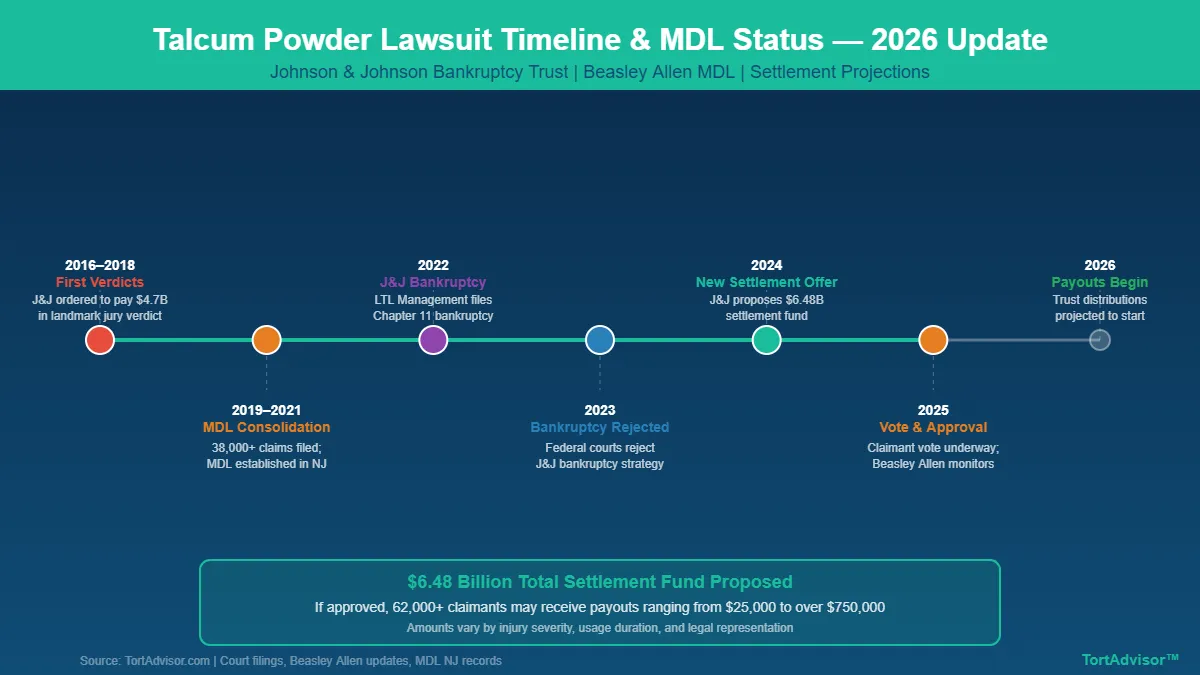
2016–2018: Major Jury Verdicts
Early trials went badly for J&J. In 2018, a Missouri jury awarded $4.69 billion to 22 women who said asbestos-tainted talc in J&J products caused their ovarian cancer. The award was later reduced on appeal, but it showed juries were taking these claims seriously.
2019–2021: MDL Consolidation
As individual filings surged past 38,000, a Multidistrict Litigation (MDL) was formed in the District of New Jersey to centralize pretrial proceedings while preserving each plaintiff’s right to an individual trial. J&J settled some cases privately and fought others in court.
2021–2022: The First Bankruptcy Maneuver
J&J created a subsidiary, LTL Management, moved its talc liabilities into it and had it file for Chapter 11 in October 2021. Known as the “Texas Two-Step,” the tactic aimed to limit payouts and pause thousands of trials, and critics called it a misuse of bankruptcy.
2023–2025: Courts Reject the Bankruptcy Attempts
In 2023, courts dismissed both LTL Management filings, finding the subsidiary was not in real financial distress and so did not qualify for bankruptcy protection. J&J then tried a third route in 2024 through Red River Talc, proposing a settlement worth about $6.48 billion in present value to be paid through a bankruptcy trust.
2025–2026: Plan Rejected and Litigation Resumes
The Red River plan required strong support from claimants and court approval. In early 2025, the bankruptcy judge rejected it, and the cases returned to the federal MDL and state courts. Beasley Allen, one of the most prominent firms in the litigation, opposed the plan and has kept clients informed. As of this update, bellwether trials and negotiations are the main paths toward resolution, and no payment timeline is set.
Has Anyone Been Paid in the Talcum Powder Lawsuit?
It helps to separate earlier private settlements from the much larger group of claimants still waiting for a broad resolution. A common question is whether anyone has received money from the talc litigation. The answer is yes, though most claimants are still waiting.
Who Has Received Money?
Over the years, J&J has privately settled many individual cases, particularly high-value mesothelioma claims and ovarian cancer claims with strong medical proof. Those deals are usually confidential, so amounts rarely become public, and some trial verdicts were paid after appeals ended. Still, most of the 62,000+ pending claims have not been paid and await either a global settlement or their own trials.
When Might the Talcum Powder Lawsuit Settle?
Everyone wants to know when the talc cases will settle. With the Red River plan rejected, there was no approved payment schedule; On July 27, 2026, J&J announced a proposed $5.5 billion settlement covering roughly 76,000 remaining ovarian cancer claims, contingent on at least 95% claimant participation; it is not final, and individual payout amounts have not been published. Resolution may come through a negotiated global settlement in the MDL, results from bellwether trials or another restructuring attempt, and some cases could run into 2028 or later. Many observers still expect a settlement eventually because of J&J’s interest in capping its liability.
What Determines Talc Settlement Value
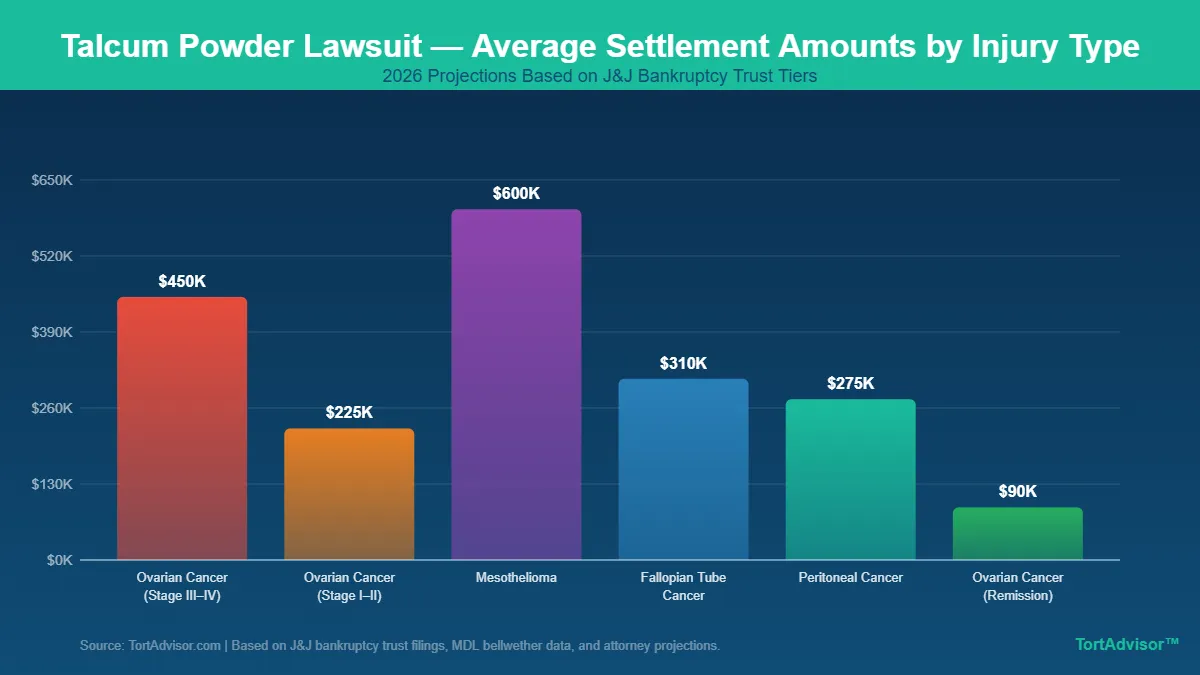
Claim values can differ dramatically between claimants, and without an approved settlement there is no reliable “average” to quote. Read this alongside our talc lawsuit payout guide for more context. Value depends largely on injury type and severity, history of use and the strength of your medical evidence.
How Claims Are Likely to Be Ranked
Mesothelioma: Typically the highest-value claims, because the disease is directly tied to asbestos and nearly always fatal. Advanced ovarian cancer (Stage III–IV): Women with late-stage diagnoses and years of talc use form the largest group and generally rank high. Early-stage ovarian cancer (Stage I–II): Cancers found before spreading usually rank somewhat lower. Fallopian tube and primary peritoneal cancer: These less common but serious cancers are generally included alongside ovarian cancer claims. Ovarian cancer in remission or with a favorable outlook: Women successfully treated may fall into lower-value categories. Exact amounts for any category will depend on the terms of a future settlement or verdict.
What Can Raise or Lower Your Claim’s Value
- How long you used talc: Years of regular use (5+) make a stronger claim
- Your diagnosis: Mesothelioma and advanced ovarian cancer generally rank highest
- Medical documentation: Pathology reports, oncology notes and earlier test results
- Product evidence: Receipts, photos or witnesses who can confirm your use
- Age and prognosis: Younger women with serious diagnoses often see higher values
Beasley Allen and the Talc Litigation in 2026
Large plaintiffs’ firms shape how claimants are informed and how settlement proposals are evaluated, which is why Beasley Allen’s talc updates draw attention nationwide. The Montgomery, Alabama firm has been among the most active in the litigation, representing many ovarian cancer claimants and helping guide MDL strategy. It publicly opposed J&J’s Red River bankruptcy plan, arguing the roughly $6.48 billion proposal would not fairly compensate claimants, especially those with the most serious diagnoses, and it continues to push for a fairer resolution. If you are represented by Beasley Allen or another firm and have not heard from your attorney recently, consider reaching out for an update on your case.
Who Qualifies for a Talcum Powder Lawsuit?
Eligibility usually turns on your diagnosis, history of use, the products involved and your filing deadline. You may have a talc claim if the following apply; for a broader overview, see our main talcum powder lawsuit page:
Core Eligibility Requirements
- Product use: Regular use of Johnson’s Baby Powder, Shower to Shower or another talc product for at least a year (four or more years makes a stronger claim)
- Diagnosis: Ovarian cancer, mesothelioma, fallopian tube cancer or primary peritoneal cancer
- Timing: The diagnosis came after a documented period of talc use
- No earlier settlement: You have not already settled a talc claim with J&J
Factors That Can Strengthen a Claim
- Using talc in the genital area for hygiene for five years or more
- A Stage III or Stage IV ovarian cancer diagnosis
- A mesothelioma diagnosis tied to asbestos-contaminated talc
- Thorough medical records and an identified treating oncologist
- Being able to document the brand, frequency and length of use
Watch the Filing Deadline
Many states allow 2 to 3 years from diagnosis (or from when you reasonably connected the diagnosis to talc) to sue, and some states’ “discovery rule” may extend that window. Don’t delay — deadlines are strict, and missing one can permanently end your right to compensation.
Evidence to Gather Before Filing
Collecting records early can affect whether a claim is accepted and how it is valued, since documentation is one of the strongest drivers of claim value. Your attorney will usually ask for:
- Medical records: The pathology report confirming diagnosis and your oncology treatment records
- Product evidence: Photos of J&J products, old receipts and statements from relatives who saw you use them
- History of use: A written timeline of when and how often you used talc
- Proof of harm: Surgical records, chemotherapy or radiation history and your current health status
- Income records: If you are seeking lost wages or other economic damages
How to File a Talcum Powder Claim in 2026
Here are the practical steps, though a review by an attorney who knows your facts is still essential before relying on any value estimate.
- Reach out to a mass tort attorney — Pick a lawyer experienced in talc litigation; most offer free consultations and work on contingency with no upfront cost.
- Pull your records together — Assemble medical records, diagnosis reports and proof of product use before your first meeting.
- Complete intake — Your attorney gathers your information and confirms whether your diagnosis, history of use and filing deadline qualify.
- File the claim — Your attorney files in the MDL, in state court or through any settlement program that exists at the time.
- Case evaluation — The claim is reviewed based on the strength of your evidence and how serious your injury is.
- Resolution — If your case settles or wins, you receive the recovery minus attorney fees (commonly 33–40% on contingency).
Talcum Powder Lawsuit FAQs
These answers summarize the latest talc litigation news for readers comparing settlement timing, claim value, eligibility and whether anyone has been paid.
When will the talcum powder lawsuit settle?
As of this update, On July 27, 2026, J&J announced a proposed $5.5 billion settlement covering roughly 76,000 remaining ovarian cancer claims, contingent on at least 95% claimant participation; it is not final, and individual payout amounts have not been published. The bankruptcy court rejected J&J’s Red River plan in early 2025, so resolution will likely come through MDL negotiations, bellwether trial results or a new proposal, and some cases may continue into 2028 or later. Many observers still expect an eventual settlement.
Has anyone been paid in the talc litigation?
Yes. J&J has privately settled many individual cases over the years, especially high-value mesothelioma and advanced ovarian cancer claims. Most of the 62,000+ pending claims, however, have not been paid and are waiting for a broader resolution.
What is a typical talcum powder settlement?
There is no reliable average because the proposed 2026 settlement has not published payout tiers and individual settlements are mostly confidential. Mesothelioma and advanced ovarian cancer claims generally carry the most value, while early-stage or remission cases tend to be worth less, depending on evidence and how any future settlement is structured.
What is the latest talcum powder lawsuit news for 2026?
J&J’s Red River bankruptcy plan, worth about $6.48 billion in present value, was rejected by the bankruptcy court in early 2025 after courts had dismissed two earlier bankruptcy attempts. Cases are moving forward in the federal MDL and state courts, and Beasley Allen and other firms continue to press for fair compensation. Check with an attorney for the latest developments.
What has Beasley Allen said about the talc litigation?
Beasley Allen, a leading firm in the talc MDL, opposed J&J’s Red River plan, arguing it would undercompensate the most seriously injured claimants, and continues to advocate for a fairer resolution while updating its clients. Represented claimants should contact their attorneys for case-specific news.
Summary: Talcum Powder Lawsuit News for 2026
This page follows Johnson & Johnson’s settlement efforts, the rejected bankruptcy plans, how claims are likely to be valued, eligibility, evidence and timing. The key takeaway is that a claim’s value depends on the diagnosis, long-term talc use, medical records, product evidence, state deadlines and the terms of any future settlement. Because the litigation keeps changing, review this update together with our settlement calculator and settlement amount pages before drawing conclusions about an individual claim.
Related Posts
Quick Answer: The Boy Scouts of America (BSA) filed for Chapter 11 bankruptcy in 2020 after facing tens of thousands [...]
Quick Answer: Survivors of sexual abuse by Catholic priests, nuns, or other Church personnel may be able to file a [...]
Quick Answer: Clergy abuse settlements vary enormously based on the severity of the abuse, the strength of evidence that the [...]