
Short answer: This article explains the key facts, eligibility issues, settlement factors, deadlines, and source-backed updates related to this legal topic. Results vary by case facts, evidence, jurisdiction, and representation.
I’m Mason Arnao. Through my work in data systems and digital advocacy, I’ve learned how Uber and Lyft assault compensation actually works in 2026, and why so many survivors of rideshare sexual assault never realize they may be owed meaningful compensation. As publisher of LegalLawsuit.com and President of Waypoint Software, I’ve spent more than 20 years helping people find information that matters. This guide covers rideshare assault settlements from start to finish: who qualifies, how the payout timeline works, and what shapes the amount you may recover.
Free, Confidential Case Review — No Fee Unless You Win
Call Now to Talk With a Rideshare Case Specialist
Available 24/7 · Confidential · Nothing Upfront
As of this update, the outlook for Uber and Lyft assault compensation in 2026 keeps moving in survivors’ favor. The $8.5M verdict against Uber set an important benchmark, and many survivors who weren’t sure about their legal options are now stepping forward. This guide explains the full settlement process: the factors that shape a settlement amount, how the payout timeline unfolds, and how experienced legal help can strengthen your recovery. If an Uber or Lyft ride led to sexual assault, see our rideshare sexual assault lawsuit page and try the rideshare settlement calculator for an educational estimate.
📋 Table of Contents
What Is Uber and Lyft Assault Compensation?
A rideshare assault settlement is money paid to a survivor of sexual assault that happened in or through an Uber or Lyft ride, reached through negotiation between the survivor’s lawyer and the company’s legal team. Most of these cases settle rather than go to trial, though some, like the case behind the $8.5M verdict against Uber, are tried before a jury with significant results. Settlements can cover medical costs (mental health care included), lost income, pain and suffering, emotional distress, loss of enjoyment of life, and sometimes punitive damages. Punitive damages punish especially bad corporate conduct and can substantially raise a recovery when Uber or Lyft knew about a particular driver’s dangerous record and did nothing. The legal basis is negligence: the companies owed riders reasonably safe transportation, breached that duty through careless hiring and safety practices, and that breach caused the harm. The DOJ’s Office on Violence Against Women notes that sexual assault carries serious, lasting physical and psychological effects, which is why the damages available can be significant even in moderately severe cases. The FTC’s consumer protection resources also address accountability for transportation platforms.
Free, Confidential Case Review — No Fee Unless You Win
Call Now to Talk With a Rideshare Case Specialist
Available 24/7 · Confidential · Nothing Upfront
What Determines the Value of a Rideshare Assault Settlement?
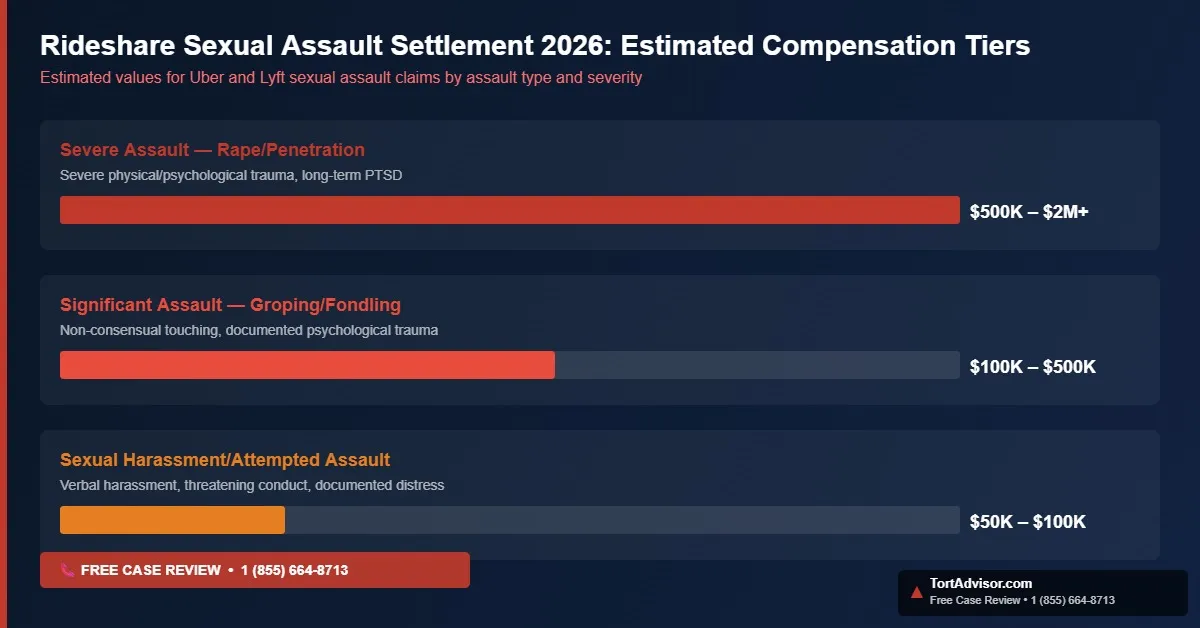
There is no fixed price for an Uber or Lyft assault claim, and quoted figures online are estimates rather than guarantees. Value generally tracks severity. Penetrative assault or rape cases, especially with physical injury and long-term PTSD needing ongoing care, sit at the top of the range, and evidence that Uber or Lyft knew of a driver’s dangerous history and failed to act can open the door to punitive damages. Groping or fondling with documented trauma, such as PTSD, anxiety, and treatment records, supports a substantial emotional distress claim. Harassment or attempted assault, including sexual comments and unwanted advances with documented distress, can also be compensable even without physical contact. For an educational estimate, use the rideshare settlement calculator, and browse all settlement calculators for more context.
Factors That Shape Your Uber or Lyft Assault Compensation
- How severe the assault was: penetrative assault is valued highest, with groping, fondling, and attempted assault valued lower but still meaningfully.
- How well it’s documented: a police report made soon after, SANE exam records from a hospital, and counseling records are the strongest evidence.
- The driver’s record: prior complaints, a criminal history, or warning signs Uber or Lyft ignored can make punitive damages available and raise the potential recovery considerably.
- Psychological harm: PTSD, documented anxiety or depression, ongoing therapy, medication costs, and being unable to ride with these services again all add to the recovery.
- Financial losses: lost pay, reduced earning ability, and job loss tied to the assault’s psychological effects are recoverable.
- The survivor’s age: younger survivors facing more years of lost earnings and diminished quality of life often receive larger awards.
- Where the case is filed: some states have histories of larger jury awards in sexual assault cases, which affects negotiations.
Uber and Lyft Assault Settlement Timeline for 2026
Many rideshare assault cases resolve faster than typical mass torts because they hinge on individual facts, one driver and one trip, that can be investigated and negotiated efficiently. A general timeline: Months 1–3: case review, gathering medical records, reviewing any police report, and retaining a lawyer. Months 3–9: demand letters go out, negotiations begin, and discovery seeks the driver’s history and Uber’s or Lyft’s hiring and screening practices. Months 9–18: the window in which many well-documented cases settle, as the companies often prefer to avoid the publicity of a trial. Years 1–3: cases that don’t settle early may head to trial, and complex litigated cases can stretch to 3–5 years. Your attorney will help you decide whether settlement or trial better serves you.
Who Qualifies for Uber or Lyft Assault Compensation?
- A passenger assaulted by an Uber or Lyft driver during or in connection with a rideshare trip
- Sexual contact without consent, or threats, coercion, or sexual violence
- An incident within the applicable statute of limitations (often 2–3 years; some states allow more)
- A claim brought in the United States
- Records of the harm, such as medical files, a police report, or therapy notes
How to File Your Rideshare Assault Claim
- Free, confidential review: call 833-333-0905 any time, day or night. Your privacy comes first.
- Protect the evidence: save your trip history in the app, consider filing a police report, and start counseling if you haven’t, since documentation strengthens your claim.
- Get matched with a lawyer: an experienced rideshare assault attorney in our network, on full contingency with no upfront fees.
- The demand: your attorney sends Uber’s or Lyft’s legal team a formal demand with your full documentation.
- Settlement or trial: many cases settle within 9–18 months, and your attorney will advise you on every offer.
Uber and Lyft Assault Compensation: Common Questions
Is it too late to file a rideshare assault claim in 2026?
If the assault happened within the past 2–3 years, you are very likely still within the filing window. Assaults before 2024 may be time-barred depending on your state, though some states have extended deadlines for sexual assault claims. Reach out right away for a free review to confirm your deadline.
What is a rideshare assault settlement worth in 2026?
There is no set amount. Value depends on how severe the assault was, the lasting psychological harm, the strength of the evidence, the driver’s history, and how clearly Uber or Lyft was negligent. Our rideshare settlement calculator offers an educational estimate.
Who can get Uber or Lyft assault compensation?
Passengers sexually assaulted by an Uber or Lyft driver during or in connection with a rideshare trip may qualify, provided the claim is within the statute of limitations; documentation of the harm makes it stronger. Call 833-333-0905 for a free, confidential eligibility review.
How long does a rideshare assault settlement take?
Well-documented cases often resolve within 9–18 months, while those requiring heavy litigation can take 2–3 years. Your attorney will evaluate your case and give you a realistic timeline; with strong evidence, many Uber and Lyft cases wrap up in under 18 months.
Do I need a police report to file?
No. A police report helps but isn’t required. Therapy and medical records, witness accounts, and your ride history can build a strong claim without one, and an attorney can tell you whether filing a report now would help.
Why does the $8.5M Uber verdict matter for my case?
The $8.5M verdict shows juries are willing to hold Uber accountable with significant awards. That gives survivors leverage, because Uber has to weigh the risk of similar verdicts against any settlement offer, and plaintiffs’ lawyers use it in negotiations. It signals a legal climate that has moved toward survivors.
About the Author
Mason Arnao is President and Managing Partner of Waypoint Software, LLC, and publisher of LegalLawsuit.com. More than 20 years in data systems and digital advocacy inform his understanding of mass tort compensation, including Uber and Lyft assault compensation in 2026, and he is committed to helping survivors understand their rights and pursue the compensation they deserve.
Deadlines Apply — Statutes of Limitations Are Running
Call Now to Talk With a Rideshare Case Specialist
Free, Confidential Case Review · Available 24/7 · No Fee Unless You Win
Related Posts
Quick Answer: The Boy Scouts of America (BSA) filed for Chapter 11 bankruptcy in 2020 after facing tens of thousands [...]
Quick Answer: Survivors of sexual abuse by Catholic priests, nuns, or other Church personnel may be able to file a [...]
Quick Answer: Clergy abuse settlements vary enormously based on the severity of the abuse, the strength of evidence that the [...]

