
Short answer: This article explains the key facts, eligibility issues, settlement factors, deadlines, and source-backed updates related to this legal topic. Results vary by case facts, evidence, jurisdiction, and representation.
📋 Table of Contents
- Why Understanding Motor Vehicle Accident Settlement Amounts Matters After a Crash
- Understanding the Building Blocks of a Settlement
- 3 Proven Methods to Estimate Your Motor Vehicle Accident Settlement Amount
- Key Factors That Will Adjust Your Final Settlement
- Navigating the Settlement Process from Claim to Payout
- Frequently Asked Questions about Motor Vehicle Accident Settlements
- Conclusion
How to Estimate an Accident Settlement — and Why It Matters After a Crash
Learning how to estimate an accident settlement matters because motor vehicle accident settlement amounts vary enormously, from modest payments for minor injuries to very large recoveries in catastrophic cases — and most people have no idea where their own claim fits. After a crash, you may be juggling medical bills, missed paychecks and stress while trying to understand what your case is really worth.
Quick Answer: What Moves a Settlement Up or Down
- Minor injuries (soft tissue, whiplash): Value tracks closely with medical bills, missed work and how quickly you recover
- Moderate injuries (fractures, herniated discs): Surgery, longer treatment and lasting limitations push value substantially higher
- Severe or catastrophic injuries (TBI, spinal cord damage, paralysis): Lifetime care costs and lost earning capacity drive the largest claims, often limited mainly by available insurance
- No injury (property damage only): Generally limited to repair or replacement costs and related expenses
Actual outcomes depend heavily on medical costs, lost income, pain and suffering and the insurance limits involved. Your settlement will reflect your specific facts, not published averages.
Insurers frequently open with low offers that do not reflect what a claim is truly worth. This guide explains three practical ways to estimate a settlement, the main factors that shape the final number and how to work through the claims process, so you can value your damages and avoid mistakes that leave money behind.
About the Author: I’m Mason Arnao. My core expertise is technology and SaaS architecture, but I have devoted significant time to researching car accident settlements, and my data analysis background gives me a useful lens on what drives fair compensation.
Key accident settlement terms:
- common motor vehicle accident injuries
- how to report a motor vehicle accident
- motor vehicle accident attorney near me
The Building Blocks of an Accident Settlement

An injury settlement is an agreement reached outside court between you and the at-fault party’s insurer. You receive money for your losses, and in return the claim is closed. Compared with a trial, it is usually faster and gives you more control over the result.
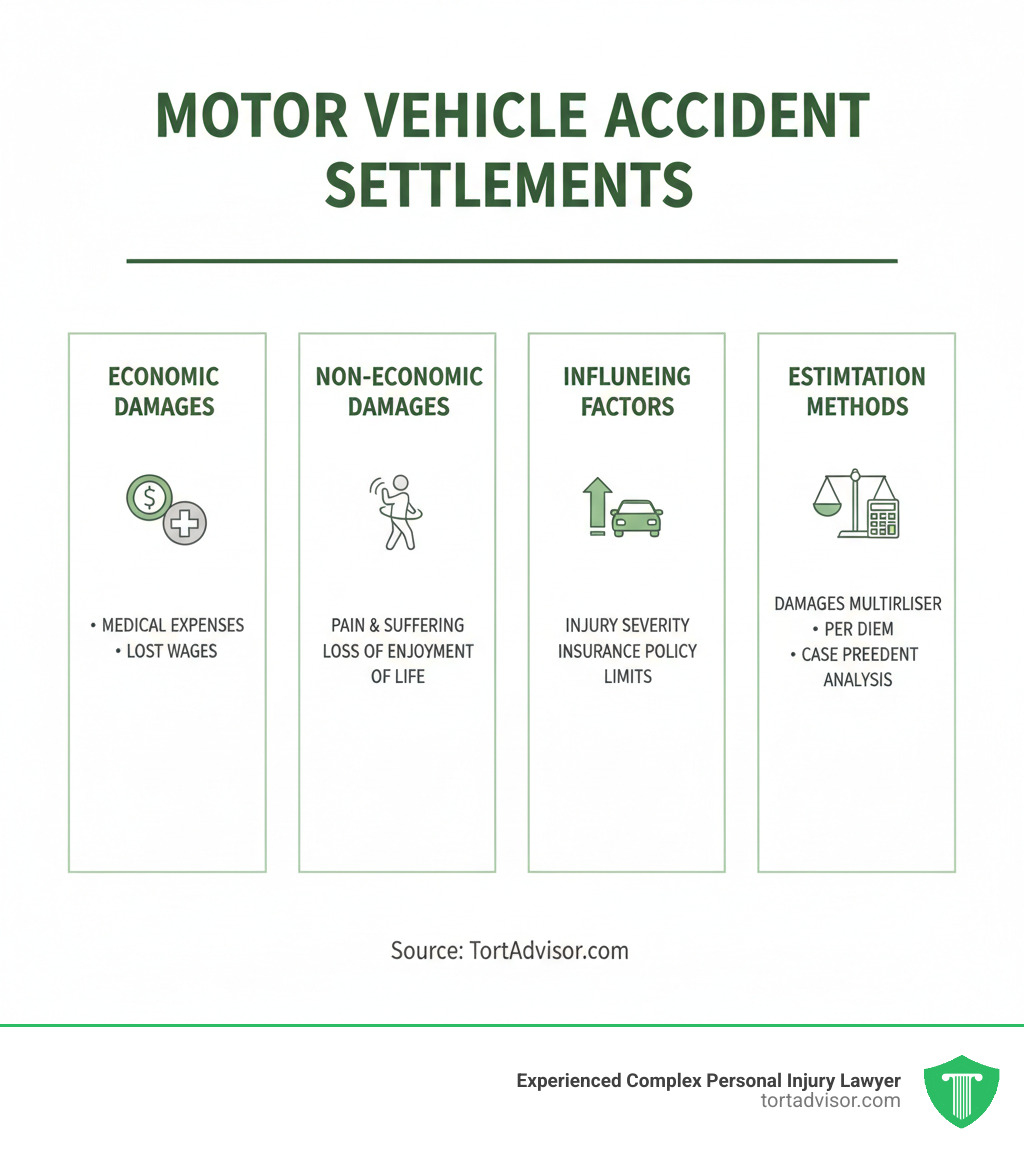
Every settlement centers on compensatory damages, which aim to put you back where you were financially before the crash. They come in two types: economic damages (concrete, measurable losses) and non-economic damages (intangible harms such as pain and suffering). Both are essential to reaching fair motor vehicle accident settlement amounts.
Your injuries shape everything. Common motor vehicle accident injuries run from whiplash to permanent spinal cord damage, and each carries its own set of recoverable losses.
What Losses Can a Settlement Cover?
A thorough settlement accounts for every way the crash has affected your life, now and down the road.
- Medical Costs: Everything from the ER visit to physical therapy, prescriptions and rehab — and, importantly, expected future treatment such as surgery or long-term pain management.
- Lost Pay and Earning Capacity: Wages, hourly pay and bonuses you missed while unable to work, plus lost earning capacity if your injuries permanently reduce what you can earn over your career.
- Property Damage: Repair or replacement of your vehicle and damaged belongings such as a phone or laptop.
- Pain and Suffering: Compensation for physical pain and emotional distress. With no receipt for suffering, this is often the most disputed piece, and some states cap it or require a “serious and permanent” injury to claim it.
- Loss of Enjoyment of Life: Recognition that injuries can keep you from sports, hobbies and other activities you valued — losses that deserve compensation.
- Additional Costs: Out-of-pocket items like travel to appointments, paid help with housework or yard work, and modifications to your home or car.
Each loss you have suffered belongs in the calculation of a fair settlement.
How to Estimate an Accident Settlement: 3 Practical Methods
Estimating motor vehicle accident settlement amounts is not an exact science, and no formula is perfect, but you are not guessing blindly either. The methods below produce a reasonable ballpark, though your final number will turn on the details of your case.

Online calculators can give you a starting point, but they often miss what makes a case unique. A better approach pairs structured methods with real-world evidence. For a more tailored look, try our MVA Settlement Calculator. Knowing how these calculations work will help you during negotiations.
Method 1: The Multiplier Method
The multiplier approach is one of the most common ways to estimate value. Start by totaling your economic damages — past and future medical bills, lost wages and other out-of-pocket costs. For this example, assume they come to $15,000.
Then multiply that total by a figure, commonly between 1.5 and 5 (higher for catastrophic harm), to account for pain and suffering and other non-economic losses. The multiplier rises with injury severity:
- Minor injuries (quick recovery): a multiplier around 1.5 to 2.
- Moderate injuries (broken arm, herniated disc): around 3 to 4.
- Severe or catastrophic injuries (TBI, paralysis): 5 or more.
Using the example of a moderate injury with $15,000 in economic damages and a multiplier of 3: $15,000 × 3 = $45,000 in non-economic damages. Adding back the $15,000 gives an illustrative estimate of $60,000.
Method 2: The Per Diem Method
“Per diem” means “per day,” and this method values pain and suffering with a daily rate. It works best when recovery has a clear end point.
Begin by choosing a daily rate, often tied to what you earn in a day, on the reasoning that a day in pain is worth at least a day’s pay. If you make $200 a day, that becomes the rate.
Multiply the rate by the number of days you were in significant pain, from the crash until you reached Maximum Medical Improvement (MMI). Ninety days at $200 equals $18,000 in non-economic damages; add the $15,000 in economic damages for an illustrative estimate of $33,000.
Per diem is a poor fit for permanent injuries, because multiplying across a lifetime produces figures insurers and courts rarely accept.
Method 3: Comparing Outcomes in Similar Cases
Each case is different, but looking at how comparable injuries have resolved can provide helpful context. Treat any such comparison as a rough guide, never a promise.
- Minor injuries (whiplash, sprains): Usually the lowest-value claims, driven mainly by treatment costs and time missed from work, and results differ significantly from state to state.
- Moderate injuries (fractures, herniated discs): Generally worth considerably more, especially when surgery, injections or months of therapy are involved.
- Serious or catastrophic injuries (TBI, spinal cord damage): The highest-value claims, reflecting lifetime care, lost earnings and profound changes to daily life; available insurance often becomes the practical ceiling.
The pattern is consistent: the more serious and lasting the injury, the more a claim is worth. Your outcome will hinge on the strength of your evidence and representation, and an experienced car accident compensation attorney can help position your claim for full value.
Factors That Shift Your Final Settlement
Estimation methods are only a beginning. The motor vehicle accident settlement amounts people actually receive can change sharply depending on several key factors, and this is where a capable attorney often makes the biggest difference.

Picture a settlement as a recipe whose result depends on how the ingredients combine — state law, insurance coverage and the quality of your evidence all matter. If you are unsure whether you need help, our guide Do I Need a Personal Injury Lawyer explains when hiring one makes sense.
How Fault Rules and State Law Affect Value
Who caused the crash matters, but how your state assigns fault can transform the outcome. Most states use an at-fault (tort) system, where the responsible driver pays. A smaller group are no-fault states, where your own insurer pays initial medical bills no matter who caused the crash.
Even when the other driver was mostly responsible, your own share of blame can shrink or erase your recovery, depending on the state’s negligence rules:
- Contributory Negligence: In a handful of states, being found even 1% at fault bars any recovery.
- Pure Comparative Negligence: Your recovery drops by your share of fault, so someone 70% at fault on a $100,000 claim could still collect $30,000.
- Modified Comparative Negligence: The most widespread approach, allowing recovery only while your fault stays under a cutoff (typically 50% or 51%). At 25% fault on a $100,000 claim you would receive $75,000, but at 51% you would get nothing. Indiana, for instance, applies a 51% rule under Indiana’s comparative fault law.
Policy Limits, Deductibles and Damage Caps
A hard reality is that settlements are bounded by available insurance. If the at-fault driver carries only $25,000 in bodily injury coverage, that may be the most the insurer will pay, even if the claim is worth far more.
That is why uninsured/underinsured motorist (UIM) coverage on your own policy matters so much — it can fill the gap when the other driver has little or no insurance.
Other financial limits may include:
- Statutory Deductibles: Some jurisdictions automatically subtract a set amount from certain awards, such as pain and suffering.
- Caps on Pain and Suffering: Some states limit non-economic damages no matter how serious the injury.
How Strong Evidence Raises Settlement Value
Insurers want proof, and the quality of your evidence can decide your claim. Solid documentation pushes insurers toward fair offers.
Important evidence includes:
- Medical Records: Imaging such as X-rays and MRIs, treatment plans and specialist prognoses objectively prove your injuries and future needs.
- Police Report: An official account of the crash, often with an early view of fault.
- Photos and Video: Pictures of the vehicles, the scene and your injuries create a compelling visual record.
- Witness Statements: Independent witnesses can back up your account.
- Income Records: Pay stubs, tax returns and employer letters document lost earnings.
- Expert Opinions: In complex claims, reconstruction experts, medical specialists and vocational experts offer valuable analysis.
For what to do right after a crash, see How to Report a Motor Vehicle Accident.
From Claim to Payout: How the Settlement Process Works
The road from injury to settlement can feel confusing, and knowing the stages helps you stay patient and decide wisely. The good news is that most car accident claims settle without a trial, which is costly, slow and unpredictable. When negotiations break down, though, a lawsuit may be necessary; our guide to Personal Injury Lawsuits explains what that involves.

No-Fault Claims vs. Tort Claims
In the U.S., how you pursue compensation depends on whether your state is “no-fault” or “at-fault,” and the difference is significant.
In no-fault states, you start with Personal Injury Protection (PIP) benefits from your own policy, regardless of who caused the crash. PIP pays immediate costs such as medical bills and lost wages up to a limit, giving you quick access to money without proving fault. To sue the at-fault driver for pain and suffering and losses beyond PIP, however, your injury must cross a threshold — defined as a “serious injury” or a set amount of medical expenses.
In at-fault (tort) states, you go straight to the at-fault driver’s insurer and must prove that driver was negligent. There is no threshold for claiming pain and suffering, but payment usually waits until the insurer finishes its liability investigation.
An experienced lawyer knows how to coordinate these claims to maximize your overall recovery. For a general overview of claims principles, the Understanding the claims process resource from the Financial Services Regulatory Authority is a helpful reference.
How a Personal Injury Lawyer Can Increase Your Recovery
Is a lawyer worth the fee? Research has found that claimants with experienced injury attorneys often recover meaningfully more than those who handle claims alone. Insurers employ adjusters and lawyers whose job is to pay less, and a skilled attorney evens the field.
An attorney will typically:
- Determine the full, long-term value of your claim.
- Collect the evidence you need, including expert opinions.
- Manage every conversation with the insurers.
- Track deadlines and handle legal procedures.
- Negotiate firmly for a fair settlement.
- Go to trial if no fair offer is made.
With a lawyer handling the legal fight, you can concentrate on getting better. Learn more in What Can a Personal Injury Lawyer Do For You.
How Long Settlements Take and the Filing Deadline
“How long will it take?” has no one-size answer. Claims generally should not settle until you reach Maximum Medical Improvement (MMI), when your condition has stabilized, because settling earlier risks underestimating future medical needs.
MMI may take months for minor injuries and more than a year for serious ones, followed by several months of negotiation. If a lawsuit is filed, court backlogs can add a year or more.
The deadline that matters most is the statute of limitations, the legal time limit to file suit. Many states allow two years from the crash, though it varies, and missing it ends your right to sue permanently. Talk to a lawyer early to protect your rights.
Accident Settlement FAQs
Questions about motor vehicle accident settlement amounts come up constantly after a crash. Here are clear answers to the most common ones.
Are car accident settlements taxable in the U.S.?
Usually, the main parts of a settlement for physical injuries are not taxable. The IRS does not treat compensation for pain and suffering, medical costs or emotional distress tied to a physical injury as income, since that money is meant to make you whole.
There are key exceptions, though. Money that replaces lost wages or income is often taxable, because you would have paid tax on those earnings anyway, and punitive damages, which are uncommon and meant to punish, are taxable as well.
Because tax rules can be complicated, it is wise to have a qualified tax professional review your settlement agreement.
Do most car accident claims settle out of court?
Yes. The vast majority of injury cases, including car accidents — often estimated at over 95% — resolve through settlement rather than trial, for practical reasons:
- Expense: Trials bring expert, filing and legal costs that can eat into your net recovery.
- Time: Court backlogs and appeals can stretch a case out for years.
- Uncertainty: Jury verdicts are unpredictable — you could win big or leave with nothing.
- Control: In a settlement, you approve the final terms and know exactly what you will receive.
When talks stall, mediation (a neutral facilitator helps the parties agree) or arbitration (a neutral decision-maker issues a binding ruling) can resolve a case without a full trial.
What counts as a fair pain and suffering amount?
Pain and suffering is among the most subjective parts of any settlement, and no fixed formula applies because every experience is personal.
Its value depends on:
- How severe and permanent the injuries are.
- How long recovery takes.
- How much daily life is disrupted — work, hobbies and relationships.
- How much emotional and psychological harm results, such as anxiety or PTSD.
Attorneys use the multiplier and per diem methods as reference points, but the final figure comes out of negotiation. An experienced lawyer knows how to present your suffering persuasively, cite comparable outcomes to support a higher value and push back when insurers minimize what you have been through, which can significantly change your result.
Conclusion
Learning how to estimate an accident settlement is as much art as science. We have covered the key pieces: identifying your damages, applying the multiplier and per diem methods and recognizing the factors that move the final number.
These tools are a useful start, but your case is unique. Your injuries, how your life has changed, available insurance and state law all matter a great deal, and managing the process while recovering physically and emotionally is a heavy load.
You should not have to become a legal expert to be treated fairly. That is why the right representation matters: an experienced injury lawyer understands how insurers try to cut payouts and how to build a claim that reflects your real losses.
Legal Lawsuit is a legal-information site that helps injured people connect with experienced attorneys in our network who handle car accident cases, starting with a free, confidential case review.
If you want to know what fair compensation could look like for you, don’t face the insurer alone — they have experts on their side, and you deserve one on yours.
Connect with an experienced attorney for your car accident claim
Your recovery and your future matter. Take the next step toward the compensation you are owed.
Additional Resources
Related Posts
Quick Answer: The Boy Scouts of America (BSA) filed for Chapter 11 bankruptcy in 2020 after facing tens of thousands [...]
Quick Answer: Survivors of sexual abuse by Catholic priests, nuns, or other Church personnel may be able to file a [...]
Quick Answer: Clergy abuse settlements vary enormously based on the severity of the abuse, the strength of evidence that the [...]