Short answer: This article explains the key facts, eligibility issues, settlement factors, deadlines, and source-backed updates related to this legal topic. Results vary by case facts, evidence, jurisdiction, and representation.
In This Guide
How Many Roundup Lawsuits Have Been Filed? The Scale of the Litigation
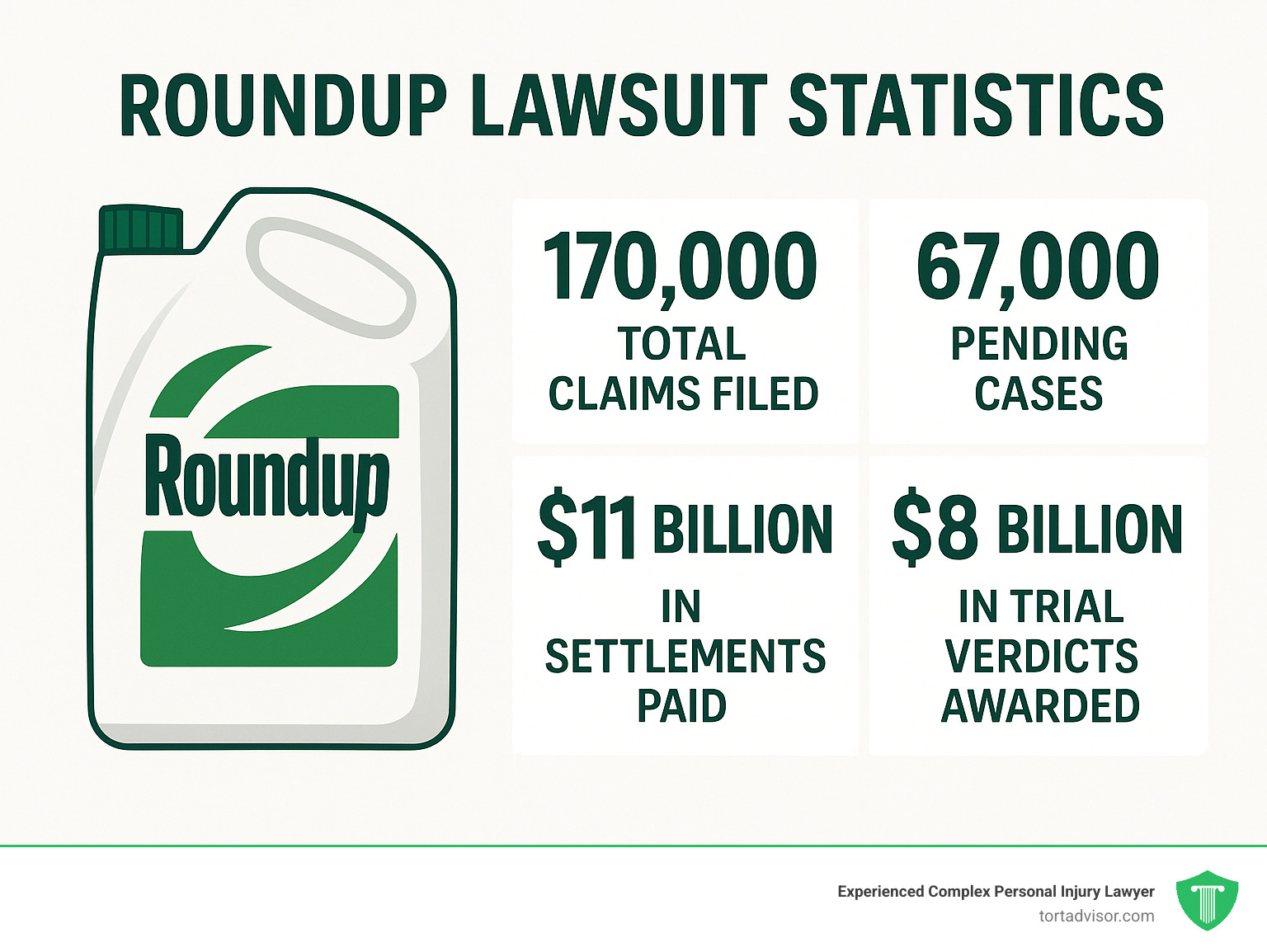
So how many Roundup lawsuits are there? The count is enormous, and new claims keep arriving as more people connect a cancer diagnosis to past Roundup exposure. The key figures, as most recently reported:
- Claims filed overall: roughly 170,000 or more
- Still unresolved: tens of thousands, reported at around 60,000 to 67,000 in 2025
- Federal MDL: about 4,437 pending in N.D. California as of August 2025
- Resolved: about 100,000 claims for roughly $11 billion
- Jury awards: billions in verdicts across two dozen trials, many later reduced
Roundup is among the largest mass torts the U.S. has ever seen. It began with farmers and home gardeners who developed non-Hodgkin lymphoma and grew into litigation involving tens of thousands of people against Bayer AG, which bought Monsanto in 2018. The volume of claims reflects concern about glyphosate, the herbicide’s active ingredient, which the World Health Organization’s cancer agency labeled “probably carcinogenic to humans” in 2015. Bayer maintains the product is safe, yet many juries sided with plaintiffs. I’m Mason Arnao, and through my work in data management and lead generation I have followed how the number of Roundup lawsuits has grown across courts and claim databases.
Related Roundup lawsuit topics:
- Class action lawsuit against roundup
- Roundup lawsuit verdict
- What cancers are included in the roundup lawsuit
How Many Monsanto Roundup Lawsuits Have Been Filed?
The Roundup fight has continued through 2025 and into 2026 and remains one of the most complicated mass torts on record. The figures below summarize where things stand.

Claims surged after 2015, when the International Agency for Research on Cancer classified glyphosate as a probable human carcinogen, prompting people who had used Roundup and later developed non-Hodgkin lymphoma to sue. The cases are complicated because they span many court systems. Bayer inherited the litigation when it acquired Monsanto in 2018. Federal cases were consolidated in a multidistrict litigation (MDL) for efficiency, while state courts handle their own large dockets.
Total Roundup Claims Filed
By most reported counts, roughly 170,000 Roundup claims have been brought, putting the litigation among the largest product liability matters in U.S. history. That growth reflects how widely Roundup was used and how much public attention the cancer question received. Our guide to Monsanto Roundup lawsuits explains how these claims work in detail.
How Many Roundup Lawsuits Are Still Pending?
Even after years of settlements, a large number of Roundup lawsuits remain open, with tens of thousands reported pending across federal and state courts in 2025. The federal MDL in the Northern District of California listed about 4,437 cases as of August 2025, and state courts carry many more, each on its own procedures and schedule. New claims have continued as people receive diagnoses and learn about the litigation, although the Supreme Court’s 2026 preemption ruling and the proposed class settlement described below have changed the outlook for many claimants.
How Many Roundup Claims Has Bayer Settled?
Bayer has worked for years to contain the litigation, resolving about 100,000 claims for roughly $11 billion. Part of the earlier settlement framework was set aside for people diagnosed in the future, which signaled Bayer expected more claims. In 2026 a proposed class settlement of roughly $7.25 billion for current and future claimants received preliminary approval in Missouri state court; check the settlement’s official notice for eligibility and deadlines.
Major Roundup Verdicts and Their Cost to Bayer
Roundup juries have returned some of the largest product liability verdicts in recent memory. Many included punitive damages meant to punish what jurors viewed as serious corporate misconduct, not just to cover medical costs.
The financial toll on Bayer has been heavy. Big verdicts have pressured its share price and pushed it toward settlements, and the pattern has repeated: a large award, an appeal that often cuts the amount, and lasting damage to the company’s finances and reputation.
How Much Roundup Juries Have Awarded
Across roughly two dozen completed trials, juries have awarded several billion dollars in total, although judges and appellate courts have reduced many of the largest awards and Bayer has also won a number of trials. Plaintiffs secured several major verdicts beginning in late 2023, which added pressure on the company to resolve claims. For more on individual trials, see our coverage of Roundup lawsuit verdicts.
Verdicts That Shaped the Litigation
A few verdicts changed how Roundup cases were tried and valued. John McKivison’s $2.25 billion verdict in Philadelphia in January 2024 was the largest Roundup award at the time; he had used the product for decades before his non-Hodgkin lymphoma diagnosis, and the judge later cut the award to about $400 million. Dewayne Johnson, a school groundskeeper, won the first Roundup trial in August 2018 with a $289 million verdict that was later reduced on post-trial motions and appeal. Alva and Alberta Pilliod, a married couple who both developed non-Hodgkin lymphoma after years of garden use, won about $2 billion in May 2019, later reduced to roughly $87 million. In 2025 a Missouri appeals court upheld a verdict of about $611 million for a group of plaintiffs, finding sufficient evidence that Monsanto failed to warn of cancer risks.
Bayer’s Appeals and the Supreme Court Preemption Ruling
Bayer’s central defense has been federal preemption: the argument that because the EPA approved Roundup’s label without a cancer warning, states cannot require one. That strategy reached the U.S. Supreme Court in Monsanto v. Durnell, a Missouri case involving a $1.25 million verdict. In June 2026 the Court ruled 7-2 that federal pesticide law (FIFRA) preempts state failure-to-warn claims based on the label, a major win for Bayer that limits that theory going forward. Other claims, such as design defect theories, and the proposed class settlement remain important for people with NHL. Bayer has also sought legislative protection, including language in federal farm legislation.
The Science and Corporate Conduct at Issue
Behind the claim counts is a long dispute over science, corporate responsibility and what Monsanto knew and when. The litigation grew alongside both new research and the release of internal company documents.

For families coping with cancer, the scientific debate is deeply personal, and internal records have raised questions about whether the company put sales ahead of safety.
Does Roundup Cause Non-Hodgkin Lymphoma?
The pivotal moment came in March 2015, when the International Agency for Research on Cancer (IARC) classified glyphosate as probably carcinogenic to humans, citing limited evidence in humans and sufficient evidence in experimental animals. In 2019, a University of Washington-led meta-analysis reported a 41% higher risk of non-Hodgkin lymphoma among people with the highest exposure to glyphosate-based herbicides. The science is not unanimous, though. The EPA has maintained that glyphosate is “not likely to be carcinogenic to humans,” and the Agricultural Health Study of more than 54,000 pesticide applicators did not find a clear link to NHL overall. That disagreement is why juries, and now appellate courts, have played such a large role.
What the “Monsanto Papers” Showed
Internal records produced during discovery, known as the “Monsanto Papers,” became central to many trials. Plaintiffs argued the documents showed efforts to undermine independent scientists and shape public perception of glyphosate’s safety. They also pointed to evidence of ghostwriting, in which company personnel allegedly drafted research that outside academics then published under their own names. Plaintiffs further cited attempts to influence regulators. Monsanto and Bayer dispute these characterizations, but jurors in several trials found the documents persuasive evidence that the company understood potential risks while publicly denying them.
Regulatory Developments to Watch
Regulators are revisiting glyphosate, which could affect future claims. The Ninth Circuit previously found significant flaws in the EPA’s cancer analysis, leading the agency to withdraw its interim decision, and a new EPA review has been expected around 2026. Federal health officials have also raised broader questions about pesticide exposure, including in the “Make America Healthy Again” report. Any change in EPA’s position could influence both the science debate and the legal landscape, though after the Supreme Court’s preemption ruling, label-based warning claims face major limits.
Who Qualifies for a Roundup Cancer Claim?
If you or someone close to you developed cancer after using Roundup, you may be wondering whether you still have a claim. With so many Roundup lawsuits filed, plenty of people have faced the same question. Options may remain even if time has passed, though recent court rulings and the proposed class settlement affect what is available. Eligibility generally turns on your diagnosis, your exposure history, filing deadlines and your medical records.
Which Cancers Are Included in Roundup Claims?
Most claims involve non-Hodgkin lymphoma (NHL), the cancer most often tied to Roundup in court, along with related blood cancers. NHL is an umbrella term for cancers of the lymphatic system. Diffuse large B-cell lymphoma (DLBCL), an aggressive subtype, appears in many trial cases. Chronic lymphocytic leukemia (CLL) generally progresses more slowly but also affects white blood cells in the blood and bone marrow. Other subtypes raised in claims include follicular lymphoma, mantle cell lymphoma, small lymphocytic lymphoma and hairy cell leukemia. Your specific diagnosis matters for eligibility, but the key is linking it to your history of Roundup use.
Evidence Needed for a Roundup Claim
A strong claim documents both your exposure and your diagnosis. Proof of Roundup use is the starting point: receipts help if you kept them, but landscaping or farm records, job history showing herbicide work, and statements from family, neighbors or coworkers can also show how often and how long you used it. Frequency and duration often matter more than perfect paperwork. Medical records confirming your diagnosis, treatment and prognosis are essential and help show when the cancer developed relative to your exposure. Expert testimony from oncologists, toxicologists and epidemiologists is frequently decisive, and attorneys who handle Roundup cases typically work with these experts.
Is It Too Late to File a Roundup Claim?
Timing depends mainly on your state’s statute of limitations, which commonly runs one to three years. In many states the clock starts under the “discovery rule,” meaning when you knew or reasonably should have known that Roundup might be connected to your illness, not necessarily at diagnosis. Wrongful death claims usually run from the date of death. Waiting can forfeit your rights, so talk to an attorney promptly even if you think a deadline is close. The proposed class settlement also has its own registration and opt-out deadlines. To learn how individual suits differ from class actions, see our page on the class action lawsuit against Roundup. If you were diagnosed after using Roundup, a quick consultation can tell you whether you still have time.
How Roundup Settlements Work
If you are considering a claim, it helps to understand how compensation is determined and paid.
What Affects the Value of a Roundup Claim?
Every claim is different, and value depends on several factors. Illness severity carries the most weight: aggressive cancers requiring chemotherapy, radiation or multiple procedures generally support higher values, and the stage at diagnosis matters. Amount and length of exposure also count, so a landscaper who used Roundup daily for years usually has a stronger claim than an occasional home user. Economic damages include medical bills, lost wages and reduced future earnings, while non-economic damages cover pain, emotional distress and loss of enjoyment of life. Under a class settlement, payments are typically set by a matrix based on diagnosis, age and exposure, so review the official settlement materials or speak with an attorney about how your case would be valued.
How Long Until a Roundup Settlement Is Paid?
Payment takes time even after a settlement is agreed, often weeks to many months. Several steps come first. Liens from Medicare, Medicaid or private insurers that paid for treatment must be resolved, fees and costs finalized and paperwork completed. Mass settlements add administration: claims administrators must review documentation for large numbers of people before issuing payments. Waiting is hard when bills are piling up, and experienced attorneys work to move the process along. Our guide, “When Will I Get My Roundup Settlement Check?”, explains each step and what timelines to expect.
Your Options Now
The numbers make the point: with roughly 170,000 claims filed and billions already paid, Roundup has been one of the defining mass torts of its era. The Supreme Court’s June 2026 preemption ruling narrowed failure-to-warn claims, while the proposed class settlement offers a separate path for many people with NHL, so the right strategy depends on your situation. Timing matters, because both court deadlines and settlement deadlines apply. Legal Lawsuit explains these developments in plain language and can connect you with independent attorneys who handle Roundup cases for a free, confidential review. You do not have to sort this out alone. Explore your options for a Monsanto Roundup lawsuit and take the first step toward understanding your rights.
Additional Resources
Related Posts
Quick Answer: The Boy Scouts of America (BSA) filed for Chapter 11 bankruptcy in 2020 after facing tens of thousands [...]
Quick Answer: Survivors of sexual abuse by Catholic priests, nuns, or other Church personnel may be able to file a [...]
Quick Answer: Clergy abuse settlements vary enormously based on the severity of the abuse, the strength of evidence that the [...]