
Short answer: This article explains the key facts, eligibility issues, settlement factors, deadlines, and source-backed updates related to this legal topic. Results vary by case facts, evidence, jurisdiction, and representation.
📋 Table of Contents
What Is Mass Tort Litigation Support? A Practical Guide
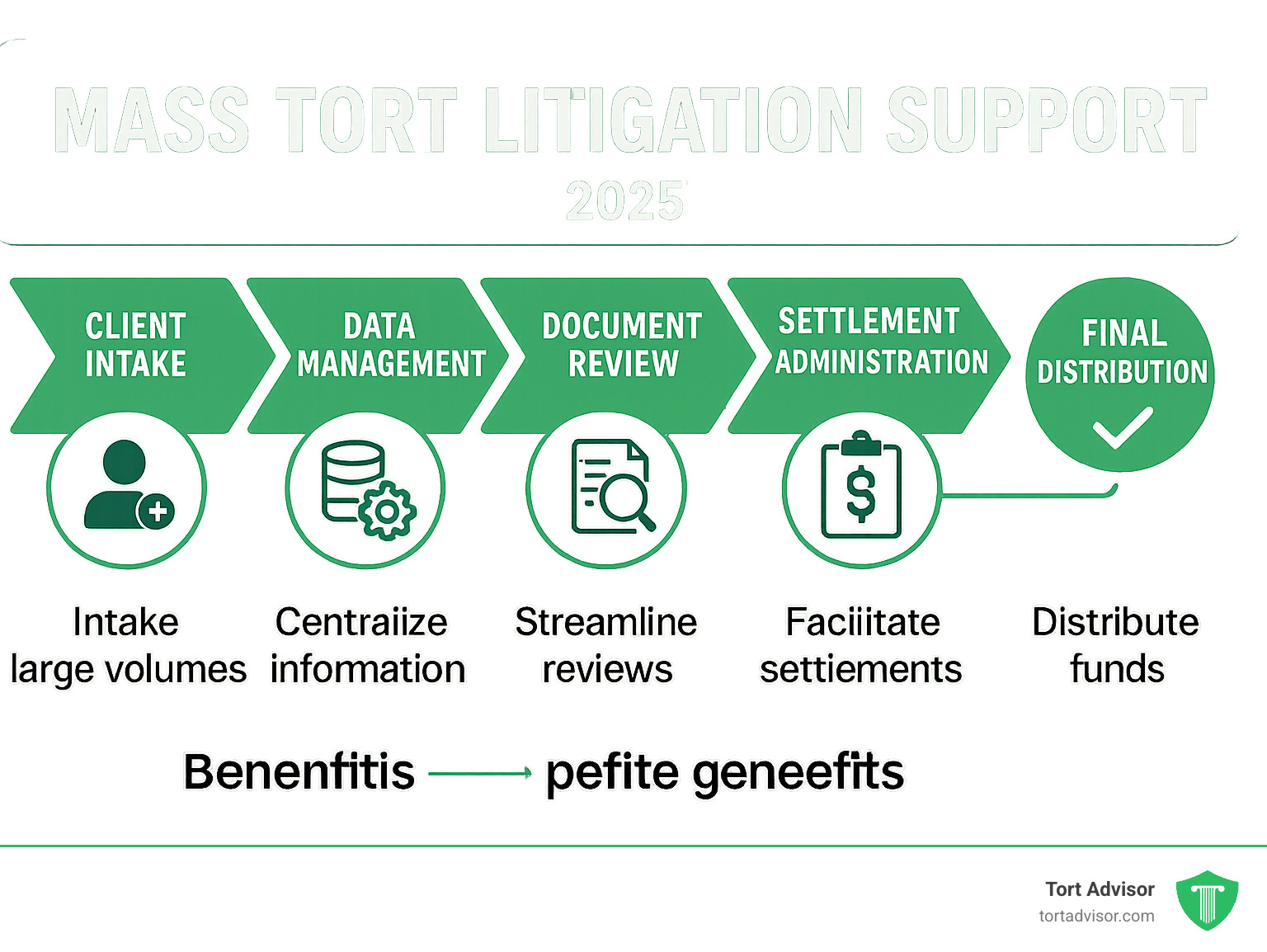
Mass torts are among the largest and most demanding cases in the legal system, sometimes involving thousands of people injured by the same product or event, such as a faulty medical device or an environmental disaster. Mass tort litigation support supplies the specialized help firms need to run these high-volume cases well.
What mass tort litigation support provides:
- Volume handling: manages the huge numbers of claimants and documents in torts such as AFFF firefighting foam or talcum powder.
- Greater efficiency: speeds up intake, medical record collection, and data management, cutting manual work sharply and producing high completion rates.
- Lighter admin load: takes heavy administrative work off the firm so it can concentrate on legal strategy.
- Sharper attorney focus: lets lawyers build cases and negotiate settlements rather than chase paperwork.
Know-how in cloud data management and automation maps directly onto the demanding data needs of mass tort litigation support, keeping enormous volumes of information secure and well organized.
Below, we look at how specialized support changes the way mass tort litigation runs.
Why Mass Tort Cases Need a Dedicated Support System

Mass torts put law firms in an unusual position: instead of one client, they serve thousands, each with a distinct story and legal needs. The scale is hard to overstate.
Litigation such as AFFF firefighting foam lawsuits and Talcum Powder cases routinely involves very large plaintiff counts. Support provider Verus, for instance, has handled more than 8.7 million claims, and firms like Faegre Drinker have worked tens of thousands of cases. Behind every number is a person looking for justice.
These cases produce enormous data sets, often terabytes of medical records and documents, and pinpointing information during complex discovery becomes a massive undertaking.
Constant repetitive work, including intake, record requests, document sorting, and deadline tracking, adds up to an administrative load that can swallow a firm’s capacity. Without solid mass tort litigation support, lawyers end up doing clerical work instead of practicing law.
Knowing How Much Does Mass Tort Lawsuits Receive matters, but the harder task is running the process efficiently so clients get the best possible result.
The Heavy Load of Administrative Work
Administration in a mass tort is essential to success and can easily become overwhelming.
Keeping claimants informed is a full-time role that calls for thoughtful, compassionate, and prompt contact with thousands of people.
Collecting medical records is a major hurdle, spanning countless providers with different systems, and one missing record could be the key piece of evidence.
Organizing documents requires precision. Each file must be labeled and searchable to avoid chaos when preparing for trial.
Court filings and compliance deadlines, particularly in Multidistrict Litigation (MDL), are intricate. Missing one, such as those addressed in a New Case Management Order On Witnesses, can put whole groups of claims at risk.
Administrative work like this can take up as much as 80% of a legal team’s time.
Letting Your Firm Focus on Strategy
Mass tort litigation support changes the equation, freeing your lawyers to do the high-value work clients depend on.
Attorneys can concentrate on substantive legal work: researching case law, building arguments, and investing in trial preparation with expert witnesses.
Clean, well-organized data makes settlement negotiations more strategic and more confident.
The firm’s priorities move from paperwork to delivering value for clients, so every matter, from a straightforward Personal Injury Lawsuit to a complex case, gets proper attention.
The payoff: more time for meaningful legal work, stronger outcomes, and a more focused team.
Core Services in a Complete Mass Tort Litigation Support Toolkit
Mass tort litigation support is a full end-to-end system, not a handful of add-ons, managing a case from the first phone call to the last payment. It blends expertise, technology, and skilled people to handle everything from screening clients to administering settlements, tailored to specific torts such as Hernia Mesh Lawsuits, a Hair Relaxer Lawsuit, and cases involving Paraquat, Roundup, Talcum Powder, AFFF, and Zantac.
Support usually unfolds in four main stages:
Stage 1: Intake and Screening Claimants
This opening stage lays the foundation for a strong case inventory. Specialized mass tort litigation support providers supply:
- Trained intake staff, frequently through round-the-clock call centers, who collect claimant details with care and speed.
- Firm-approved qualification criteria to spot viable claims fast and weed out those that don’t qualify.
- Handling of plaintiff questionnaires so data is captured fully and consistently.
- Help moving qualified clients through retention, often with secure online tools that keep it quick and simple.
Stage 2: Managing Medical Records and Data
After retention, attention turns to data. In most personal injury mass torts, medical records carry the proof of injury and causation.
- Record retrieval: support teams lean on proven systems and provider relationships to gather records quickly from many sources.
- Chronologies and summaries: stacks of records are condensed into tight summaries so lawyers can absorb the key medical facts fast.
- Gap analysis: missing documentation is identified and tracked down.
- Data extraction: critical details such as diagnosis dates and treatments, essential in matters like the Depuy Synthes Knee Implant Lawsuit, are pulled from the records.
Together these services turn raw information into usable insight and save legal teams enormous amounts of time. Examples can be seen at providers like Tort Solutions, and reviews are available for firms such as Medsmith LLC.
Stage 3: Building the Case and Expert Support
Once records are in order, the work shifts to building the strongest case possible, which calls for targeted legal and medical expertise.
- Plaintiff Fact Sheets (PFS): providers assemble these standard MDL forms and check them for accuracy and completeness before filing.
- Document review: goes past medical files to discovery materials and scientific research, often using advanced tools to surface key evidence.
- Bellwether picks: providers help firms choose strong, representative cases for early trials, which often shape global settlements.
- Finding expert witnesses: providers link firms with qualified medical and scientific experts. The Expert Institute’s Mass Tort Accelerator, for example, gives access to physicians who supply research and analysis that put cases on solid scientific ground.
This work is essential for getting cases ready for trial or settlement and for meeting milestones such as those set out in Getting Cases Ready For Trial.
Stage 4: Administering Settlements and Resolving Liens
After a settlement, distributing the money becomes its own complex project that demands financial and administrative skill.
- Claims administration: verifying claims, calculating each award under the settlement matrix, and keeping clients informed.
- Qualified Settlement Funds (QSF): overseeing the special accounts that hold settlement money and keeping them legally and tax compliant.
- Lien resolution: specialists negotiate and pay off liens held by Medicare, Medicaid, and private insurers, a core service of administrators like JND Legal Administration.
- Distributing payments: sending funds securely and accurately to thousands of claimants. The sums can be huge; Verus alone has paid out more than $8 billion in awards.
This last stage makes sure clients receive what they are owed, including working through issues like the appointment of Settlement Masters.
Technology and Data Security Behind Modern Support

Strong technology underpins today’s mass tort litigation support, driving speed, accuracy, and security. Advanced case management systems, AI tools, and secure cloud platforms let providers handle vast, complicated data sets while protecting their integrity.
Case Management Software That Simplifies Workflows
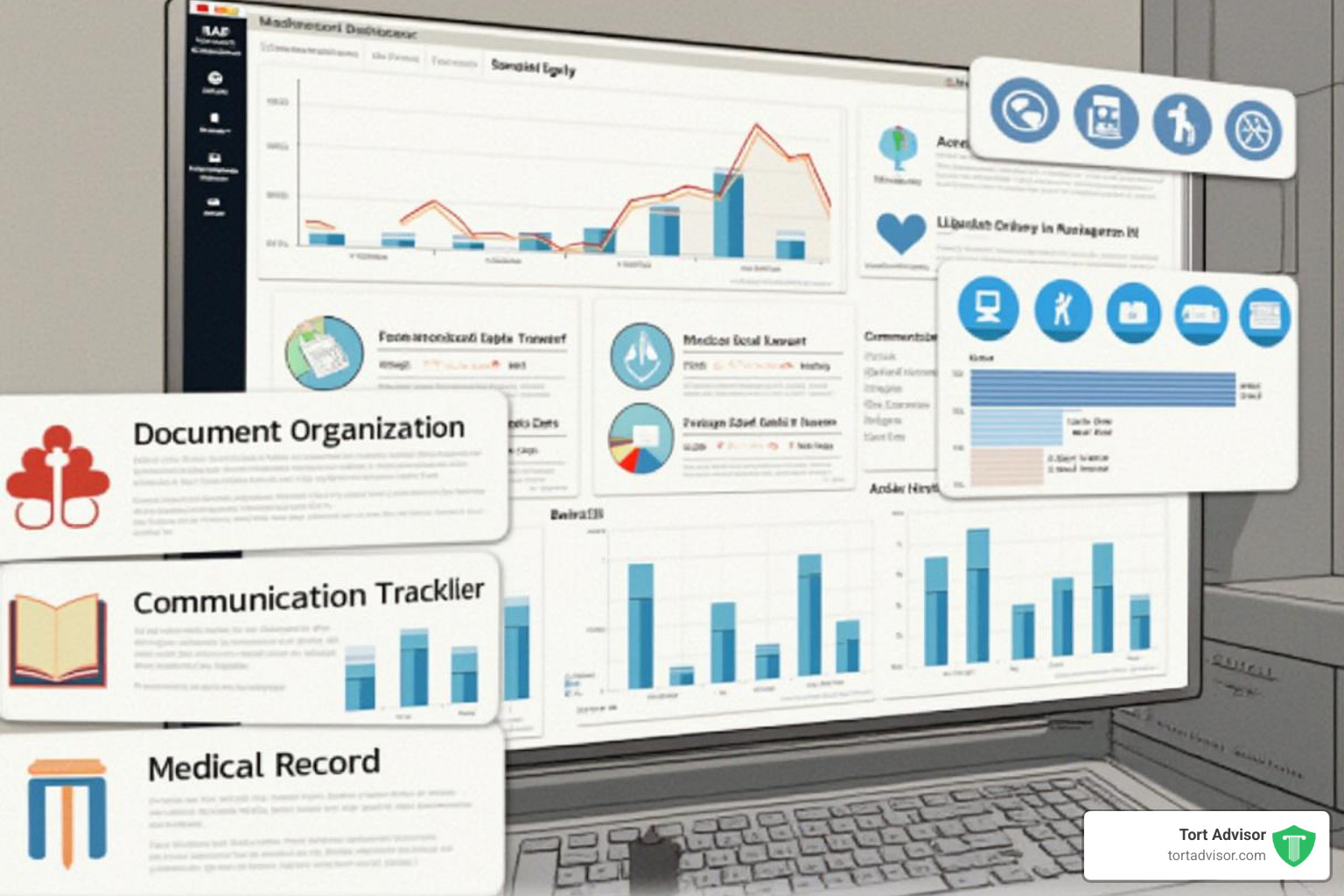
Purpose-built case management software sits at the center of modern mass tort litigation support. It acts as a single hub for every case, showing claimant data, documents, and status from one dashboard.
Core capabilities:
- One central database: a single reliable source for all case data, replacing scattered files.
- Automation: handles routine work like intake forms and reminders so staff can tackle strategic tasks.
- Live reporting: dashboards show case progress and key metrics instantly.
- Client portals: secure spaces where claimants upload documents, check status, and send messages, which keeps them engaged.
Tools such as Filevine, Litify, and CASEpeer are built for these workflows and play a central role in efficient case management and healthcare lien compliance.
Protecting Data and Confidentiality
With sensitive client information on the line, security can’t be compromised. Trustworthy mass tort litigation support providers make it a priority to avoid devastating breaches.
Core safeguards:
- SOC compliance: recurring SOC (Service Organization Control) audits confirm strict controls over security, confidentiality, and privacy.
- Encryption: data is encrypted both in transit and at rest to block unauthorized access.
- Confidentiality agreements: every team member signs strict nondisclosure terms.
- Data handling rules: firm internal protocols control who can access, process, and store data.
- Trusted platforms: secure, industry-standard software and cloud systems.
This layered approach keeps sensitive information safe and compliant, even in complicated situations like a dispute over privileged documents.
How to Choose the Right Support Provider

Picking a mass tort litigation support partner is a major decision. You are forming a relationship with a team that grasps the particular demands of mass torts and can grow alongside your firm, so check each candidate’s experience and fit carefully. Even big firms work with specialists like Tritura for e-discovery and data management, which shows how valuable these partnerships are.
Comparing Engagement Models
Providers of mass tort litigation support offer a few different engagement models. The right fit depends on your needs, budget, and how much control you want. The most common:
| Factor | Outsourced Staffing (e.g., Legal Soft) | Project-Based Work (e.g., Medical Record Review) | Full-Service Partner (e.g., Verus, Epiq) |
|---|---|---|---|
| Cost | Usually the most economical for ongoing admin; flat monthly fee. | Priced per project or item; predictable for defined tasks. | Costs more overall, but complete and integrated. |
| Scalability | Very flexible; scales up or down easily with caseload. | Scales for defined tasks; less adaptable to broad needs. | Extremely high; built for large, shifting volumes. |
| Integration | Needs some integration with the firm’s CRM and workflow. | Little integration needed for set deliverables. | Deeply integrated into firm systems and processes. |
| Scope | Admin, client communication, data entry, CRM upkeep. | Defined tasks (such as medical summaries or PFS). | Full lifecycle management from intake to payout. |
| Control | High; the firm directly supervises outsourced staff. | Moderate; the firm sets scope and the provider executes. | Less day-to-day control; more strategic oversight. |
| Expertise | General legal administration, often trained on mass tort software. | Deep skill in particular tasks (medical, data, and so on). | Wide, multidisciplinary skill across every stage. |
What to Look For in a Mass Tort Litigation Support Partner
Besides the engagement model, weigh these factors when choosing a provider:
- Mass tort expertise: Does the team understand the fine points of mass torts and specific case types? Look for depth in medical, legal, and process management talent.
- Technology: Do they run modern case management software, AI-assisted document review, and strong analytics? Their systems must process huge data volumes smoothly.
- Track record: Request references, case studies, and metrics such as claims handled and awards paid out. Client feedback offers useful insight into performance.
- Security practices: Essential. Confirm SOC compliance, strong encryption, and strict confidentiality agreements protecting client data.
- Ability to scale: Can they ramp resources up or down fast as caseloads change?
- Communication: Expect clear reporting, a dedicated account manager, and fast responses, the basics of a healthy partnership.
Costs and Return on Investment for Mass Tort Litigation Support
Price matters, but judge it by return on investment (ROI). Support is an investment in your firm’s capacity and efficiency. Typical pricing includes hourly billing, per-case fees, and subscriptions.
The return can be substantial. Outsourcing can cost far less than hiring in-house staff (some providers estimate savings above $50,000 a year per position) even before benefits and overhead are counted. The value also goes beyond direct savings:
- More capacity: take on more cases without raising fixed overhead.
- Lower admin spending: avoid the cost of recruiting, training, and managing support staff.
- Quicker case movement: smoother processes shorten the case lifecycle and help cash flow.
- Better client outcomes: well-documented claims position clients for the strongest results, supporting firm revenue and reputation.
- Attention on high-value work: lawyers spend their time on strategy, where they add the most.
Investing in expertise and efficiency expands what your mass tort practice can achieve and helps improve How Much Does Mass Tort Lawsuits Receive for your clients.
Mass Tort Litigation Support: Frequently Asked Questions
Answers to questions law firms often ask about mass tort litigation support.
Is client information secure with an outside support provider?
Yes. Any reputable mass tort litigation support provider treats data security as its first priority, because protecting sensitive information is central to its business. Protection comes in layers, including binding confidentiality agreements for every staff member and secure systems for handling and storing data.
Typical safeguards include robust encryption, recurring SOC (Service Organization Control) compliance audits, and careful screening of both staff and technology. Good partners handle your clients’ data with great care.
How much training do outsourced support staff need?
Very little. One big advantage of specialized support is that staff arrive ready to contribute. Teams are made up of already-trained assistants who know mass tort procedures and often already use common platforms like Litify, Filevine, and CASEpeer, so the learning curve is short.
Your firm just supplies its own process preferences, such as how you like notes and communications logged, which saves time and gets them productive fast.
How does support help with ongoing claimant communication?
Mass tort litigation support services are built to take on the enormous job of keeping claimants informed and heard. Dedicated teams send regular updates by phone, email, or portal about case progress and milestones.
Every contact goes into shared communication logs for consistency. Many providers also run secure client portals where claimants can follow their case, upload files, and send messages, which improves transparency and cuts incoming calls. The result is more satisfied clients and a less stretched legal team that can stay on core legal work.
Conclusion
In high-pressure mass tort practice, the right support makes a real difference. Mass tort litigation support providers work behind the scenes to solve the heavy administrative and data problems that high-volume cases create, bringing efficiency, scalability, and specialized expertise that can transform how a firm operates.
Using these services gives your firm an edge. Handing off repetitive work lets attorneys do what they do best, developing strong legal strategy and pursuing justice for every client, and it ultimately means delivering more value to people who were harmed.
As mass tort litigation keeps evolving with complex matters like the Johnson & Johnson settlement, looking to 2025 and beyond, demand for specialized support is only going to rise.
Legal Lawsuit helps injured people connect with experienced attorneys in our network who handle mass tort cases, so they can get clear guidance and a free, confidential case review.
With the right support in place, your firm can handle complex litigation more smoothly and deliver stronger results for clients. Browse our active lawsuit resources to learn more.
Related Posts
Quick Answer: The Boy Scouts of America (BSA) filed for Chapter 11 bankruptcy in 2020 after facing tens of thousands [...]
Quick Answer: Survivors of sexual abuse by Catholic priests, nuns, or other Church personnel may be able to file a [...]
Quick Answer: Clergy abuse settlements vary enormously based on the severity of the abuse, the strength of evidence that the [...]