
Short answer: This article explains the key facts, eligibility issues, settlement factors, deadlines, and source-backed updates related to this legal topic. Results vary by case facts, evidence, jurisdiction, and representation.
📋 Table of Contents
- The Growing Crisis: When Gaming Becomes a Legal Battle
- The Grounds for Legal Action: What Do Gaming Addiction Lawsuits Allege?
- Recognizing the Harm: The Human Cost of Video Game Addiction
- Navigating the Legal System: Your Guide to a Lawsuit for Gaming Addiction
- Frequently Asked Questions about Gaming Addiction Lawsuits
- Conclusion: Taking the First Step Towards Justice
Gaming Addiction Lawsuit Overview: When Play Turns Into a Legal Fight
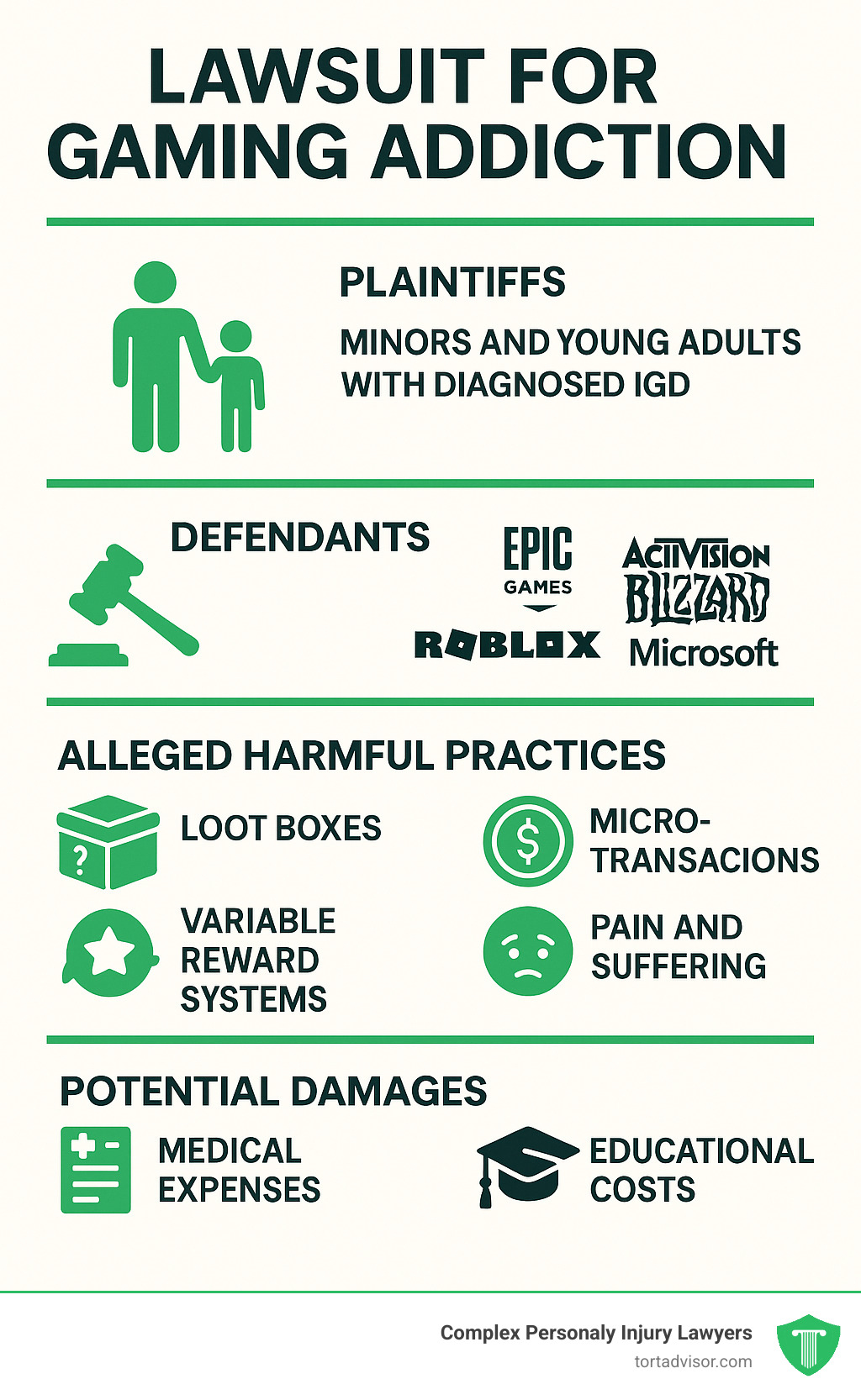
A gaming addiction lawsuit is a claim against video game makers alleging they built games to be deliberately addictive, particularly for kids, teens and young adults. These cases seek money for:
- Treatment costs for gaming addiction and related mental health conditions
- Lost income or reduced ability to earn
- School-related costs tied to academic setbacks
- Pain and suffering from depression, anxiety and isolation
- Punitive damages meant to hold companies responsible
The game industry brought in more than $176 billion in 2024, but there is a troubling story behind that figure. Families are suing major publishers — including Epic Games (Fortnite), Activision Blizzard (Call of Duty) and Roblox Corporation — claiming they intentionally designed addictive products. The suits allege the companies relied on psychological hooks such as loot boxes, variable rewards and microtransactions, causing serious financial and personal damage.
A lot is riding on these cases. Some estimates suggest up to 10% of people in the U.S. may struggle with video game addiction, and roughly 1.2% to 10% of adolescents in Western countries show signs of internet gaming disorder. The World Health Organization formally recognizes gaming disorder as a mental health condition, which gives these claims a recognized medical footing.
In one painful example, a California family sued several game companies after their child, who began playing at six, showed serious addiction symptoms including falling grades, withdrawal from friends and depression.
I’m Mason Arnao. Working in technology and data systems, I have seen firsthand how companies apply behavioral psychology to drive engagement, which gives me useful perspective on the tactics at the center of many gaming addiction lawsuit claims.
Related gaming addiction lawsuit terms:
- Lawsuit against video game maker
- Minecraft class action lawsuit
What Gaming Addiction Lawsuits Claim
Families bringing a gaming addiction lawsuit make a serious charge: that addiction is a foreseeable — and profitable — result of how these games are built. At bottom, the suits accuse companies of putting revenue ahead of players’ health.
Allegedly Addictive Design and Psychological Hooks
A central allegation in every video game addiction lawsuit is that companies purposely engineer compulsive play, allegedly using behavioral science to exploit the brain’s reward circuitry.
According to the complaints, developers take advantage of the brain’s dopamine system. Through variable reward schedules much like slot machines, games hand out unpredictable rewards that trigger dopamine and make it hard to put the controller down. A Jerusalem Post article has examined how this dopamine-driven design can fuel compulsive use, and researchers have even pinpointed brain responses such as the P300-CE response that make in-game events feel especially significant and deepen engagement.
Tactics cited in the lawsuits include feedback loops that manufacture urgency with limited-time events, leaderboard-driven social pressure and progression systems that always hold out one more reward. Some games are accused of building in frustration that only spending can fix. Plaintiffs say these are intentional uses of behavioral science aimed at maximizing playtime and spending. Read more about how a leading game developer was hit with major lawsuits.
Aggressive Monetization: Microtransactions and Loot Boxes
Microtransactions and loot boxes sit at the heart of most of these lawsuits, which accuse them of encouraging gambling-like behavior and causing real financial harm.
Microtransactions are small in-game purchases that add up fast. Many “free-to-play” titles rely on them, putting obstacles in the way that players can pay to skip.
Loot boxes raise even bigger concerns because they work like a lottery: players pay real money for a random chance at rare items, and research shows a strong association between loot boxes and problem gambling.
The money lost can be staggering, especially when children make purchases without permission. Reported cases include kids running up thousands of dollars, such as a 6-year-old who reportedly spent $16,000 on microtransactions.
These are not one-off situations; a relatively small group of heavy spenders generates enormous revenue, with microtransaction spending reported at $190 billion in 2021. Regulators have stepped in: the FTC has issued $72 million in refunds over Epic Games’ billing practices, and Canadian courts have certified class actions against Electronic Arts over loot boxes.
Which Companies and Games Are Being Sued?
The companies named in these cases are global entertainment giants, not small studios.
- Epic Games faces claims over Fortnite, with plaintiffs alleging its design drives compulsive play that leads kids to neglect school, sleep and friends.
- Activision Blizzard is accused of psychological tactics in Call of Duty and World of Warcraft, especially in multiplayer and progression features.
- Roblox Corp. is accused of fostering addiction and enabling gambling-like activity among children on its user-created game platform.
- Microsoft has been sued over Minecraft, with its online and spending features under scrutiny.
- Rockstar Games and Take-Two Interactive are also named, with the online world and monetization in Grand Theft Auto drawing criticism.
The suits contend these companies put profit ahead of player welfare, particularly for young people, and aim to hold them responsible for the harm that followed.
The Real-World Harm of Video Game Addiction
The complaints describe serious damage that reaches well beyond the screen, touching mental health, social growth and physical health. Formal medical recognition of the condition gives these claims a firm base.
What Is Internet Gaming Disorder (IGD)?
When gaming shifts from pastime to addiction, it can upend a young person’s life. Clear medical definitions of the condition are essential to any gaming addiction lawsuit.
The World Health Organization added gaming disorder to the ICD-11 in 2018. Its criteria call for gaming that causes “significant impairment” in personal, family, social or educational life, typically over at least 12 months.
The American Psychiatric Association’s DSM-5 lists Internet Gaming Disorder as a condition warranting further research, with diagnosis requiring at least five specific symptoms over 12 months.
IGD is especially worrying because it can appear as early as age 10, and some studies find about 4% of children showing clinical signs. It reflects a loss of control in which gaming outranks essential parts of daily life.
Warning Signs and Serious Consequences
Moving from casual play to addiction can change a life. Frequent warning signs include:
- Constant focus on gaming
- Withdrawal, such as irritability and anxiety when not playing
- Hiding or lying about time spent gaming
- Letting hygiene, school or work slide
- Dropping other interests
- Playing despite clear harm
- Gaming to escape bad feelings
- Being unable to limit play
The fallout from gaming addiction can be severe and far-reaching:
- Mental Health: Research finds addicted teens face roughly twice the risk of depression and anxiety. A study from the National Institutes of Health connects gaming addiction with suicidal thoughts, and other research points to a possible higher risk of psychosis later in life.
- School and Social Life: Grades often collapse and some students drop out. Real relationships fade as online ones take priority, leaving deep isolation.
- Money Problems: Spending on microtransactions plus the cost of neglected work or school add up, and unauthorized purchases by kids can hit family budgets especially hard.
- Physical Health: Problems include repetitive strain injuries like carpal tunnel, chronic eye strain and serious sleep loss; for some people, games can trigger seizures.
- Aggression: Extreme “gamer rage” can lead to explosive outbursts and broken property when play is frustrated or interrupted.
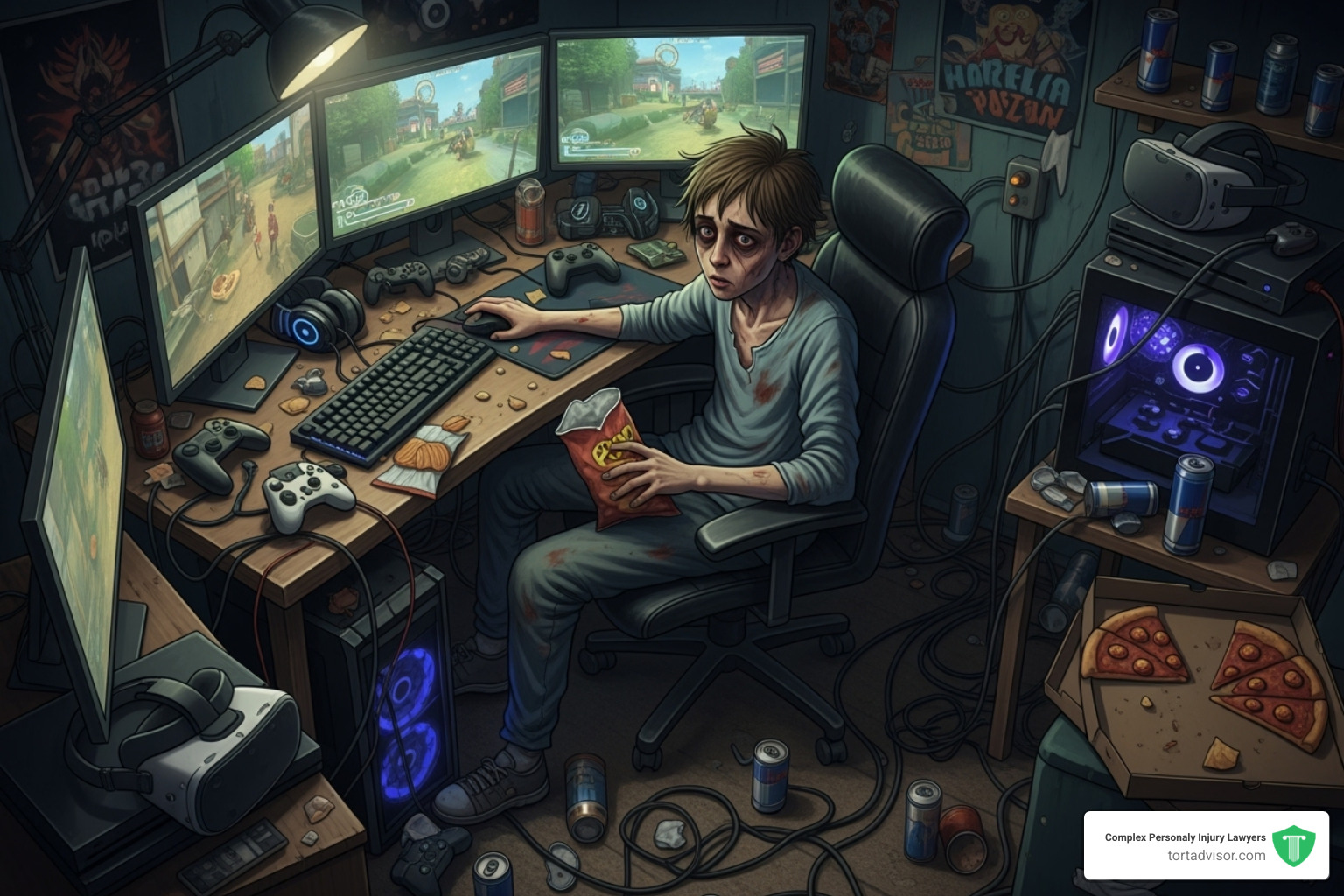
Taken together, these effects explain why gaming addiction is now treated as a real public health issue. If other digital platforms are causing similar problems, you may also want to read about social media addiction.
How to File a Gaming Addiction Lawsuit: What to Know
Knowing your rights is the first step toward accountability. The law here is still developing, but clearer routes are opening for affected people and families to pursue compensation.
Who Qualifies for a Gaming Addiction Lawsuit?
If gaming addiction has hurt your family, you may be able to bring a gaming addiction lawsuit, though heavy play alone is not enough. Attorneys generally look for:
- Age: Claims usually involve people 24 or younger, since developing brains are more susceptible to manipulative design.
- Diagnosis: A formal Internet Gaming Disorder (IGD) diagnosis from a medical provider is key, providing the medical basis for the claim.
- Proof of Harm: Significant damage must be shown through treatment bills, school records reflecting decline and records of in-game spending.
- Witness Accounts: Statements from family and friends about behavior changes and withdrawal carry weight, as do records of physical problems caused by excessive play.
Timing matters because statutes of limitations differ by state, so reaching out to an attorney promptly helps protect your rights. If you are wondering whether these claims are legitimate, read more about whether a video game addiction lawsuit is legit.
Where Things Stand: Individual Claims vs. Class Actions
Many people assume these are class actions, but the situation is more nuanced, and individual claims can serve victims better. As of this update, there is no nationwide class action or MDL for gaming addiction in the U.S., because a request to create a Multidistrict Litigation was denied.
Individual cases focus on the specific harm you suffered, which can yield fairer compensation than a uniform class settlement. State-level coordination such as JCCP No. 5363 in California helps courts manage similar cases efficiently while keeping recovery individualized.

A case starts with filing and moves into discovery, when both sides exchange information through written questions, document requests and depositions, and your attorney may seek internal company records. Expert testimony from psychologists and other specialists is central. Most cases end in settlement talks, but your lawyer should be ready for trial if no fair offer comes.
Damages in a Gaming Addiction Lawsuit
If you are weighing a gaming addiction lawsuit, it helps to understand what compensation may cover, which depends on the harm involved.
Compensatory damages repay actual losses, such as:
- Treatment Costs: Addiction care, therapy and medication.
- School Costs: Tutoring, repeated classes or delayed graduation.
- Lost Income: Pay lost because of an inability to work, or reduced future earnings.
- Rehab Programs: The cost of specialized gaming addiction treatment.
- Pain and Suffering: Compensation for emotional distress and a diminished quality of life.
Punitive damages may also be sought to punish especially egregious conduct and deter it in the future.
As of this update, no gaming addiction case has produced a body of public settlements large enough to support reliable dollar estimates, so be wary of anyone quoting specific figures. Value will likely depend on the severity and duration of the addiction, the documented mental health effects, treatment costs, academic or financial losses, the age at which play began and the strength of evidence about the game’s design.
Gaming Addiction Lawsuit FAQs
What does it cost to hire a lawyer for a video game addiction claim?
Most injury attorneys take gaming addiction lawsuit cases on contingency, so there is nothing to pay upfront. The fee comes as a percentage of any settlement or award, and if the case is unsuccessful you owe no attorney fees — which removes the financial risk of taking on large game companies.
What evidence does a gaming addiction claim need?
A strong case usually draws on several kinds of evidence:
- Medical Records: Documentation of an IGD diagnosis, therapy notes and treatment plans.
- School Records: Report cards showing slipping grades, attendance logs and teacher comments.
- Financial Records: Bank or card statements showing in-game purchases and spending patterns.
- Witness Statements: Accounts from family and friends describing behavior changes, isolation and other effects.
- Expert Testimony: Psychologists, neuroscientists and even former game developers can help strengthen a case.
How long do these cases take?
A gaming addiction lawsuit can take anywhere from several months to a few years, depending on:
- Complexity: These cases involve technical arguments and extensive discovery.
- The Defense Approach: Some companies settle early, while others fight and drag things out.
- Court Calendars: Crowded dockets can add delays.
The process can be lengthy, but the aim is the best possible result, and your attorney should keep you posted on the timeline and developments.
Final Thoughts: Taking the First Step Toward Accountability
The growth of gaming addiction lawsuit filings is a warning to the game industry. Plaintiffs argue that addicted players’ struggles are not personal failings but the foreseeable outcome of deliberately manipulative design.
Epic Games, Activision Blizzard, Roblox and others face serious allegations that they used psychological tactics to create and profit from addiction, especially among young people, putting revenue ahead of their users’ welfare.
If your family has been affected, you know the toll — worsening mental health, isolation, falling grades and money trouble. The lawsuits allege these results were built into the design.
You do not have to deal with this alone. Legal options are taking shape as courts catch up, with the WHO recognizing gaming disorder and regulators like the FTC taking action.
These are demanding cases against powerful companies, so experienced counsel matters. Legal Lawsuit helps families understand their options and connect with attorneys in our network who have the resources to take on these lawsuits.
Don’t keep wondering “what if.” The game companies have legal teams protecting their interests, and you deserve strong representation protecting yours.

If you or someone you love has been harmed, learn more about filing a Video Game Addiction Lawsuit and request a free, confidential case review.
Additional Resources
Related Posts
Quick Answer: The Boy Scouts of America (BSA) filed for Chapter 11 bankruptcy in 2020 after facing tens of thousands [...]
Quick Answer: Survivors of sexual abuse by Catholic priests, nuns, or other Church personnel may be able to file a [...]
Quick Answer: Clergy abuse settlements vary enormously based on the severity of the abuse, the strength of evidence that the [...]