Short answer: This article explains the key facts, eligibility issues, settlement factors, deadlines, and source-backed updates related to this legal topic. Results vary by case facts, evidence, jurisdiction, and representation.
I’m Mason Arnao. Through years of work in data systems and digital advocacy, I have seen how an institutional abuse lawsuit affects survivors harmed by people in positions of trust — clergy, coaches, teachers, counselors and others — inside institutions that were supposed to keep them safe. As publisher of LegalLawsuit.com and President of Waypoint Software, I have spent more than 20 years helping people find essential information. This guide explains who qualifies, how to file and what survivors may recover.
Free, Confidential Case Review — No Fee Unless You Recover
Call Now to Talk With a Sexual Abuse Case Specialist
Available 24/7 · Private · Nothing to pay upfront
The 2026 surge in institutional sexual abuse lawsuit filings is one of the most significant shifts in American civil rights and injury law. People abused by clergy, coaches, teachers, camp staff, medical providers and other authority figures inside trusted institutions now have stronger legal tools than ever to seek accountability and compensation. Major court rulings, state laws extending filing deadlines for childhood sexual abuse and widely publicized institutional settlements have together created a favorable climate for survivors. If you were abused in an institutional setting and have not explored your legal options, this is the time to do so.
📋 Table of Contents
What Is an Institutional Abuse Lawsuit?
An institutional abuse lawsuit is a civil case a survivor brings against both the abuser and the organization that hired, oversaw or enabled that person. What sets these claims apart is the two-defendant approach: survivors pursue not only the individual but also the entity that failed to stop the abuse — a diocese, school district, youth sports league, summer camp, hospital or similar organization. The legal theory is negligence. Institutions owe a duty to protect the people in their care, children above all, and when they skip background checks, overlook warning signs, fail to supervise staff or conceal known abuse, they breach that duty and can be held liable. Where an institution actively covered up abuse — as has been widely documented involving the Catholic Church, USA Gymnastics, the Boy Scouts of America and others — punitive damages may substantially increase the recovery. Coordinated institutional abuse claims have produced some of the largest settlements in U.S. history: the Boy Scouts of America agreed to an $850 million settlement with survivor groups as part of its bankruptcy, the Catholic Church has paid billions across thousands of diocesan cases, and USA Gymnastics reached a settlement of more than $380 million with survivors of Larry Nassar. These outcomes show institutions can be held accountable and individual survivors can obtain meaningful compensation. See our sexual abuse lawsuit page for a broader overview of current institutional abuse litigation.
Free, Confidential Case Review — No Fee Unless You Recover
Call Now to Talk With a Sexual Abuse Case Specialist
Available 24/7 · Private · Nothing to pay upfront
Kinds of Institutional Abuse Cases in 2026
In 2026, institutional abuse claims span many settings and types of abusers:
- Religious organizations: The Catholic Church, evangelical churches, Jehovah’s Witnesses and other faith groups where clergy or staff committed abuse
- Schools and universities: Teachers, counselors, coaches or administrators who abused students in K-12 or higher education
- Youth sports: Coaches, trainers and officials in organized youth athletics who exploited their roles to abuse athletes
- Camps and youth programs: Summer camps, scouting groups, after-school programs and other organizations serving young people
- Medical and therapy settings: Physicians, nurses, therapists and other providers who abused patients
- Juvenile detention and foster care: Abuse by staff at detention centers, foster homes and residential treatment facilities
- Campus sexual assault: Colleges and universities that did not properly respond to reported assaults under Title IX
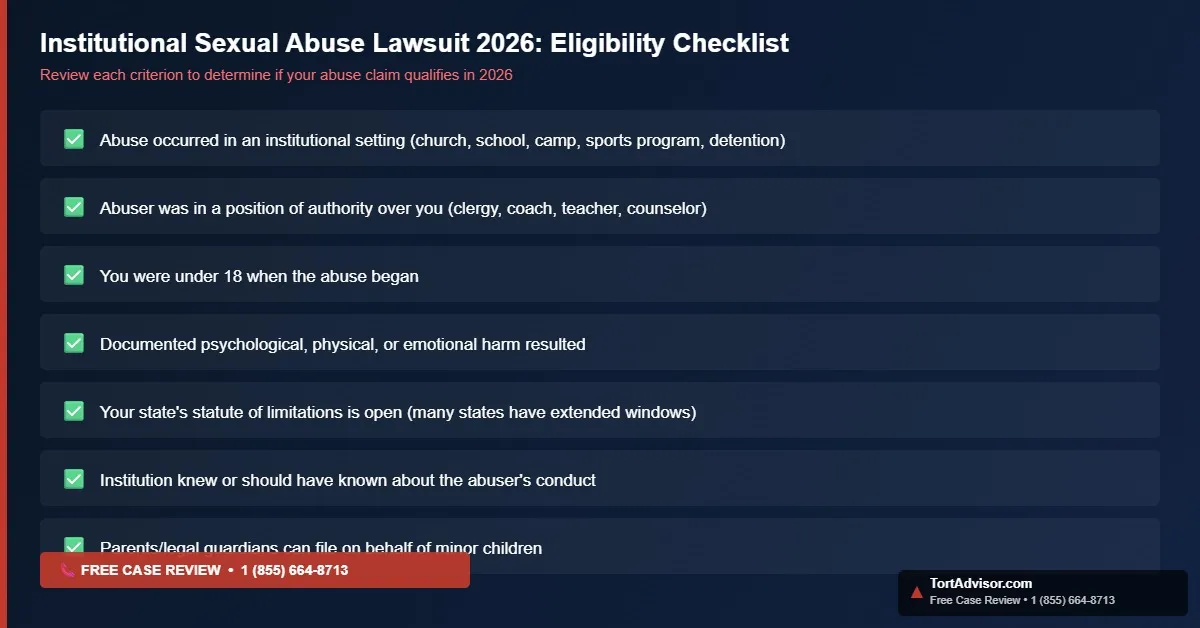
Who Qualifies for an Institutional Abuse Lawsuit in 2026?
- Someone in a position of authority within an institution sexually abused you
- You were under 18 when it happened (or, in certain settings, an adult patient or student)
- The institution owed you protection and failed through negligent hiring, poor supervision or its response to known abuse
- The abuse caused you psychological, emotional or physical harm
- Your claim falls within the filing deadline that applies — see the 2026 update below
Call 833-333-0905 for a free and fully confidential case review. Our intake specialists understand how sensitive these claims are and will treat your story with respect and discretion.
What Institutional Abuse Survivors May Recover
Outcomes in institutional abuse cases vary widely, and as of this update there is no reliable public data that supports quoting a typical dollar range for an individual claim. Value generally depends on how severe and prolonged the abuse was, the number of abusers, how much the institution knew or concealed, the lasting psychological harm and treatment needs, lost educational and career opportunities, the strength of the evidence and the state where the claim is filed. Claims involving repeated abuse over long periods, serious ongoing trauma and evidence of a cover-up generally carry the greatest value. Try the sexual abuse settlement calculator to explore the factors in your situation, or browse all settlement calculators at LegalLawsuit.com.
2026 Filing Deadline Update for Institutional Abuse Claims
A major change in institutional abuse litigation in recent years has been widespread reform of filing deadlines for childhood sexual abuse. As of 2026, many states let survivors file well into adulthood, in some cases until age 55 or later. Research on sexual violence compiled by the NIH shows that survivors of childhood abuse often do not disclose until decades later because of trauma, shame and the psychological dynamics of abuse, and the law increasingly reflects that reality. Several states have also opened “revival windows,” temporary periods when previously expired claims can be filed, and an attorney can tell you whether one applies where you live. For current national data on sexual violence and its effects, see the CDC’s sexual violence fast facts page.
How to File an Institutional Abuse Claim
- Free, confidential review: Call 833-333-0905 any time, day or night. Your privacy is protected throughout.
- Gather documentation: Collect therapy and medical records, written accounts, witness statements and anything showing how the institution responded to the abuse.
- Get matched with an attorney: Connect with an experienced institutional abuse attorney in our network who works on contingency, with no upfront fees.
- Investigation: Your attorney looks into the institution, the abuser’s background and any evidence that the institution knew or covered up the abuse.
- Resolution: Most institutional abuse cases settle. Your attorney brings every offer to you and advises whether to accept or push for more.
Institutional Abuse Lawsuit FAQs for 2026
Is it too late to bring an institutional abuse lawsuit in 2026?
Many survivors can still file in 2026 because most states have extended deadlines for childhood sexual abuse claims, with some allowing filing until age 40, 50 or later, and several have recently opened revival windows for expired claims. A free review can confirm the deadline in your state — call 833-333-0905.
What is an institutional abuse lawsuit worth?
There is no standard value. A claim’s worth depends on the severity and length of the abuse, how culpable the institution was, the lasting harm and the strength of the evidence. Our sexual abuse settlement calculator can help you understand the factors involved.
Who can file an institutional abuse lawsuit?
People abused by clergy, coaches, teachers, counselors or other authority figures within an institution may qualify, provided the institution’s negligence enabled the abuse and the claim is filed within the applicable deadline. Call 833-333-0905 for a free, confidential eligibility review.
How long do institutional abuse cases take?
These cases commonly take about 2–4 years, and complex cases against large institutions with many plaintiffs can take longer. Well-documented individual claims sometimes settle in less than 2 years, and your attorney can give you a realistic timeline.
Is a police report required to file?
No. A civil institutional abuse lawsuit does not require a police report, since civil and criminal cases are separate, and many survivors file civil claims without ever reporting to police. If a report exists, though, it can strengthen the civil case, and your attorney will guide your evidence strategy.
Where do institutional abuse lawsuits stand in 2026?
As of 2026, institutional abuse litigation is at record levels. State law changes have opened new filing windows, and major resolutions — the Boy Scouts of America’s $850 million agreement with survivor groups, billions paid by the Catholic Church and USA Gymnastics’ settlement of more than $380 million — show institutions can be held to account. Favorable law and longer deadlines make this an important time for survivors to act.
About the Author
Mason Arnao is President and Managing Partner of Waypoint Software, LLC, and publisher of LegalLawsuit.com. Drawing on more than 20 years in data systems and digital advocacy, he brings an analytical approach to complex institutional abuse litigation and is dedicated to helping survivors find the information and legal resources they need.
Deadlines Apply — Don’t Wait
Call Now to Talk With a Sexual Abuse Case Specialist
Free, Confidential Consultation · Available 24/7 · No Fee Unless You Recover
Request a Free Institutional Abuse Case Review
If you or someone you love was abused within an institution, call 833-333-0905 or complete the confidential form below for a free case review.
Additional Resources
Related Posts
Quick Answer: The Boy Scouts of America (BSA) filed for Chapter 11 bankruptcy in 2020 after facing tens of thousands [...]
Quick Answer: Survivors of sexual abuse by Catholic priests, nuns, or other Church personnel may be able to file a [...]
Quick Answer: Clergy abuse settlements vary enormously based on the severity of the abuse, the strength of evidence that the [...]