Short answer: This article explains the key facts, eligibility issues, settlement factors, deadlines, and source-backed updates related to this legal topic. Results vary by case facts, evidence, jurisdiction, and representation.
📋 Table of Contents
- Understanding the Tax Implications of Your Disability Benefits
- The Golden Rule of Private Disability Insurance: Who Paid the Premiums?
- Taxability of Federal and State Disability Programs
- Navigating the Complexities of Disability Benefits Tax
- Strategies to Reduce Your Tax Burden
- Frequently Asked Questions about Disability Taxes
- Conclusion
Helpful Depo-Provera Claim Tools
Depo-Provera Settlement Calculator — A quick estimate of possible compensation tied to a meningioma diagnosis and related injuries.
Depo-Provera Settlement Amounts — An overview of what’s publicly known about Depo-Provera claim values and what affects them.
Are Disability Benefits Taxable? How the Rules Work
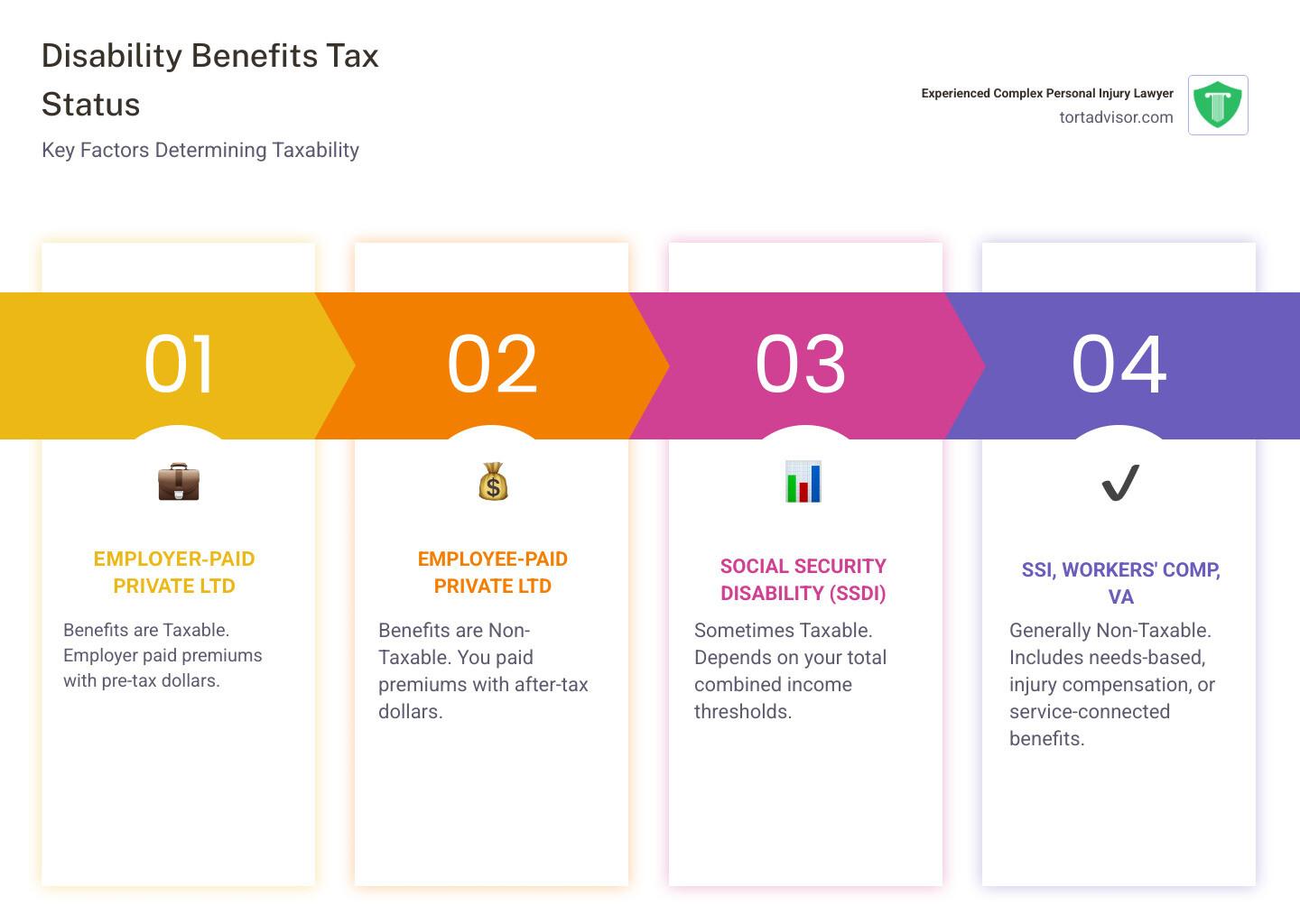
Are disability benefits taxable? Knowing the answer is essential to planning your finances when you can’t work — a surprise tax bill is the last thing you need while recovering. It comes down to what kind of benefit you receive and who paid for the coverage. Short Answer: When Disability Benefits Are Taxed
| Kind of Disability Benefit | Generally Taxable? | Key Factor |
|---|---|---|
| Private Disability Insurance (Premiums Paid by Employer) | Yes | Premiums paid by employer with pre-tax money |
| Private Disability Insurance (Premiums Paid by Employee) | No | Premiums paid by you with after-tax money |
| Social Security Disability Insurance (SSDI) | Sometimes | Hinges on your total income |
| Supplemental Security Income (SSI) | No | Needs-based program |
| Workers’ Compensation | No | Benefits for an on-the-job injury |
| VA Disability Benefits | No | Service-connected benefits |
Plenty of people are caught off guard to find that some disability payments are taxed and others aren’t. Long-term disability (LTD) payments from a policy your employer paid for are usually taxable, for example, while benefits from a policy you funded with after-tax dollars generally aren’t. Things get more complicated when you collect more than one benefit — say LTD plus Social Security Disability Insurance (SSDI) — because the combination can change what you owe. This guide walks through the core reporting and compliance rules.
Related disability benefits tax topics:
- Applying for disability benefits
- Help with a disability claim
- How disability appeals work
Private Disability Insurance: Who Paid the Premiums Decides
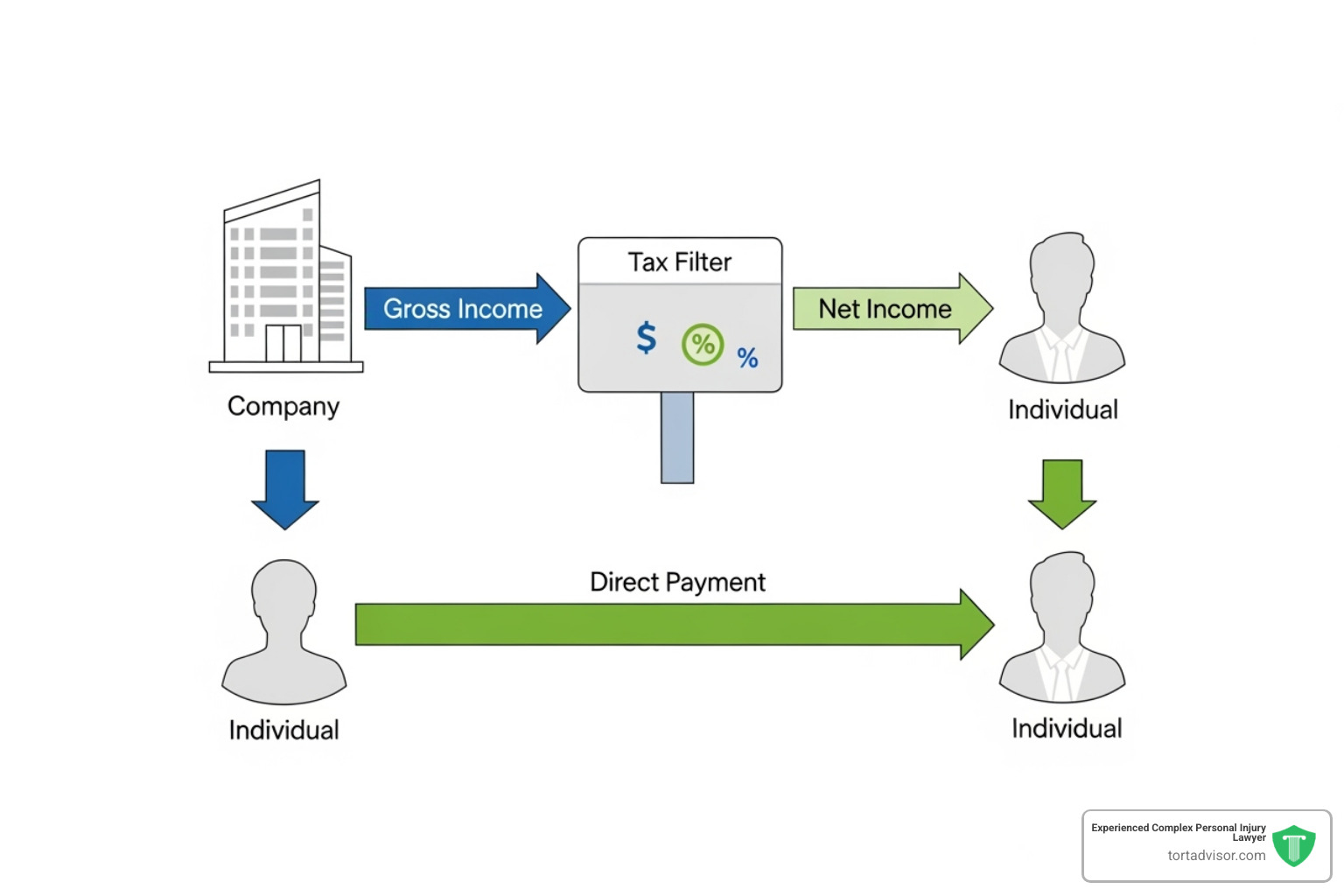
With private disability coverage, the tax answer turns on a single question: who paid the premiums? That rule covers both Long-Term Disability (LTD) and Short-Term Disability (STD) plans. The IRS doesn’t tax the same money twice — premiums paid with after-tax dollars mean tax-free benefits, while premiums paid with pre-tax dollars (typically by an employer) mean taxable benefits.
Employer-Paid Plans
When your employer covers 100% of the premium with pre-tax money, the benefits count as taxable income, since no tax was ever paid on the premium dollars. They’re treated like wages, show up on your W-2 and raise your taxable income for the year.
Employee-Paid Plans
When you cover 100% of the premium yourself with after-tax money, the benefits are usually tax-free. That includes individual policies you buy on your own and certain employer plans where you pay the whole premium through after-tax payroll deductions. Tax-free benefits offer valuable stability while you recover.
Cost-Shared Plans
When you and your employer share the premium, the benefits are partly taxable, in proportion to each side’s contribution. If your employer paid 70% and you paid 30% with after-tax dollars, 70% of your benefits are taxable and 30% are not. Keep records of your share so you can figure your disability benefits tax correctly.
Are Government Disability Benefits Taxable?
Many people depend on public programs as well as, or instead of, private coverage, and federal and state benefits often follow different tax rules.

Is SSDI Taxable?
Social Security Disability Insurance (SSDI) is taxable in some cases, based on your overall income. The test uses “provisional income”: your adjusted gross income (AGI) plus any tax-exempt interest plus half of your Social Security benefits.
- Single Filers: As much as 50% of benefits can be taxed when provisional income falls between $25,000 and $34,000, and as much as 85% above $34,000.
- Married Filing Jointly: The ranges are $32,000–$44,000 for the 50% tier and over $44,000 for the 85% tier.
- Married Filing Separately: If you lived with your spouse during the year, up to 85% of benefits may be taxed no matter your income.
Each year you’ll get Form SSA-1099 listing the total benefits paid to you, for use at tax time.
Is SSI Taxable?
SSI benefits are not taxable. Because Supplemental Security Income is need-based, serving people with limited income and resources, the IRS doesn’t treat it as income. If SSI is all you receive, you probably won’t have to file a return.
Is Workers’ Compensation Taxable?
Workers’ comp benefits are usually tax-free. Payments for a work-related injury or illness aren’t subject to federal income tax. A wrinkle appears if you also get SSDI: when combined benefits are too high, SSDI may be reduced (the SSDI offset), and the part of SSDI offset by workers’ comp can become taxable. Because this interplay is tricky, talk to a tax professional if it applies to you.
Are VA Disability Benefits Taxable?
VA disability benefits are entirely tax-free. Compensation for service-connected conditions, pensions and other VA disability payments aren’t taxable income and don’t go on your return — one less worry while you focus on your health.
Tricky Disability Tax Situations
Real life often goes beyond the basic rules. These more complicated scenarios can change your disability benefits tax picture.
State Rules on Taxing Disability Benefits
Federal law is only part of the story; state and provincial rules vary. In Canada, for instance, the Canada Disability Benefit interacts with provincial support differently in Alberta than in other provinces. In the U.S., programs like California’s State Disability Insurance (SDI) and New Jersey’s Temporary Disability Benefits (TDB) have their own tax treatment. Some states tax benefits the IRS exempts, and others give relief on federally taxed benefits. Check your state revenue department’s website or ask a local tax professional.
How Collecting More Than One Benefit Affects Your Taxes
Collecting from several sources — such as private LTD and SSDI — can complicate taxes because of offset provisions. Many LTD policies cut your payment when you start receiving government benefits. If your LTD insurer reduces your check because taxable SSDI or CPP Disability benefits began, your total income might stay the same while your tax bill changes, since the government portion is now taxable — often an unpleasant surprise. Understanding how benefits coordinate is key to planning accurately.
How Lump-Sum Settlements Are Taxed
A lump sum’s tax treatment depends on what it pays for. Settlements for physical injury or illness are usually not taxable, including amounts for medical bills and pain and suffering. Punitive damages and interest on a settlement, however, are generally taxable. How the agreement allocates the money matters a great deal. Workers’ comp lump sums, for example, are usually tax-free, yet their interaction with SSDI can create tax consequences. Have an attorney and a tax professional review any settlement before you sign.
Ways to Lower Taxes on Disability Income
A few strategies can shrink the tax you owe on disability benefits. Deductions, credits and dedicated savings accounts can add up to real savings.
Deducting Medical Expenses
Large medical costs tied to your disability may be deductible.
- In the U.S., if you itemize, qualified medical expenses above 7.5% of your Adjusted Gross Income (AGI) can be deducted.
- In Canada, the Medical Expense Tax Credit lets you claim eligible medical costs that weren’t reimbursed to reduce the tax you owe. In both countries, thorough records and receipts are a must.
ABLE Accounts: Tax-Favored Savings for People With Disabilities
For Americans whose disability began before age 26, ABLE accounts are a strong option. Savings grow tax-free and can be withdrawn tax-free for qualified disability costs such as housing, health care and education, without jeopardizing eligibility for SSI or Medicaid. Annual contributions are capped, but these accounts let you save while keeping vital benefits.
Other Tax Credits Worth Knowing
Several credits are aimed at people with disabilities and their families.
- U.S.: The Credit for the Elderly and the Disabled helps lower-income taxpayers who are 65 or older, or retired on permanent and total disability with taxable disability income. The Credit for Other Dependents may also apply.
- Canada: The Disability Tax Credit (DTC) is an important non-refundable credit that cuts income tax and opens the door to other programs. Learn more about the Disability Tax Credit. Qualifying for the DTC can make you eligible for the Registered Disability Savings Plan (RDSP), the Child Disability Benefit and the Canada Caregiver Credit. Learn more about RDSPs and the Child Disability Benefit.
About the Canada Disability Benefit (CDB)
Introduced in 2025, the Canada Disability Benefit (CDB) is a new tax-free federal monthly payment for working-age Canadians with disabilities and low incomes. Eligibility depends on qualifying for the Disability Tax Credit (DTC), and the benefit is meant to top up existing provincial and territorial programs, adding financial security without raising your disability benefits tax bill.
Disability Benefits Tax FAQs
Quick answers to the questions people ask most about whether disability benefits are taxable.
Is a lump-sum disability settlement taxable?
That depends on what the money covers. In general, settlements for physical injury or illness — medical costs, lost wages, pain and suffering — are not taxable, while amounts designated as punitive damages or interest usually are. That’s why the exact language of your settlement agreement matters; always have legal and tax professionals review it.
How do I report taxable disability income?
You report it using the forms the paying agency or insurer sends you.
- SSDI: Use Form SSA-1099 and enter the taxable amount on Form 1040.
- Private LTD: Taxable benefits typically appear on a W-2 from your employer or the insurer.
- CPP Disability (Canada): You’ll get a T4A slip to report the income on your Canadian return. Store every tax form you receive somewhere safe until you file.
Can taxes be withheld from my disability benefits?
Yes — and doing so is a smart way to avoid a big bill at year’s end.
- U.S. Social Security: Submit Form W-4V to the Social Security Administration to withhold a percentage of benefits.
- Private LTD: Ask the insurer directly to set up withholding.
- Canadian CPP Disability: Send Form ISP3520 to Service Canada. Withholding spreads your tax obligation across the year and brings peace of mind.
Conclusion
The rules on whether disability benefits are taxable can be tangled, but the fundamentals are what protect your finances. For private insurance, remember the core rule: whoever paid the premium determines the tax treatment. Government benefits vary — SSI and VA benefits are tax-free, while SSDI may be taxed depending on income. Offsets and lump-sum settlements call for extra care. Thankfully, medical expense deductions, ABLE accounts and various credits can ease the load. Knowing the rules is a strong start, but applying them to your own circumstances can be hard. If you’re dealing with a denied claim, confusing benefit coordination or another legal problem tied to your disability or an injury, expert guidance helps. Legal Lawsuit can connect you with attorneys in our network who handle exactly these issues. Whether it’s a disability claim or another injury matter, these resources can help:
- SSDI Iowa Ultimate Guide 2025
- Disability Appeal Forms Complete Guide
- Denied Disability Claim
- SSDI Reconsideration Appeal
- SSDI Lawsuits
- How to Claim Social Security Disability Insurance Arkansas
Legal Lawsuit also helps people connect with attorneys in our network who handle many other matters — car accident lawsuits, workplace sexual harassment, and product liability cases such as Ozempic, Roundup and NEC baby formula lawsuits, plus asbestos, hernia mesh, hair relaxer, breast implant, Suboxone, Paraquat, PFAS cancer, Depo-Provera, Bair Hugger and mesothelioma claims. Attorneys in the network also handle sensitive cases involving child sexual abuse, teacher sexual abuse, abuse within churches or religious organizations, athlete sexual abuse and university sexual assault, along with wildfire and video game addiction lawsuits. Planning ahead on taxes and getting expert advice when you need it can save you money and stress, so don’t hesitate to reach out to a qualified professional for guidance tailored to you.
Additional Resources
Related Posts
Quick Answer: The Boy Scouts of America (BSA) filed for Chapter 11 bankruptcy in 2020 after facing tens of thousands [...]
Quick Answer: Survivors of sexual abuse by Catholic priests, nuns, or other Church personnel may be able to file a [...]
Quick Answer: Clergy abuse settlements vary enormously based on the severity of the abuse, the strength of evidence that the [...]