
Short answer: This article explains the key facts, eligibility issues, settlement factors, deadlines, and source-backed updates related to this legal topic. Results vary by case facts, evidence, jurisdiction, and representation.
📋 Table of Contents
- Why Construction Workers Face Unique Legal Challenges After Workplace Injuries
- Understanding Construction Accidents and Your Legal Rights
- Workers’ Compensation vs. Third-Party Lawsuits: Know Your Options
- The Role of a Lawyer in Maximizing Your Construction Injury Compensation
- Finding the Right “Construction Injury Lawyer Near Me”: A Step-by-Step Guide
- Frequently Asked Questions about Construction Injury Claims
- Conclusion: Your Blueprint for Justice and Recovery
Why Injured Construction Workers Need a Construction Injury Lawyer
Looking for a construction injury lawyer usually means a serious job-site accident has turned your life upside down. Construction ranks among the deadliest lines of work in the country, responsible for 17% of work-related deaths even though it employs just 8% of the workforce.
Construction Injury Help in Brief:
- Workers’ Compensation: Report and file right away through your employer (pays medical care and part of your wages)
- Third-Party Claims: Pursue full damages from careless contractors, equipment makers or property owners
- Deadlines: Lawsuits usually must be filed within 2-4 years depending on the state, while workers’ comp reporting windows can be just days
- No-Cost Consultations: Construction injury attorneys typically work on contingency, with no upfront fee
- Local Knowledge: Pick a lawyer who knows your state’s construction rules and the nearby courts
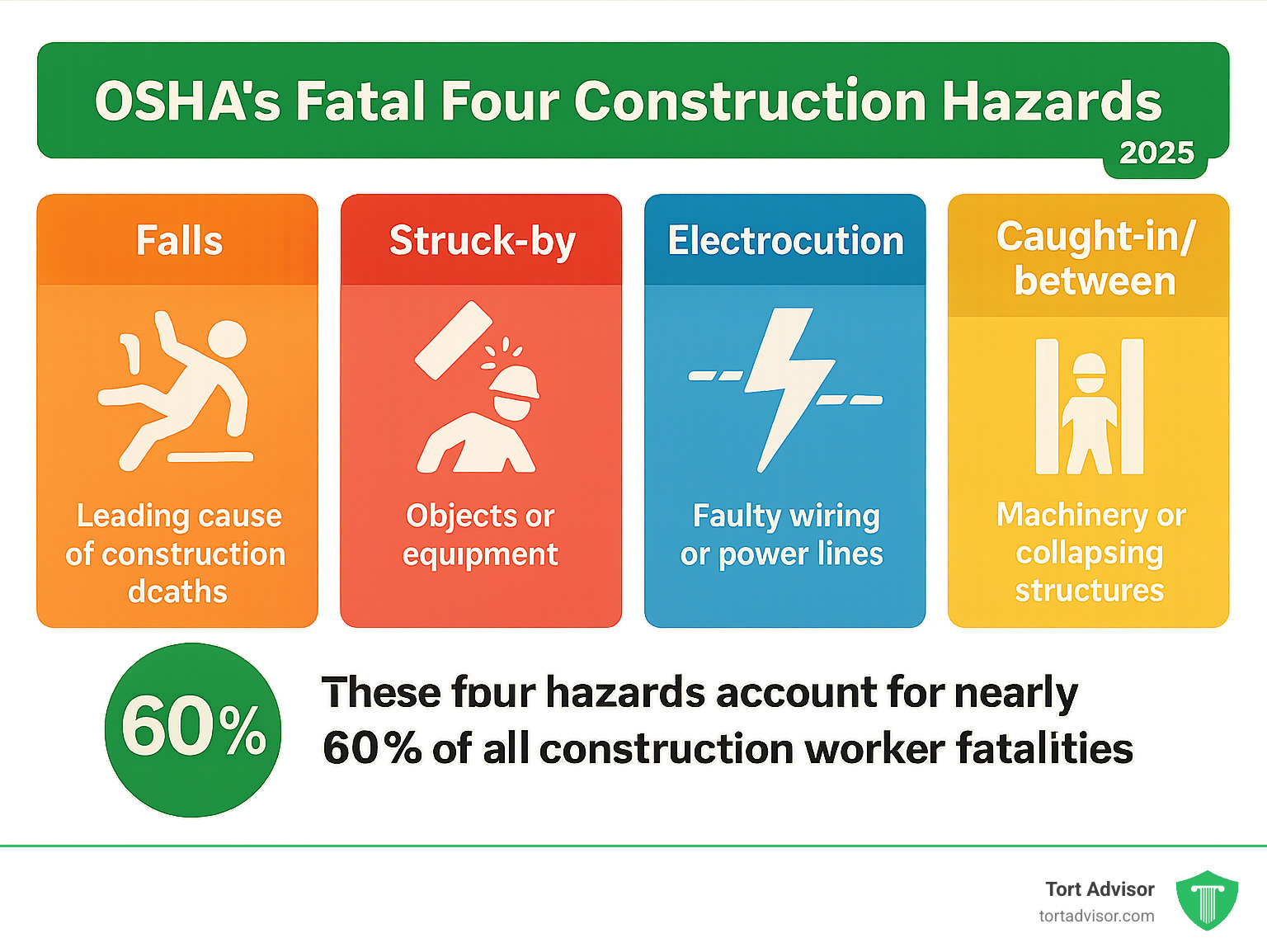
Job sites carry built-in danger every day from what OSHA calls the “Fatal Four”: falls, struck-by incidents, electrocution and caught-in/between accidents. Construction injuries also tend to involve several parties at once — your employer, the general contractor, subcontractors and the property owner — which makes the legal picture complicated and calls for focused experience.
Getting fairly compensated is not always simple. Workers’ comp helps, but it seldom covers everything you have lost. Many workers do not know that a third-party lawsuit may also be available, opening the door to pain and suffering damages, full lost wages and future medical costs.
I’m Mason Arnao, and for more than ten years I have helped people connect with qualified professionals. I know how hard it is to find the right construction injury lawyer near me while juggling serious injuries and growing bills, and how much it matters to find local experience fast.
Related construction injury lawyer near me searches:
- accident attorneys near me
- brain injury attorneys near me
Construction Accidents and Your Legal Rights Explained
Construction work is physically demanding and genuinely risky, and if you were hurt on a site, you have plenty of company. Injury rates in the trade are among the highest of any industry — British Columbia alone accepted 6,765 lost-time claims in 2023. Each of those numbers is a real person. Knowing your rights is the first step toward recovering and getting the compensation you are owed.
The Most Common Construction Site Injuries
Job sites change constantly and expose workers to many hazards, and the resulting injuries can be serious and permanent. The most frequent include:
- Falls from height: The top cause of construction deaths, accounting for more than a third of fatalities. Falling from scaffolds, ladders or roofs can lead to fractures, spinal cord injuries and traumatic brain injuries (TBI).
- Scaffold accidents: Common incidents include falls from poorly built scaffolds, collapses of unsecured frames and maintenance failures.
- Slips and trips: Wet surfaces, debris and uneven ground frequently cause torn ligaments, broken bones and back injuries. Premises liability rules, such as British Columbia’s Occupiers Liability Act, require owners to keep sites reasonably safe.
- Falling objects: Tools, materials or debris dropped from above can cause serious head injuries, concussions or death.
- Heavy equipment accidents: Being hit by or pinned between forklifts, cranes and other machines can cause crush injuries, amputations or internal damage.
- Trench collapses: Trenches without proper shoring can bury workers, causing suffocation or severe crushing injuries.
- Electrocution: Touching live wiring, defective electrical tools or overhead lines can cause deep burns, internal injuries or fatal shocks.
- Serious burns: Electrical contact, chemical spills, fires and explosions can all cause them.
- Toxic exposure: Breathing hazardous chemicals, asbestos or other toxins can cause lung disease and lasting health problems.
- Repetitive strain injuries: Doing the same motions over and over can lead to carpal tunnel syndrome or tendonitis, causing chronic pain and disability.
- Attorneys in our network also handle other catastrophic injuries, including cases that call for brain injury attorneys.
How Safety Rules Can Make or Break Your Claim
Safety regulations are legal requirements meant to protect workers, and in the U.S. the Occupational Safety and Health Administration (OSHA) writes and enforces them.
- The duty to keep the site safe: Employers must keep job sites free of known hazards by supplying proper safety gear, following safety procedures and inspecting regularly.
- Violations as proof of negligence: When ignoring a safety rule leads to an injury, that failure often amounts to negligence. If an employer provided no fall protection and a worker fell from a scaffold, that is a clear violation and strong evidence. OSHA hazard reports regularly point to these same repeat problems.
- Insufficient training: A worker hurt while running equipment they were never properly trained on points to a breach of the employer’s duty of care.
- Missing or faulty safety gear: Working without the right equipment, or with defective gear, sharply increases risk, and employers must supply and maintain it.
- What noncompliance means legally: Safety violations are strong evidence in an injury claim because they show the responsible party failed to protect you, which helps establish liability.
Workers’ Comp or a Third-Party Lawsuit? Understanding Your Options
After a construction injury, compensation generally comes through two routes: workers’ compensation and injury lawsuits against third parties. Knowing how each works is essential.
| Aspect | Workers’ Compensation | Third-Party Lawsuit |
|---|---|---|
| Basis | No-fault (who caused the accident does not matter) | Fault-based (you must show another party was negligent) |
| Who Pays | Your employer’s insurance carrier | The negligent outside party or its insurer |
| What It Pays For | Limited (medical care, partial wages, disability benefits) | Broad (full wages, pain and suffering, future losses) |
Workers’ comp is a no-fault program, so benefits are available no matter who caused the accident. The trade-off is that you usually cannot sue your own employer for more — the “exclusive remedy” rule.
Construction sites are a special case, though. With many contractors, subcontractors and suppliers on site, third-party liability claims are often possible against anyone besides your direct employer whose carelessness played a part.
The main distinction: workers’ comp usually pays medical costs and part of your lost wages but nothing for pain and suffering, while a successful third-party suit can deliver far broader compensation.
How the Workers’ Compensation Process Works
Workers’ comp claims are often harder than people expect. Injured workers regularly run into denials, reduced benefits and red tape while they are trying to heal.
Report the injury right away. Most states set a deadline for telling your employer — sometimes as short as 30 days — and missing it can put the claim at risk.
After reporting, you must submit a formal claim. In British Columbia, for instance, that means following WorkSafeBC’s specific forms and steps.
Medical records are everything. Document every appointment, diagnosis and treatment plan to tie your condition to the accident.
Denials happen often. Insurers profit by paying less and may claim the injury is not work-related, is not as serious as you say, or that you can go back to work sooner.
You can appeal a denial, but tight deadlines apply (often 30 to 90 days). Appeals are complex and frequently require precise legal arguments, which is where a construction injury lawyer becomes essential.
When Can You Bring a Personal Injury Lawsuit?
Workers’ comp offers some help, but it rarely matches the true cost of a serious injury. That is why finding a negligent third party can be so important to your financial recovery.
Responsibility for safety on a construction site is spread across many parties. Your injury may trace back to a general contractor who ignored safety procedures, a subcontractor whose work created a hazard, an architect whose design was flawed or an equipment maker that sold defective machinery.
Property owners may also be responsible if they knew about a dangerous condition and did nothing. Each of these parties carries its own insurance, separate from your employer’s comp coverage.
Third-party claims let you get past the “exclusive remedy” limit, so instead of being capped at comp benefits, you can pursue full damages through an injury lawsuit.
That can include all of your lost wages plus compensation for pain, emotional distress and future medical care, and punitive damages may be possible where negligence was gross. Success depends on proving an outside party’s negligence contributed to the injury, which takes skilled advocacy.
How a Construction Injury Lawyer Helps Maximize Your Recovery
After a serious construction injury, healing should come first, yet the legal and money pressures can be crushing. An experienced construction injury lawyer can be your most important resource.
How Your Attorney Builds a Construction Accident Case
A construction accident attorney serves as your advocate, investigator and strategist, taking on the complicated parts of the case so you can focus on recovering.
- Investigating the scene: Your lawyer examines the accident site, often going back to photograph it and collect evidence that may have been missed or altered.
- Talking to witnesses: They locate and interview witnesses and lock in statements that back up your account.
- Consulting experts: Engineers, construction safety specialists and doctors help analyze what happened, establish the cause and measure the full scope of your injuries and future needs.
- Recording safety violations: An attorney can pinpoint and document OSHA violations or other safety breaches that help prove negligence.
- Proving fault and causation: This is the heart of every injury claim — gathering proof that ties a third party’s negligence directly to your injuries, which is where construction accident experience pays off.
- Valuing your losses: Financial and medical experts help total every present and future loss accurately.
- Handling insurers: Insurance companies aim to pay as little as possible. Your lawyer manages all communication and negotiation, pressing for a settlement that matches the claim’s real value.
- Going to court: If no fair settlement is offered, your attorney can take the case to trial and represent you vigorously.
Damages Available in a Construction Injury Lawsuit
A successful third-party injury suit, unlike workers’ comp, can compensate you for the full range of your losses, including:
- Economic damages: Financial losses that can be measured.
- Past and future medical costs: Emergency treatment, surgery, hospital time, rehab, prescriptions and continuing therapy.
- Lost wages: Pay you have missed because you could not work after the accident.
- Reduced earning capacity: Compensation for the long-term financial hit if you cannot return to your old job or earn what you did before.
- Job retraining: The cost of new training or education if your former work is no longer possible.
- Non-economic damages: Payment for losses that are harder to measure.
- Pain and suffering: For the physical pain and discomfort of your injuries.
- Emotional harm: Anxiety, depression, PTSD and other psychological effects of the accident.
- Loss of enjoyment of life: When injuries keep you from hobbies, social life or everyday activities you used to enjoy.
- Punitive damages: Occasionally, for gross negligence or deliberate misconduct, a court may award punitive damages — not to repay your losses, but to punish the wrongdoer and discourage similar conduct.
How to Choose a Construction Injury Lawyer Near Me: Step by Step
Choosing the right representation matters enormously. A local construction injury lawyer near me will know your state’s laws, how nearby courts operate and even the track record of opposing lawyers and local builders — knowledge that can make a real difference.
What to Look For in a Local Attorney
As you compare attorneys, weigh these qualities:
- A focus on construction injuries: Plenty of lawyers do personal injury work, but one with construction accident experience understands OSHA rules, multi-party fault and the hazards specific to the trade.
- Results you can verify: Look for a documented history of strong settlements and verdicts in construction cases, and ask about prior outcomes.
- Courtroom experience: Most cases settle, but you want a lawyer ready to go to trial if needed. Insurers notice which lawyers avoid court.
- Contingency fees: Reputable construction injury lawyers generally charge nothing upfront and are paid a share of the settlement or award only if they win, which makes quality representation available regardless of your finances.
- Strong client feedback: Reviews from former clients reveal how a lawyer communicates and how much care they give. Seek out trusted personal injury attorneys with solid reputations.
- Clear communication: Your lawyer should keep you updated, explain legal terms simply and answer questions quickly.
Legal Lawsuit is a legal-information site, not a law firm. We help people understand their options and connect with experienced attorneys in our network across many practice areas, construction injury included, through a free, confidential case review. The goal is to help you find a lawyer who knows the law, your local courts and your particular circumstances.
Questions Worth Asking at Your Free Consultation
After narrowing your list of construction injury lawyer near me options, book free consultations and use them to interview each lawyer. Key questions include:
- How many construction injury cases like mine have you handled? Ask for concrete examples.
- Which past outcomes can you tell me about? Each case differs, but prior success shows what they can do.
- How do your fees work? Confirm the contingency percentage and how case expenses are treated.
- Who will I deal with day to day? Find out whether you will work with the lead attorney or mostly with associates and paralegals.
- Where is my case strong, and where is it weak? A good lawyer will be candid and realistic.
- How long might a case like mine take? Construction cases can run long, so knowing the likely timeline helps.
Construction Injury Claim FAQs
A construction injury brings a flood of questions while you are trying to heal, and the legal system can feel overwhelming on top of pain and money worries. These are the questions people searching for a construction injury lawyer ask most.
What is a typical construction injury settlement?
It is a reasonable question, but no meaningful “average” settlement exists because every construction injury case is different.
A small laceration and a spinal cord injury are valued very differently. Your claim’s worth depends on your circumstances — how severe the injury is, current and future medical costs, lost income and how clear the fault is.
Medical expenses and lost earnings, past and future, carry heavy weight. How negligent the other side was also matters, since a clear safety violation strengthens a claim. Even location plays a role, because laws and juries differ from place to place.
Because of these variables, construction injury outcomes span an extremely wide range. Claims involving permanent disability, defective equipment, multiple liable parties and strong evidence of safety violations generally carry the greatest value, while minor injuries with disputed fault are worth far less. An attorney who reviews your records can give you a realistic sense of what your specific claim may be worth.
Can I file a claim if I was partly to blame for the accident?
In most states, yes — sharing some fault does not automatically bar a claim. The rule that allows this is called “comparative negligence.”
States generally use one of two versions. With pure comparative negligence, your award shrinks by your share of fault. With modified comparative negligence, you can recover only if your share is below 50% or 51%, depending on the state.
Better still, workers’ comp is no-fault, so it usually covers you no matter who caused the accident, unless you were intoxicated or meant to hurt yourself.
An experienced construction injury lawyer is especially useful here, because presenting the facts to keep your share of fault low directly affects what a third-party claim can recover.
What is the deadline to file a construction injury lawsuit?
Timing is crucial. The statute of limitations, which differs by state, sets your filing deadline.
Most states allow roughly 1 to 3 years from the injury date to bring a personal injury suit. Workers’ comp deadlines are usually far shorter — sometimes only days to report the injury and 30-90 days to appeal.
Missing the deadline permanently ends your right to compensation, however strong the case. Exceptions are extremely rare and should never be counted on.
That is why it pays to speak with a lawyer soon after a construction accident. They will make sure every report and filing goes in on time while you concentrate on healing.
Final Thoughts: Your Path to Recovery and Fair Compensation
If you have read this far, you are probably going through an extremely hard time. A construction injury hurts more than your body — it can upend your work, your family’s finances and the life you have built.
Keep this in mind: you have more power here than it may seem. This guide has laid out legal routes that are complicated but manageable. Construction cases involve tangled responsibility, from OSHA violations to many parties on one site, and understanding that is the first step toward justice.
Both workers’ comp and personal injury law give you rights. Comp can provide quick medical coverage and partial wage replacement, but it is often only a beginning. If a careless third party — a general contractor, equipment maker or property owner — contributed to the injury, a lawsuit can deliver compensation that fully reflects your losses.
This is not about a windfall or gaming the system. It is about paying for the care you need, replacing lost income and rebuilding after someone else’s negligence disrupted your life.
An experienced construction injury lawyer is key to working through this process and recovering fair compensation. Insurers and opposing parties have legal teams focused on paying you less, and you deserve an equally capable advocate who understands construction law, OSHA rules and how to prove negligence in multi-party cases.
Legal Lawsuit knows how overwhelming the search for legal help can be alongside pain, appointments and financial stress. That is why we help injured workers connect with carefully screened attorneys in our network who focus on construction injury cases and typically work on contingency, so there is no fee unless the case succeeds.
Protect your rights without delay. Each day that passes risks lost evidence, fading memories and approaching deadlines. Filing limits differ by state but often fall between one and three years, and that time goes quickly while you are recovering.
Getting started takes one call or click. Look into your personal injury lawsuit options today with a free, confidential case review and take the first step toward the compensation and closure you deserve. You made it through the accident — now get the guidance you need for the road ahead.
Additional Resources
Related Posts
Quick Answer: The Boy Scouts of America (BSA) filed for Chapter 11 bankruptcy in 2020 after facing tens of thousands [...]
Quick Answer: Survivors of sexual abuse by Catholic priests, nuns, or other Church personnel may be able to file a [...]
Quick Answer: Clergy abuse settlements vary enormously based on the severity of the abuse, the strength of evidence that the [...]

