
Short answer: This article explains the key facts, eligibility issues, settlement factors, deadlines, and source-backed updates related to this legal topic. Results vary by case facts, evidence, jurisdiction, and representation.
Roundup Lawsuit Guide: The Controversy Explained
This Roundup lawsuit guide covers the litigation often described as a class action lawsuit against Roundup, one of the biggest mass torts ever, in which thousands of people say the popular weed killer caused their cancer.
📋 Table of Contents
Roundup Lawsuits at a Glance:
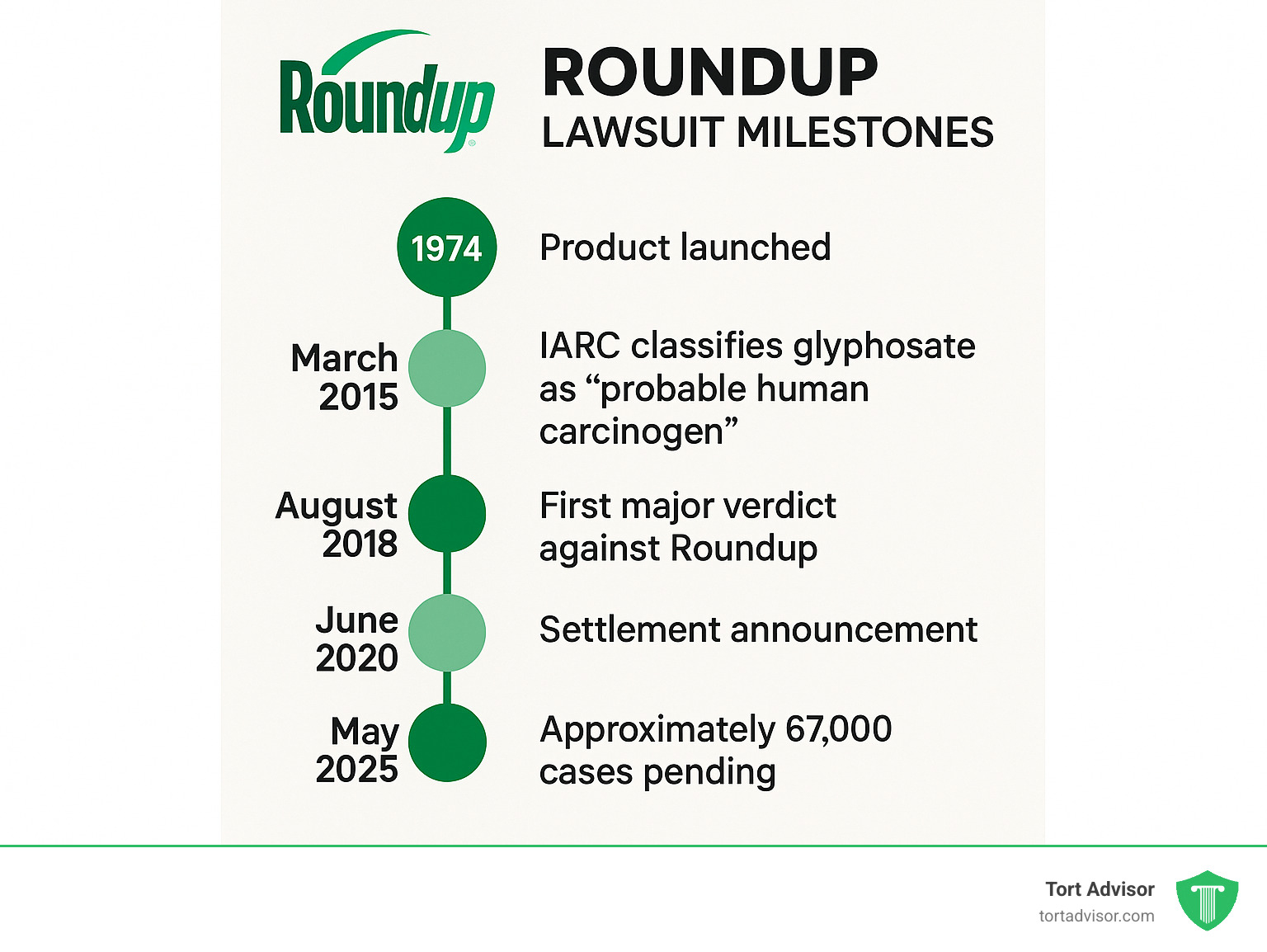
- Where things stand: about 67,000 lawsuits still pending as of May 2025
- Settlements: Bayer has paid roughly $11 billion to resolve close to 100,000 cases
- Primary health concern: Non-Hodgkin’s Lymphoma tied to glyphosate exposure
- Recent verdicts: $2.1 billion in Georgia (March 2025) and $2.25 billion in Pennsylvania (January 2024)
- Canadian class action: certified December 8, 2023, with an opt-out deadline of July 17, 2025
- Who qualifies: people diagnosed with Non-Hodgkin’s Lymphoma after “significant exposure” to Roundup
At the center of the dispute is glyphosate, Roundup’s active ingredient, which the World Health Organization’s International Agency for Research on Cancer labeled a “probable human carcinogen” in 2015. The EPA, however, says glyphosate is safe when used according to directions.
Bayer took on these enormous liabilities when it bought Monsanto in 2018. The company is accused of not warning consumers about cancer risk and of misleading marketing, and internal records known as the “Monsanto Papers” allegedly show efforts to sway scientific research and minimize health concerns.
The stakes are huge: jury verdicts have reached into the billions, though appeals often reduce them. Farmworkers, landscapers, and home gardeners who developed lymphoma after regular Roundup use make up most of the plaintiffs.
I’m Mason Arnao. Working with large legal and health data systems has let me follow how the class action lawsuit against Roundup has unfolded, and that data background helps explain how these cases develop and resolve.
Key Roundup lawsuit guide topics:
- average Monsanto settlement
- Roundup settlement payout
- when will I get my Roundup settlement check
Why Is Roundup Being Sued? The Science and the Law
The class action lawsuit against Roundup grows out of serious health concerns and accusations that Monsanto deliberately concealed cancer risks.
Glyphosate and Cancer: The Health Concerns
The dispute intensified in 2015 when the World Health Organization’s International Agency for Research on Cancer (IARC) labeled glyphosate a “probable human carcinogen.” A major University of Washington study later found that heavy glyphosate exposure was associated with a 41% greater risk of Non-Hodgkin’s Lymphoma.
Non-Hodgkin’s Lymphoma is the cancer most often tied to Roundup, though some research also points to leukemia and other blood cancers. Scientists think glyphosate may damage DNA or disturb gut bacteria in ways that could lead to cancer. The EPA’s position that glyphosate is safe as directed creates a clash of assessments that has become a central courtroom fight.
What Monsanto and Bayer Are Accused Of
The core accusation is that Monsanto put profit ahead of public health. The main claims in the class action lawsuit against Roundup are failure to warn about possible cancer risk and misrepresenting product safety, including marketing Roundup as harmless and claiming it targets enzymes “not found in people or pets” despite knowing of potential dangers.
The most damaging evidence comes from internal records called “The Monsanto Papers,” which allegedly show ghostwritten scientific articles and campaigns to discredit independent scientists, pointing to a pattern of misleading marketing. For people who trusted Roundup, these revelations feel like a betrayal, and courts are now deciding Bayer’s responsibility.

How the Roundup Litigation Is Organized
Understanding the legal structure matters for anyone affected. Here is how the litigation is set up, where it stands, and the key dates.
Class Action or MDL? What Kind of Case You’d Be In
Most U.S. injury suits linking Roundup to cancer aren’t traditional class actions; they’re part of a Multidistrict Litigation (MDL).
- In a traditional class action, a single group represents everyone with similar claims.
- In an MDL, individual cases move to one federal court for pretrial proceedings, but each person keeps their own lawsuit, and cases that don’t settle can go back to their original courts for trial.
Roundup cases are consolidated in Roundup MDL 2741 in the Northern District of California, which has been vital for handling the volume. Class certification is a court’s approval for a case to proceed as a class action, while MDLs consolidate cases without certifying a class. Our personal injury lawsuits resources offer more background.
Roundup Lawsuit Update: Current Status and Key Deadlines
As of May 2025, Bayer had settled close to 100,000 lawsuits for about $11 billion, with roughly 67,000 still pending, and new cases keep being filed.
Recent verdicts have been enormous: $2.1 billion in Georgia (March 2025), $2.25 billion in Pennsylvania (January 2024), and $1.56 billion in Missouri (November 2023). Appeals usually cut these awards substantially; the $2.25 billion verdict fell to $400 million and the $1.56 billion verdict to $611 million.
Bayer removed glyphosate-based Roundup from U.S. retail shelves for home use by early 2023 but still sells commercial formulas, and it continues to appeal verdicts aggressively.
In Canada, a nationwide class action lawsuit against Roundup was certified on December 8, 2023, with an opt-out deadline of July 17, 2025 for eligible Canadians who wanted to pursue their own cases.

Who Qualifies for a Roundup Lawsuit?
Eligibility for the class action lawsuit against Roundup depends on two things: your Roundup exposure and a later Non-Hodgkin’s Lymphoma diagnosis.
Who Can Bring a Roundup Claim?
A Non-Hodgkin’s Lymphoma diagnosis after Roundup use may qualify you. Typical claimants include:
- Farmworkers and farmers with regular, large-scale exposure.
- Professional landscapers and groundskeepers who applied Roundup commercially.
- Homeowners and gardeners who used Roundup for routine weed control over several years.
The essential requirement is a Non-Hodgkin’s Lymphoma diagnosis following exposure, since that cancer has the strongest statistical tie to glyphosate. Relatives may also bring wrongful death claims if a loved one died of NHL possibly linked to Roundup.
What ‘Significant Exposure’ Means
“Significant exposure” means meaningful, repeated contact over time, so how often and how long you used Roundup matters most. The Canadian class action, for example, defines it as using glyphosate herbicides more than twice in a 12-month period AND more than 10 times over a lifetime. That isn’t a U.S. rule, but it shows the kind of use considered significant. How you applied it, such as mixing concentrate or spraying without protective gear, also affects exposure.
Proving exposure is essential and can rely on receipts, work records, or statements from relatives and coworkers, and experienced attorneys can help you gather that evidence. Our Monsanto Roundup Lawsuits resources have more on eligibility. Every situation differs, so a professional review is important.
Compensation and Outcomes: What This Roundup Lawsuit Guide Can Tell You
The financial and personal stakes are enormous. Here’s what compensation can look like and what the litigation means more broadly.
What Can Plaintiffs Recover?
Compensation in a class action lawsuit against Roundup is meant to address the full harm of a cancer diagnosis, including:
- Medical costs: doctor visits, testing, chemotherapy, surgery, and medication.
- Lost income: wages missed during treatment and recovery, plus reduced future earning ability.
- Pain and suffering: the physical pain and emotional distress of a cancer diagnosis.
- Punitive damages: awarded to punish especially bad conduct, such as concealing known risks.
Jury verdicts have reached billions, though appeals often reduce them significantly, and final amounts can still be life-changing. Individual settlement values vary widely with the type and stage of cancer, the extent of exposure, medical costs and lost income, and the strength of the evidence.
What the Litigation Means for Bayer and Consumers
The fallout reaches far. Bayer’s finances have taken a major hit, with about $11 billion in settlements and pressure on its share price. In response, Bayer changed Roundup, introducing glyphosate-free versions for U.S. home use in 2023 while commercial versions still contain it. Public awareness of glyphosate has surged and many consumers now look for alternatives. The future of pesticide regulation is also uncertain, as the suits expose conflicts between regulators and scientific bodies and some countries restrict or ban glyphosate. To learn about the payment process, read When Will I Get My Roundup Settlement Check?. The litigation marks a turning point showing that even very large companies can be held accountable for product safety.
Roundup Lawsuit FAQs
Is it too late to file a Roundup lawsuit?
No, new claims are still being filed, but time is limited. The statute of limitations, the legal deadline to sue, differs by state and is strictly enforced, so talk with an attorney right away to learn your deadline and protect your right to file.
How do U.S. and Canadian Roundup lawsuits differ?
Their structures are very different. In the U.S., most federal cases are part of a Multidistrict Litigation (MDL) that combines individual lawsuits for pretrial efficiency. In Canada, a national class action certified on December 8, 2023 groups all eligible claimants into one case; qualifying residents were included automatically unless they opted out to sue individually by the July 17, 2025 deadline.
How do I find a lawyer for a Roundup claim?
These complicated cases call for an attorney with mass tort experience and a record of taking on large corporations, someone who understands the science and legal strategy specific to Roundup. Most injury lawyers work on contingency, so there are no upfront fees and they’re paid only if you settle or win, which lets people take on major companies without financial risk. Legal Lawsuit connects people with experienced attorneys in our network who handle these complex cases.
Your Next Steps in the Roundup Litigation
The class action lawsuit against Roundup is a landmark test of corporate accountability. For the many families affected by Non-Hodgkin’s Lymphoma after using Roundup, these cases offer a path to justice, and billions in verdicts and settlements show what ordinary farmworkers, gardeners, and landscapers can achieve against a global corporation.
The fight isn’t over. Bayer has paid about $11 billion to resolve close to 100,000 cases, yet roughly 67,000 suits were still active as of May 2025, and large jury awards show courts continue to take these claims seriously.
Timing matters. State statutes of limitations set filing deadlines, and waiting too long can cost you your rights. In Canada, the national class action’s opt-out deadline was July 17, 2025.
What to do next:
- Collect proof of your Roundup use, such as receipts and work records.
- Get experienced legal help, because the class action lawsuit against Roundup is too complicated to handle alone.
Legal Lawsuit connects people with experienced attorneys in our network who handle these specific cases on contingency, so you pay nothing unless you win. These lawsuits drive lasting change, from reformulated products to greater public awareness, and if your family has been affected, understanding your rights is the first step.

Connect with an experienced attorney for your Roundup lawsuit.
Additional Resources
Related Posts
Quick Answer: The Boy Scouts of America (BSA) filed for Chapter 11 bankruptcy in 2020 after facing tens of thousands [...]
Quick Answer: Survivors of sexual abuse by Catholic priests, nuns, or other Church personnel may be able to file a [...]
Quick Answer: Clergy abuse settlements vary enormously based on the severity of the abuse, the strength of evidence that the [...]

