
Short answer: This article explains the key facts, eligibility issues, settlement factors, deadlines, and source-backed updates related to this legal topic. Results vary by case facts, evidence, jurisdiction, and representation.
In This Guide
Why an Athletic Director Sexual Abuse Policy Matters
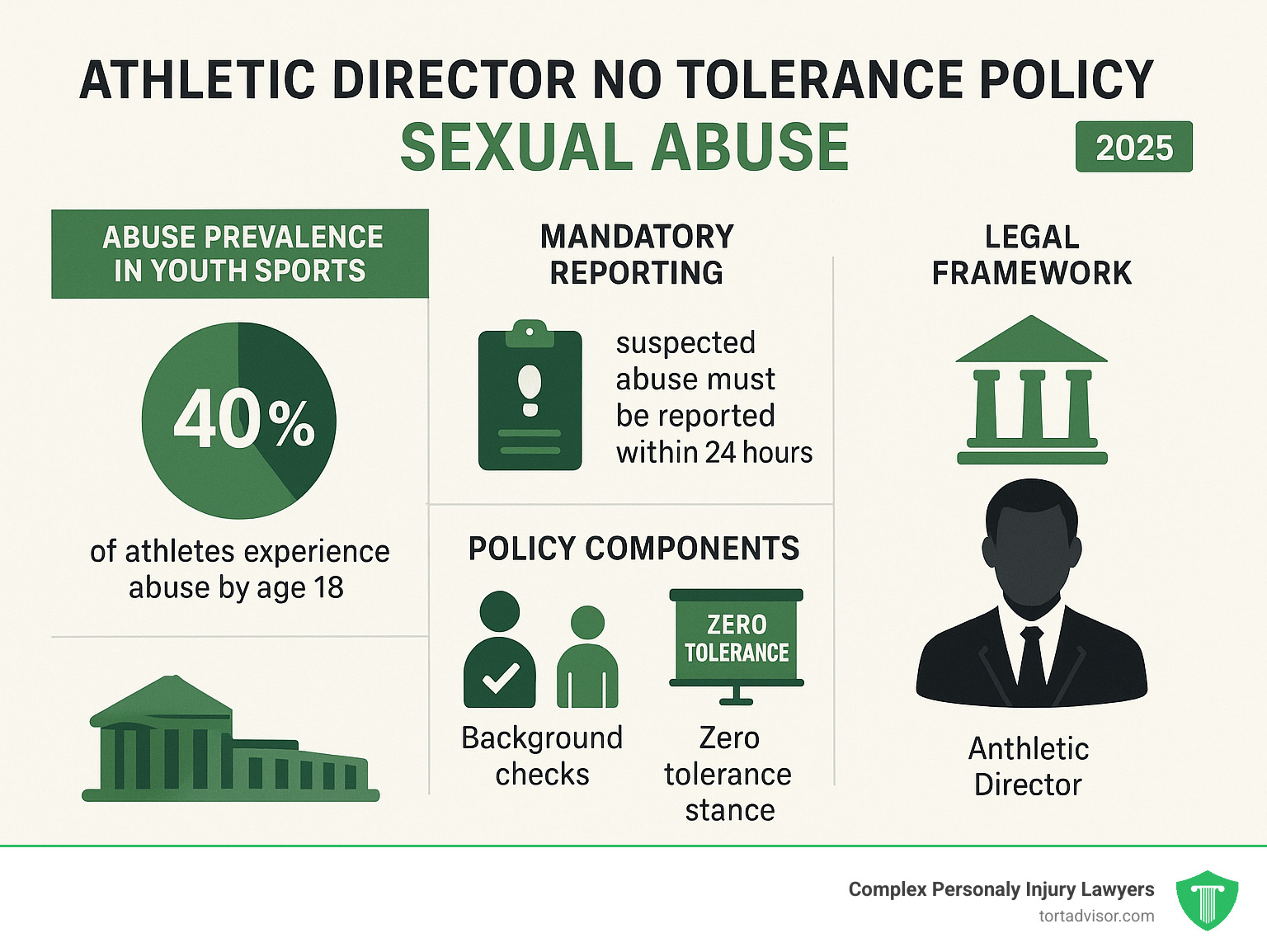
A strong athletic director sexual abuse policy is one of the most important protections a school or youth sports program can give its athletes. A true no-tolerance policy spells out firm rules with no exceptions, so that everyone involved knows predatory behavior will be stopped and reported immediately.
What a no-tolerance athletics policy usually includes:
- No exceptions – any sexual misconduct triggers immediate consequences
- Prompt reporting – staff report suspected abuse within 24 hours
- Screening – background checks for every coach, employee and volunteer
- Two adults present – no private one-on-one time between adults and minors
- Set discipline – consequences, up to firing, defined in advance
- Yearly training – every adult learns to spot and prevent abuse
Athletic directors answer for an entire program, which makes this duty heavy. Their job is to build a setting where athletes can train and compete without fear. When a policy breaks down or goes unenforced, the damage reaches well past the field.
Sports carry specific risk factors. The authority coaches hold, overnight trips, locker rooms and a culture that prizes toughness can all raise the danger of abuse when no one is managing them carefully.
In my work building compliance and monitoring systems, I (Mason Arnao) have seen that an athletic director sexual abuse policy only protects anyone when it is complete and applied the same way every time. Clear, written procedures with no gaps are what make the difference.
Types of Abuse and Misconduct in Sports
Before writing an athletic director sexual abuse policy, leaders need a clear picture of the harms it must prevent. Athletic programs create settings where several kinds of misconduct can take root unless adults stay alert.
Sexual abuse is the gravest breach of trust in sports. It covers any sexual act with a minor or vulnerable adult, from unwanted touching to violent assault. In athletics it is especially damaging because abusers take advantage of the trust athletes give coaches and mentors.
Sexual harassment takes a different form but is just as harmful. It includes unwanted advances, remarks about an athlete’s body, explicit jokes, or any conduct that makes taking part uncomfortable or depends on putting up with sexual behavior. It often happens in front of others, yet it can shatter an athlete’s sense of safety.
Physical misconduct goes beyond what training requires. Any deliberate force that causes harm, such as striking an athlete, punishing with extreme exercise or touching passed off as “coaching,” crosses from demanding instruction into abuse.
Emotional misconduct is harder to see but deeply damaging. It means a pattern of constant belittling, public shaming, threats or intimidation that wears down an athlete’s self-worth. Pushing players is part of coaching; psychological abuse is not.
Bullying and hazing are often lumped together, but they are separate problems. Bullying is repeated harm by someone with more power against someone with less. Hazing, often defended as “tradition,” makes newcomers endure dangerous or humiliating acts to be accepted.
Grooming may be the most dangerous form because it is built to go unnoticed. An abuser slowly earns trust and wears down boundaries. Warning signs include singling out isolated or struggling athletes, offering “extra practice” for private access, giving gifts and special praise, gradually raising sexual topics or touch, separating the athlete from family and friends, asking the athlete to keep secrets, and finally treating abuse as normal while threatening consequences for telling.
Programs also have to watch for peer-on-peer abuse, when athletes harm teammates. Research on child sexual abuse suggests a substantial share of cases, often estimated at around a third, involve another minor, which is why supervision must cover athletes’ interactions with each other as well as with adults.
The authority gap between coaches and athletes raises the risk and the harm of every type of misconduct. Coaches decide playing time, influence scholarships and shape team life, and they are often trusted mentors. That built-in power requires firm ethics rules and real oversight.
Knowing the full range of misconduct lets athletic directors write policies that cover every kind of harm. When those protections fail and an athlete is hurt, survivors have legal options to pursue accountability.
Learn how athlete sexual abuse lawsuits work
Writing a No-Tolerance Athletic Director Sexual Abuse Policy
A real athletic director sexual abuse policy is more than paperwork for compliance. It is a commitment to every athlete on your field, court or track that their safety outranks wins, schedules and reputations.
“Zero tolerance” has to mean what it says: no gray areas, no second chances and no excuses dressed up as team culture. Any sexual misconduct leads straight to consequences set in advance. That is different from ordinary conduct codes, which leave discipline to case-by-case judgment.
Many programs have adopted this firm approach. Groups such as the Canadian Cerebral Palsy Sports Association, Parker Youth Sports, the North St. Paul Athletic Association and the North Rockland Soccer Association publish zero-tolerance abuse policies, reflecting a shared view that child protection allows no compromise.
Federal law sets the baseline through the Safe Sport Act of 2017. It requires amateur sports organizations to report suspected child abuse to law enforcement within 24 hours, restrict one-on-one contact between adults and minors, train adults on abuse prevention and bar retaliation against anyone who reports.
A policy that sits unread in a binder protects no one. Coaches, staff, volunteers, athletes and parents all need to read it and sign off on it. That takes a proactive approach, with yearly reviews and refresher sessions that keep everyone informed and accountable before anything goes wrong.
Core Elements of a No-Tolerance Sexual Abuse Policy in Athletics
An effective athletic director sexual abuse policy depends on several safeguards that reinforce one another.
Screening and background checks come first. Anyone with direct access to athletes should pass a criminal background check before starting and at regular intervals afterward, with many programs re-checking about every five years and listing clear disqualifiers such as sex offenses and violent felonies. This basic step keeps dangerous people away from children.
Required prevention training teaches adults to recognize warning signs, understand their reporting duties and follow protective practices. Staff, coaches and volunteers should train every year, and minors can receive age-appropriate lessons with parental permission. The NFHS offers free courses focused on the coach’s role in prevention.
Under a two-adult (“two-deep”) rule, at least two adults attend every practice, game, trip and event involving minors. That alone removes most of the private situations abusers look for.
Supervision rules keep oversight constant and visible. No adult should be alone with a minor athlete unless another adult can see them, and individual sessions should take place in open areas. The North St. Paul Athletic Association, for example, recommends one adult per eight children and at least two adults at every activity.
A safe physical setting comes from how spaces are arranged and managed. Private talks should happen within sight of others, not behind closed doors, which discourages misconduct and builds confidence among parents and athletes.
Coaches carry a special share of this duty. Many are mandated reporters who must hold themselves to the highest standards while building positive bonds with athletes. The NFHS article Coaching to Prevent Abuse in High School Athletics explains this role in more depth.
High-Risk Situations: Travel, Locker Rooms and Online Contact
Certain settings carry more risk than others, and good athletic directors write specific rules for each.
Team travel needs careful planning, whether it is a day tournament or an overnight trip. Drivers should be licensed and insured, and no adult should drive alone with an unrelated minor. On overnight trips, programs should use same-sex chaperones, never let staff room with unrelated minors, and assign athletes two to four per room. Curfews, a ban on alcohol and drugs for chaperones and daily check-ins with parents keep trips safe and accountable.
Locker rooms and changing areas call for their own rules: proper supervision, no phones or recording devices, and clear privacy standards for moments when athletes are most exposed.
Online and text communication now plays a large role in how coaches and athletes connect. Messages between staff and minors should stay professional and about the team, with a parent or second staff member copied whenever possible. Private messaging, inappropriate content and off-topic personal conversations should be banned. Some programs also limit direct contact by age and forbid private conversations on social media.
The guiding rule is to remove private one-on-one contact, in person and online. When group, visible interaction is the norm, it becomes far harder for an abuser to isolate and manipulate an athlete.
None of this is meant to wall coaches off from athletes or breed suspicion. The aim is a program where healthy mentoring and athletic growth can happen safely, giving families confidence and athletes the protection they are owed.
How Reporting and Investigations Should Work
Even strong prevention cannot stop every incident, so any athletic director sexual abuse policy needs a reporting and investigation process people can find, use and trust. When people feel safe speaking up, the whole program becomes safer.
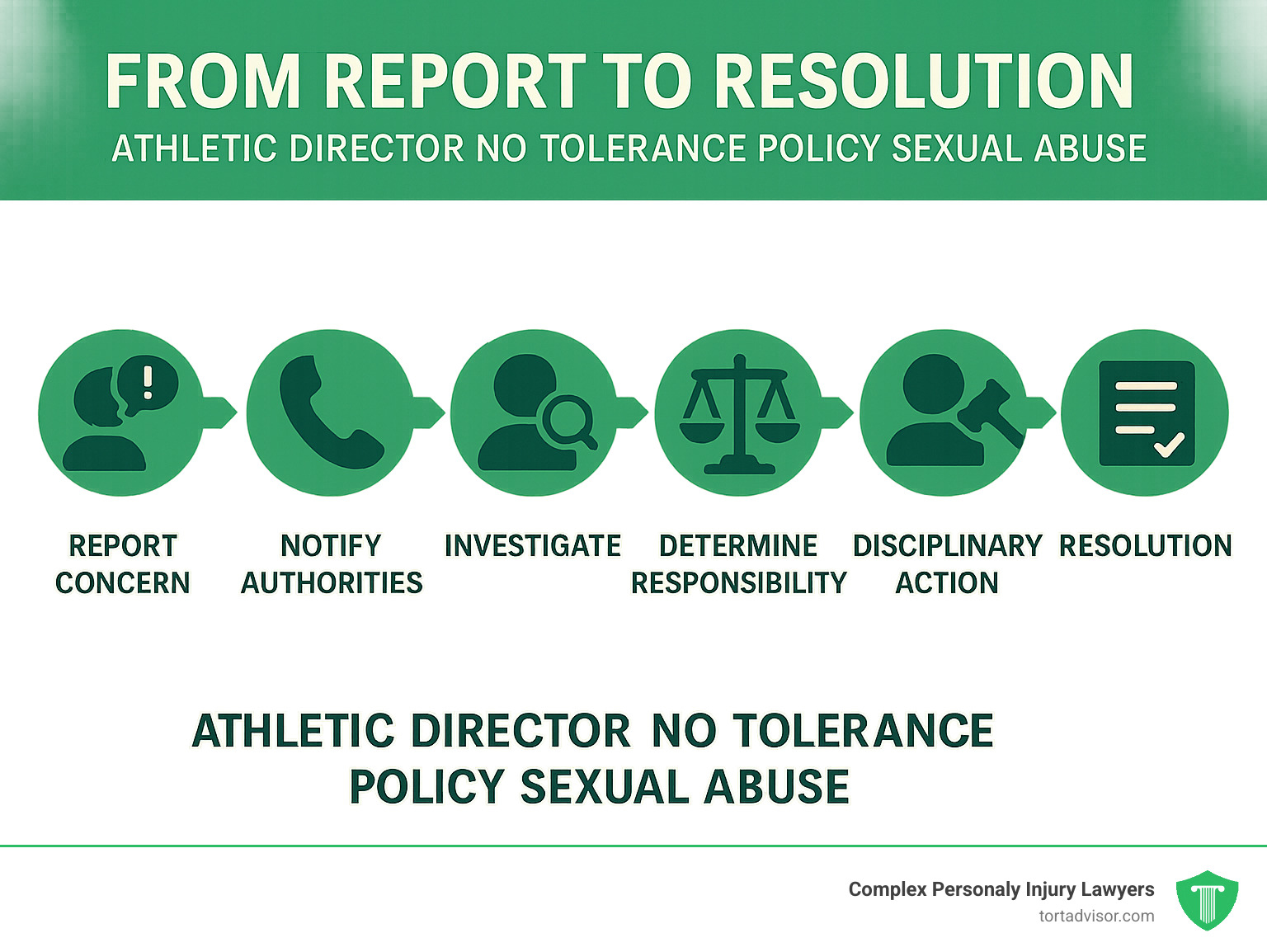
Good reporting starts with several ways to report. Athletes, parents and staff should know exactly where to go: the athletic director, a school administrator, a designated misconduct officer, the Title IX Coordinator or a trusted parent liaison. More options mean more people willing to come forward.
It works like the exits in a building: people need to know there is more than one way out when something goes wrong.
At schools, the Title IX Coordinator does far more than file forms. Title IX bars sex discrimination, including sexual harassment and abuse, in federally funded education programs, and the coordinator oversees compliance, runs the grievance process, arranges supportive measures and supervises investigations. Many districts require employees to alert the coordinator within a day or two of learning about an allegation.
Fear of payback keeps many people silent, so protection for whistleblowers is essential. The policy should state plainly that no one who reports in good faith will face retaliation, and that promise should be repeated every year so reporting is seen as expected, not risky.
Confidentiality for everyone involved takes balance. Complete secrecy is not always possible, but details should be shared only as needed to investigate and resolve the matter and to meet legal duties such as reporting to police. Careful handling encourages reports while protecting all parties.
Once a report comes in, a fair, timely investigation should follow a set process. Suspected sexual or physical abuse of a child must be reported to law enforcement and child protective services within 24 hours, without exception, and the accused staff member should be removed from duties while the investigation proceeds.
Investigators should collect all relevant evidence, including anything that cuts against the allegation. The person reporting and the person accused should both be treated fairly and offered supportive measures, and no one’s credibility should hinge on their title or status.
After the evidence is reviewed, the decision on responsibility usually applies a “preponderance of the evidence” standard. If misconduct is found, sanctions range from a warning up to firing or removal from the program, and both sides should have access to a fair appeal.
Failing to report suspected child abuse is more than an ethical lapse. It can bring criminal charges and serious penalties for individuals and for the organization.
To see how schools and universities handle these cases, read our guide to university sexual assault lawsuits.
Legal Duties and the Cost of Getting It Wrong
Every athletic director carries real legal responsibility, and the law leaves little room for error when children are involved. A no-tolerance athletic director sexual abuse policy is both the ethical choice and a way to meet obligations that can decide an organization’s future.

Title IX sets firm requirements for schools. Institutions that receive federal money must prevent and respond to sexual harassment and abuse, and failing to do so can put that funding at risk along with exposing the school to lawsuits.
The Safe Sport Act of 2017 reshaped duties for amateur sports. Its 24-hour reporting rule is federal law, not a guideline. Combined with state mandatory reporting statutes, which cover school employees in most states, it means nearly every coach and athletic director must report suspected abuse right away.
Negligence claims are the legal risk sports programs face most often. Courts regularly hold organizations responsible when poor hiring, weak supervision or keeping a problem employee leads to an athlete being hurt, and recent litigation against residential programs and youth facilities shows how seriously courts treat these failures.
Criminal penalties for not reporting can be devastating on a personal level. Beyond fines or jail, a criminal charge can end a career and permanently damage a reputation.
Institutional liability and lost trust often do the most lasting harm. Legal costs are only part of it; enrollment, sponsors and community support can fall away, and some institutions never fully recover.
The law keeps moving toward survivors. Many states have lengthened or removed time limits for child sexual abuse claims, so organizations can be held liable for abuse that happened decades ago.
State-by-state rules are summarized by the Child Welfare Information Gateway. For school-specific issues, see our guide to teacher sexual abuse lawsuits.
What Happens Legally When a No-Tolerance Policy Fails
When an athletic director sexual abuse policy exists on paper but is not enforced, the legal fallout can be severe. The distance between the written rule and what actually happened often becomes the core of a survivor’s case.
Negligent hiring and supervision claims are increasingly common. Courts have little patience for programs that skipped background checks or failed to watch their staff, and if a coach with past misconduct got through weak screening, the organization can be held responsible.
Under vicarious liability, an institution cannot simply point at one employee. When a coach or staff member abuses their position, the employer often shares legal responsibility because it benefited from that person’s work.
Personal liability can reach athletic directors and coaches individually. In civil suits their own assets may be at stake, and immunity offers less protection than many assume when legal duties were ignored.
Damages and settlements in these cases can be very large. Value depends on the harm to each survivor, the evidence of institutional failure, the number of people affected and the state where the case is filed, and cases with many survivors can threaten a small organization’s survival.
Outside the courtroom, the lasting harm to survivors and communities runs deep. Survivors may live with trauma for years, and communities can lose faith in institutions they relied on, with effects that reach families and teammates for a long time.
Next to that human cost, the legal consequences are almost secondary. When a policy fails, real people are hurt in ways money cannot fully repair.
Keeping the Trust Families Place in Athletic Leadership
Leading an athletic department is about far more than wins and trophies. Every time a parent drops a child at practice, an athlete looks up to a coach, or a town rallies behind a team, they are trusting the people in charge. A no-tolerance athletic director sexual abuse policy is what keeps that trust protected.
Athletic directors influence lives, not just seasons. The rules you adopt, the standards you enforce and the culture you build spread in ways you may never see. A student who feels safe reporting a problem may later speak up for others, and a coach who has been properly trained may spot warning signs in time to stop abuse.
A culture of safety and openness takes time to build. It needs steady effort, regular training and the willingness to have uncomfortable conversations. Athletes must feel free to raise concerns, every report must be taken seriously and investigated, and leaders must show through action that everyone deserves to play without fear.
Protecting athletes protects far more than their time in sports. It preserves their ability to trust, to grow and to reach their potential, and it keeps athletics a positive force in the community.
Even well-designed policies sometimes fail, whether because an organization falls short or because someone betrays the trust placed in them. When that happens, survivors deserve real accountability and support, not just apologies.
Survivors failed by a sports program have legal options. Coming forward about abuse by a coach or administrator takes courage, and Legal Lawsuit exists to help survivors understand their rights and connect with experienced attorneys who handle these cases with care.
You do not have to navigate this alone. Survivors, parents and athletic directors looking to strengthen their programs can all find guidance and support.
Related Posts
Quick Answer: The Boy Scouts of America (BSA) filed for Chapter 11 bankruptcy in 2020 after facing tens of thousands [...]
Quick Answer: Survivors of sexual abuse by Catholic priests, nuns, or other Church personnel may be able to file a [...]
Quick Answer: Clergy abuse settlements vary enormously based on the severity of the abuse, the strength of evidence that the [...]